The invisible labour in imagining peace: The Return
Tender, searching and remarkably generous, The Return reaches for the humanity that generations of fear and violence so often obscures. Ala’a Al Qaisi’s courageous appeal to find our way beyond them and towards one another is, in a word, extraordinary.
The Future Is Peace: A Shared Journey Across the Holy Land, a new book by Palestinian peacebuilder Aziz Abu Sarah and Israeli peace activist Maoz Inon, begins from losses that might seem to place its authors irreconcilably apart. Abu Sarah’s brother died following torture in Israeli custody. Inon’s parents were killed on 7 October 2023. From these profoundly different experiences, the two men have made a shared project: to imagine peace.
I thought about them while watching Ala’a Al Qaisi’s The Return.
Al Qaisi’s play begins from another devastatingly particular grief. It is evoked from the experience of Palestinian father Marwan Abu Samra, whose daughter Rozan was killed and her sister Nagham critically injured in an Israeli air strike on Gaza in December 2023. Nagham later died from her injuries. But bearing witness is not the endpoint of The Return. Through magical realism, poetry, music and spiritual reflection, Al Qaisi reaches towards understanding and hope.
These are enormous ideas to place inside a theatre. Perhaps more extraordinary still is the position from which she attempts to approach them.
Speaking after the performance, Al Qaisi described writing the play after long periods in meditation, attempting to loosen the hold of her pain and approach the story from something resembling a God’s-eye view. None of us encounters violence as a tabula rasa: we inevitably carry history, identity, belonging, knowledge and the scars of injustice and grief. What is remarkable about The Return is not that it escapes these conditions, but the seriousness with which it attempts to move beyond them.
Indeed, this is a work born from the deep well of Palestinian experience – of dispossession, violence and survival – and it makes no pretence otherwise. Yet Al Qaisi’s imaginative project keeps reaching outward from the particular towards something larger: an inquiry into what violence does to human beings – both those who survive it and those who perpetrate it – what might interrupt its repetition, and whether it remains possible to recognise the humanity of the other from within injustice and immense loss.
That reaching is not without cost.
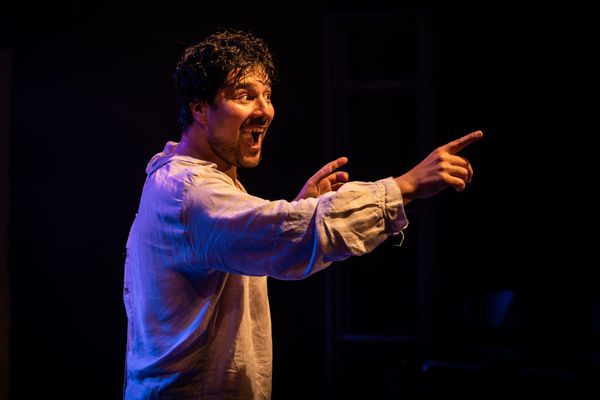
Speaking at the Q&A after the performance, Mohammed El Kesm, who plays the Israeli soldier Aviv, described the moral injury he experiences in stepping into the character each night. The phrase stayed with me. Here is a performer choosing to inhabit a position that causes him genuine moral discomfort, because the larger imaginative project requires somebody to step across that distance.
“When each side believes that the other is a threat to its existence, talk of peace can feel like a betrayal of one’s people” Abu Sarah writes in The Future Is Peace.
Perhaps this is part of the difficult work shared by The Return and Abu Sarah and Inon’s project: not the erasure of difference, nor the pretence that suffering, power or responsibility can be made equivalent, but a willingness to expend something of ourselves in imagining a future beyond violence.
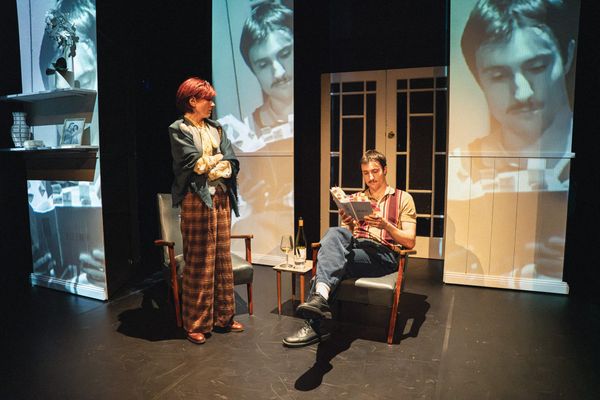
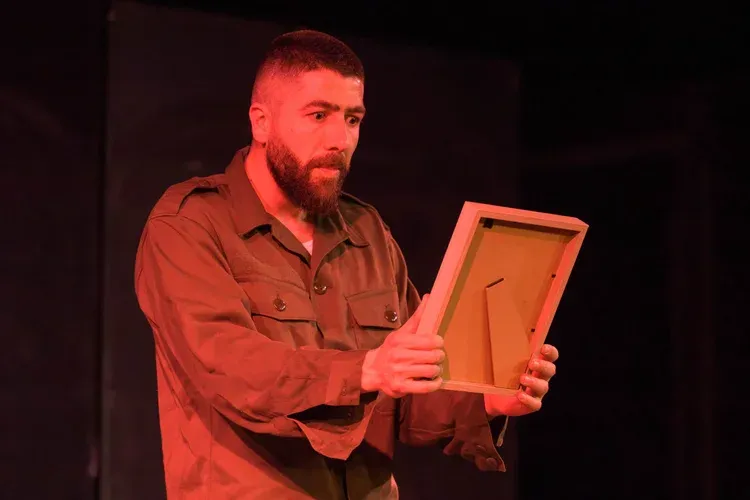
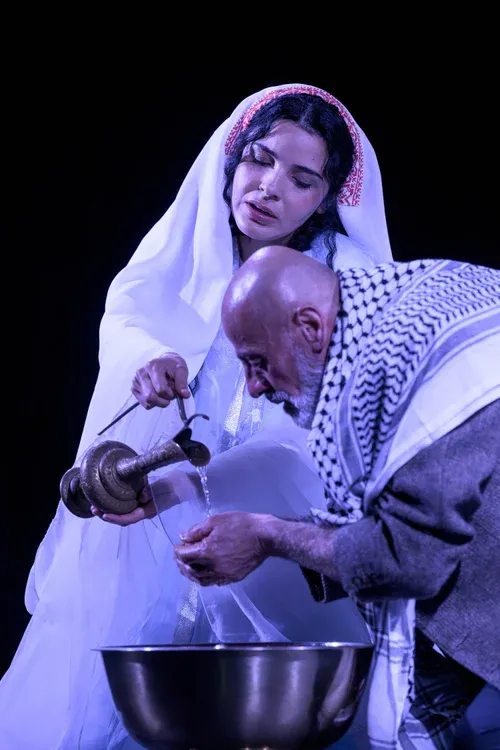
Al Qaisi gives that work its most affecting expression in Rozan. As an apparition, Rozan is extraordinarily patient with Aviv, the soldier who killed her. She stays curious about the person beneath the uniform. At one point, Aviv holds a photograph of Anne Frank. The image reaches backwards into a history of Jewish persecution and the Holocaust, and the fear inherited from both. Rozan neither dismisses that history nor allows it to excuse the violence he has enacted against her. She sees the cost of Aviv’s place within that history, and his own need for healing.
For all the enormity of its ideas, The Return is often at its most affecting in its delicacy. Al Qaisi’s writing handles material so raw with remarkable care, moving readily between the intimate and metaphysical. Her performance as Rozan carries the same quality, finding tenderness and curiosity in the face of the unimaginable. Mohammed El Kesm is particularly strong as Aviv, bringing emotional and physical force to a role that demands considerable shifts in register.
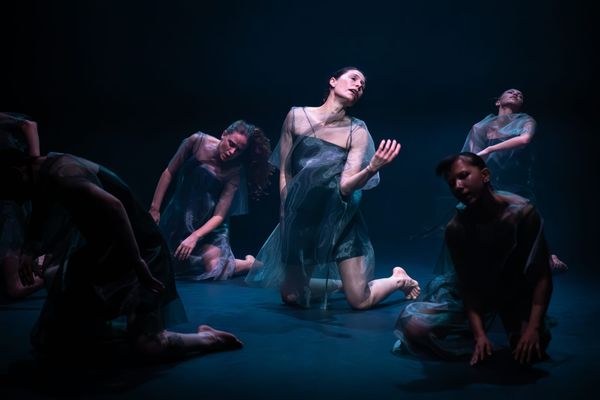
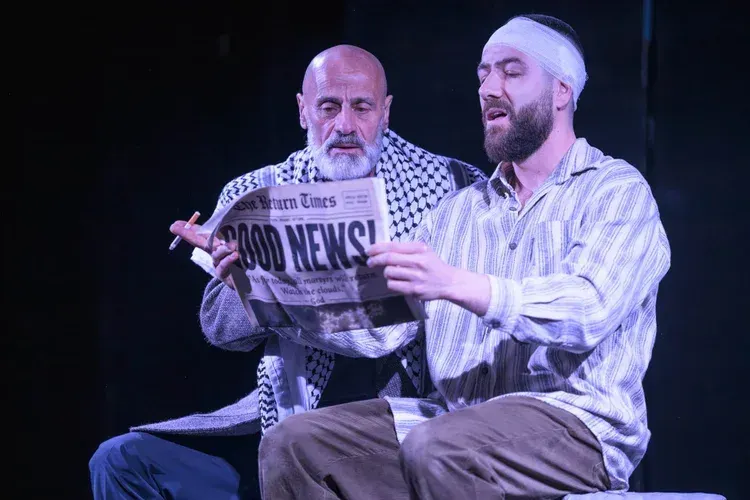
Ahlam Hijazi gives Sarah, Aviv's grandmother, an uncompromising rigidity, embodying the calcified certainties that The Return is attempting to reach beyond. As Marwan, Rashid Taki brings a beautiful sense of wonder to the production; his openness to the impossible provides an entry point into its metaphysical world. Around them, Fairuz Hussaini, aka El Moe, creates a soundscape that shapes the strange, suspended space in which the living and dead can encounter and reunite.
The Return arrives on stage at a time when such reaching feels desperately necessary. Across Gaza and far beyond it, violence is repeatedly sustained by our capacity to reduce other people to categories and abstractions: enemy, threat, casualty, collateral. Al Qaisi remains curious about what lies beneath those categories: the origins of fear, the histories through which it is inherited, and the socialisation through which it can harden into certainty.
The theatre cannot give us a God’s-eye view. Perhaps nothing can. But it can make the imaginative movement towards another person possible. It can hold us there, for a while, in the difficult work of trying to heal, to understand, to move beyond searing pain and fear and into the vulnerability of choosing a different way.
The epilogue of The Future Is Peace, penned by both Abu Sarah and Inon, renders the possibility in vivid detail:
"Our journey comes to an end many years into the future. We are older and grayer, but our people have finally achieved a lasting peace. Instead of interminable warfare, we now live in a land of freedom and equality. There is no grasping for more, as everyone has enough. There is no yearning for home, for all the exiled have returned. There are no fences, no watchtowers, no checkpoints. Everyone has the same rights, the same privileges. The battlegrounds have reverted to fields and pastures. Instead of raising memorials and monuments to the dead, we have gardens and parks and playgrounds for the living. A generation of Palestinian and Israeli children have grown up never having known the misery of war or hunger or insecurity."
At this moment, Al Qaisi’s courageous appeal to believe another future possible, and to collectively reach towards it, feels profoundly important.
The Return plays at Ballarat Performing Arts Centre on 18 September, Chandler Community Centre, Keysborough, on 19 September; Next Wave - Brunswick Mechanic's Institute until 20 September 2026; and The Phee Broadway Theatre Castlemaine on 22 September 2026.