Before I Forget: Learning to listen
What do we overlook when we measure a person's needs by what they can no longer do? Kamarra Bell-Wykes's deeply affecting Before I Forget offers a moving portrait of memory, family and belonging. From its powerful final scene, this essay examines aged care failures and the assumptions of criticism.

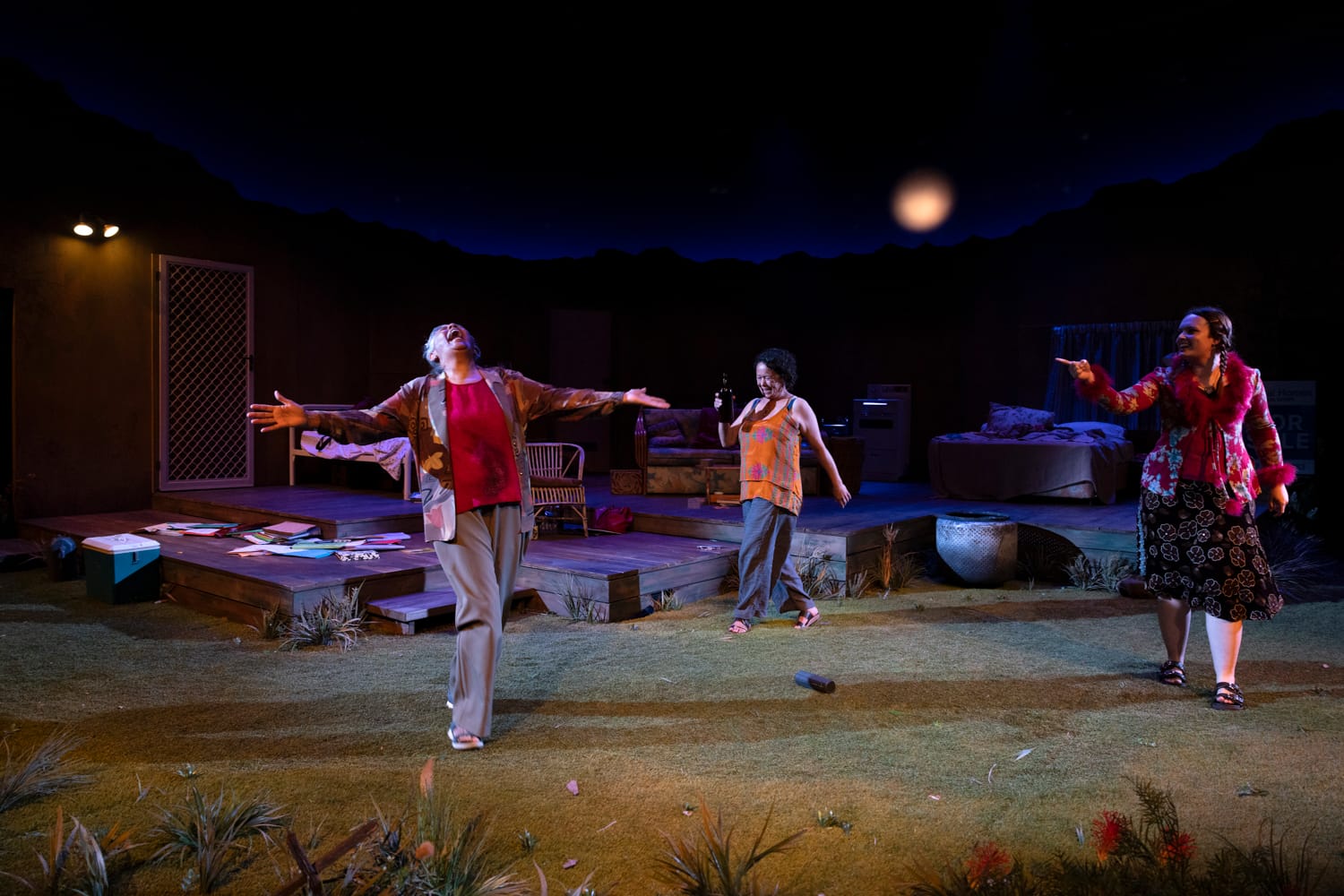
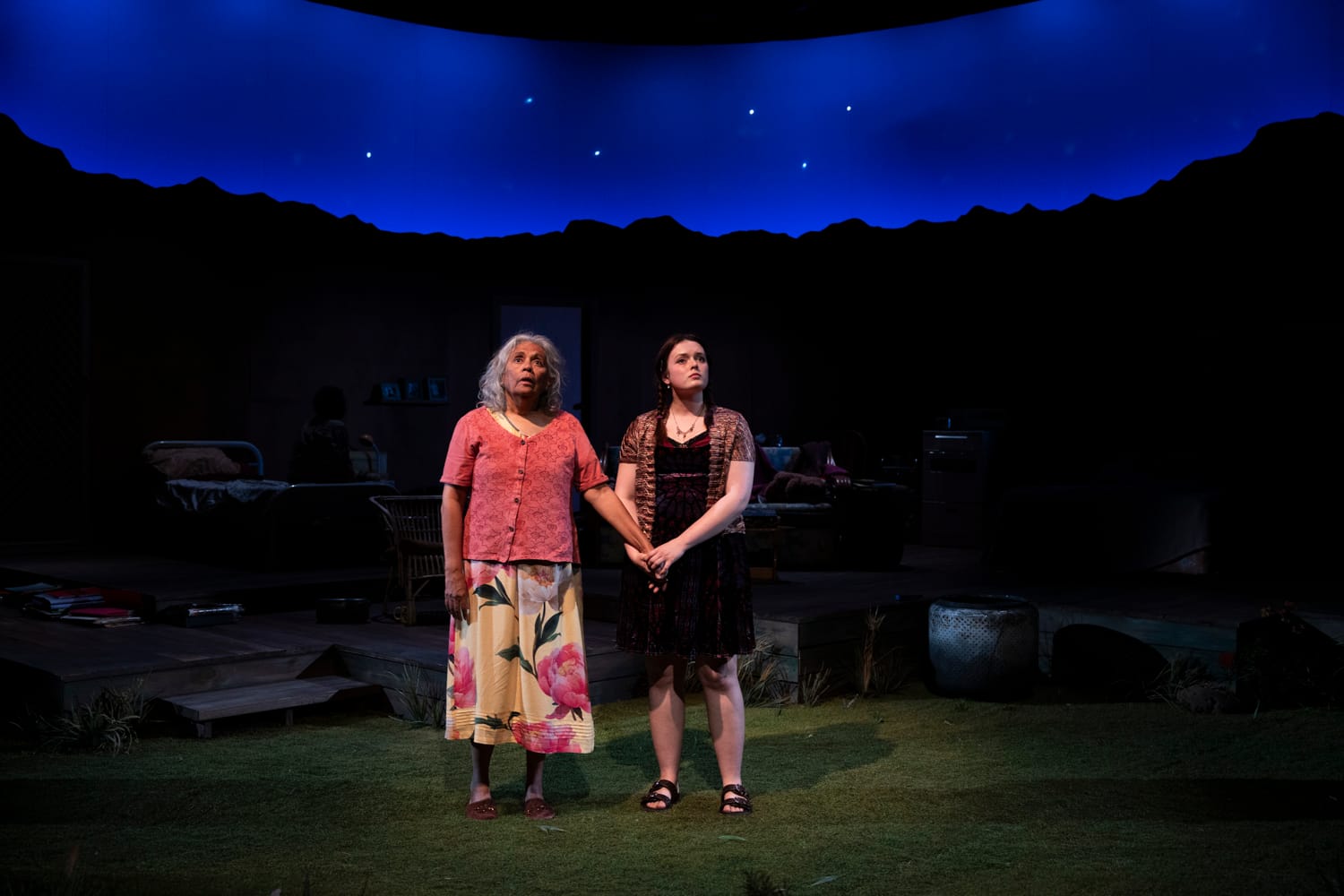
Towards the end of Kamarra Bell-Wykes's Before I Forget, three women stand on a patch of grass, holding hands and looking up at the stars. A fire has been lit. The youngest, Hope (Tyallah Bullock), has managed to bring her mother, Karma (Melodie Reynolds-Diarra), and grandmother, Faith (Roxanne McDonald), together after another of the arguments that have occupied much of their time, and now they are speaking words in Gubbi Gubbi and Butchulla languages. We've heard these words before, whispered through the auditorium at intervals, catching the attention of one woman or another. But this is the first time the three have spoken them together. It's a beautiful moment, and a peculiar one to find myself remembering with such tenderness, because I hadn't been entirely persuaded by the play until then.
Just before this, Hope has organised a living eulogy for her grandmother, Faith, who is living with dementia. The idea is rather funny, when you think about it. Why wait until somebody is dead to tell them how much they've meant to you? Why leave them out of the occasion altogether? Faith gets to attend her own eulogy, and, better still, to contribute to it. There is affection and mischief in the arrangement, a welcome lightness after the family's quarrels. By the time the women gather by the fire, something has shifted between them. I felt it keenly. Days later, thinking of the scene, I found myself unexpectedly close to tears again.
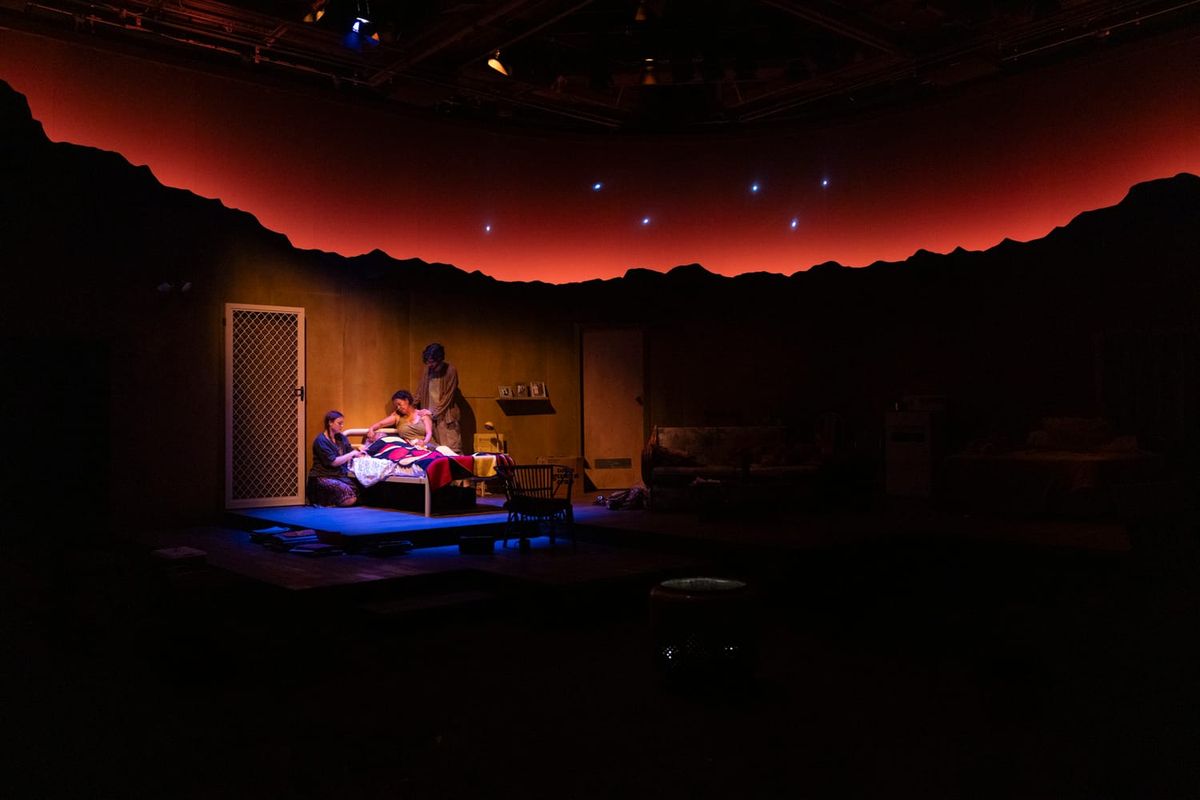
Before I Forget is an intensely personal work, written and directed by Bell-Wykes and drawing on the life of her mother, Dr Jeanie Bell, whose work preserving Gubbi Gubbi and Butchulla languages gives the play much of its historical and emotional substance. The story concerns three generations of Aboriginal women, although it is the middle generation, Karma, who has most of the immediate problems to solve. Her mother, Faith, has dementia. The family home must be sold, arrangements made for her care, the practical consequences of a changing life somehow managed. There are telephone calls, assessments, arguments about what should happen next. The house is full of belongings, the contents of a life waiting to be sorted, and a For Sale sign makes the family's predicament rather horribly public.
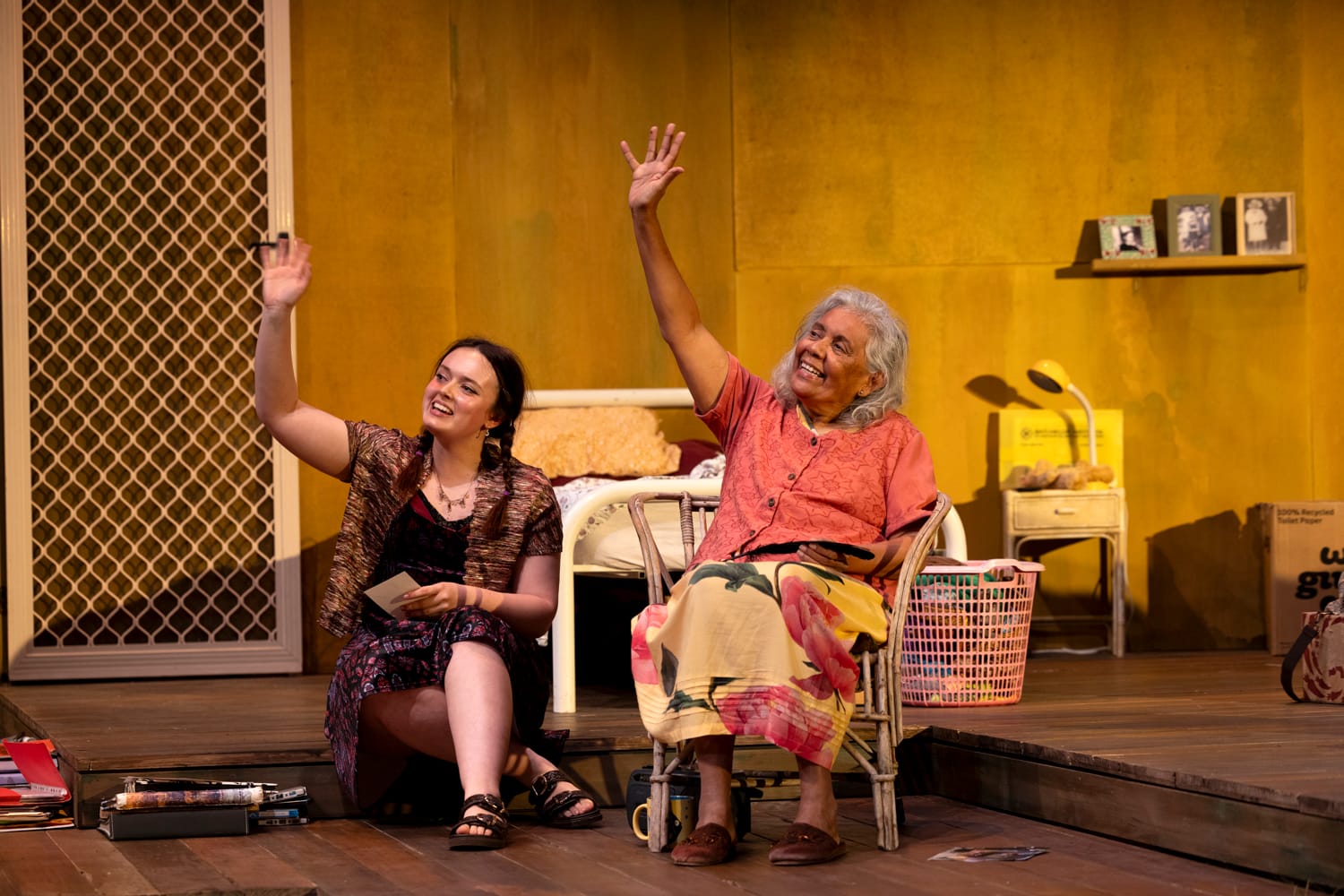
Karma is tired. She has good reason to be. Anybody who has negotiated aged care arrangements for a family member will recognise the peculiar exhaustion of having to translate a person's life into the language of eligibility, risk and assessed need. Hope, Karma's daughter, has a different set of preoccupations. She is curious about her grandmother's past, about the language materials sitting in piles on the floor, about the work Faith has done and the stories she might still tell. While Karma is trying to organise the future, Hope keeps asking about the past. Both are responding to the same predicament, although neither seems particularly able to appreciate what the other is doing.
I was initially inclined towards Hope, as I suspect many spectators might be. Her interest in Faith feels generous and attentive, and there is something dispiriting about watching a person's rich history disappear beneath the paperwork of dependency. But the more I thought about Karma, the less comfortable I became with that preference. Hope has time to ask questions partly because somebody else is attending to the unlovely tasks of care. Somebody has to make the calls. Somebody has to sell the house. If Karma sometimes seems impatient with her daughter's curiosity, I can hardly blame her. Curiosity is a lovely thing, but it doesn't necessarily get your mother a place in residential care.
Of course, there's a problem with accepting all this as inevitable. The Australian aged care system is hardly a triumph of Western institutional thinking. The Royal Commission into Aged Care Quality and Safety uncovered failures so extensive that its commissioners called for fundamental reform. None of this came as much of a surprise to the families who had been dealing with the system for years.
But there is something especially revealing about its encounter with Aboriginal and Torres Strait Islander families. Our aged care system has inherited a set of Western assumptions about individual need, dependency and professional expertise, assumptions that sit uneasily with understandings of wellbeing grounded in kinship, community and Country. When care is organised around what a person can no longer do, the relationships that give their life meaning can become almost incidental. Karma must negotiate these arrangements on her mother's behalf, spending her time and energy navigating a system remarkably ill-equipped to recognise the life she is trying to care for.
And perhaps this is where the criticism ought to widen. We tend to discuss the failures of aged care in terms of funding, regulation and service quality. Fair enough. These things matter enormously. But the institutions we build also tell us something about the societies we are. What do our arrangements for care reveal about our ideas of independence, dependency and belonging?
In Culture is Inclusion, Aboriginal researcher Scott Avery identifies a rather embarrassing contrast. Despite encountering substantial barriers in mainstream systems, Aboriginal and Torres Strait Islander people with disability participate in cultural activities at rates broadly comparable with those without disability. Meanwhile, a society forever congratulating itself on its progress seems increasingly preoccupied with loneliness and disconnection. There is something almost breathtakingly arrogant about a society that laments widespread loneliness and disconnection while treating its own assumptions about independence and dependency as universal, apparently unable to recognise what it might learn from First Nations understandings of belonging.
One of Avery's examples has stayed with me. An Aboriginal woman who once hunted and gathered food for her family now accompanies her husband but waits in the car because of a mobility impairment. Yet when describing the activity, she says, ‘We go hunting.’ Avery notices the pronoun. She is still part of it, even though what she physically does has changed. It's such an ordinary expression that one might easily pass over it. But there's a whole understanding of participation contained in that little word we.
Dementia brings particular difficulties that Avery's account of disability cannot fully address. Still, his example made me think again about Faith, and the questions that come to dominate when dementia enters a family's life. What can she remember? What can she manage? Is she safe on her own? These questions are enormously important, particularly for Karma. But what about the others? What does Faith know? What does she have to teach? What does she still enjoy? Who is she to the people around her, and who are they to her?
Hope's questions belong to this second group. She wants to hear about Faith's life and the work she has done, and her curiosity gives her grandmother an opportunity to occupy a position that dementia threatens to take away: that of someone who knows things worth knowing. There is particular poignancy here because of the language work underpinning the play. A dictionary is, among other things, an act of faith in the future. Somebody records words because they want them to be available to people who come afterwards, perhaps long afterwards, when the circumstances in which those words were spoken have changed beyond recognition. Bell's dictionary, first published in 1994, supplies the words we hear throughout the production. The language is being carried forward even as Faith's own memory becomes less reliable.
It took me some time to appreciate what Bell-Wykes was doing here. Faith's dementia is changing her life, certainly, but she remains a mother, a grandmother, a woman whose history is entangled with other people's. Karma and Hope must work out what they owe her, what she needs from them, and what they might still receive from her. We have a habit, in Western society, of dividing care into two parties, the person who gives it and the person who receives it, as though the roles were fixed and the transaction straightforward. Yet here is another understanding of care, grounded in relationships that endure and change, in obligations that run in more than one direction. Perhaps we ought to be paying closer attention.
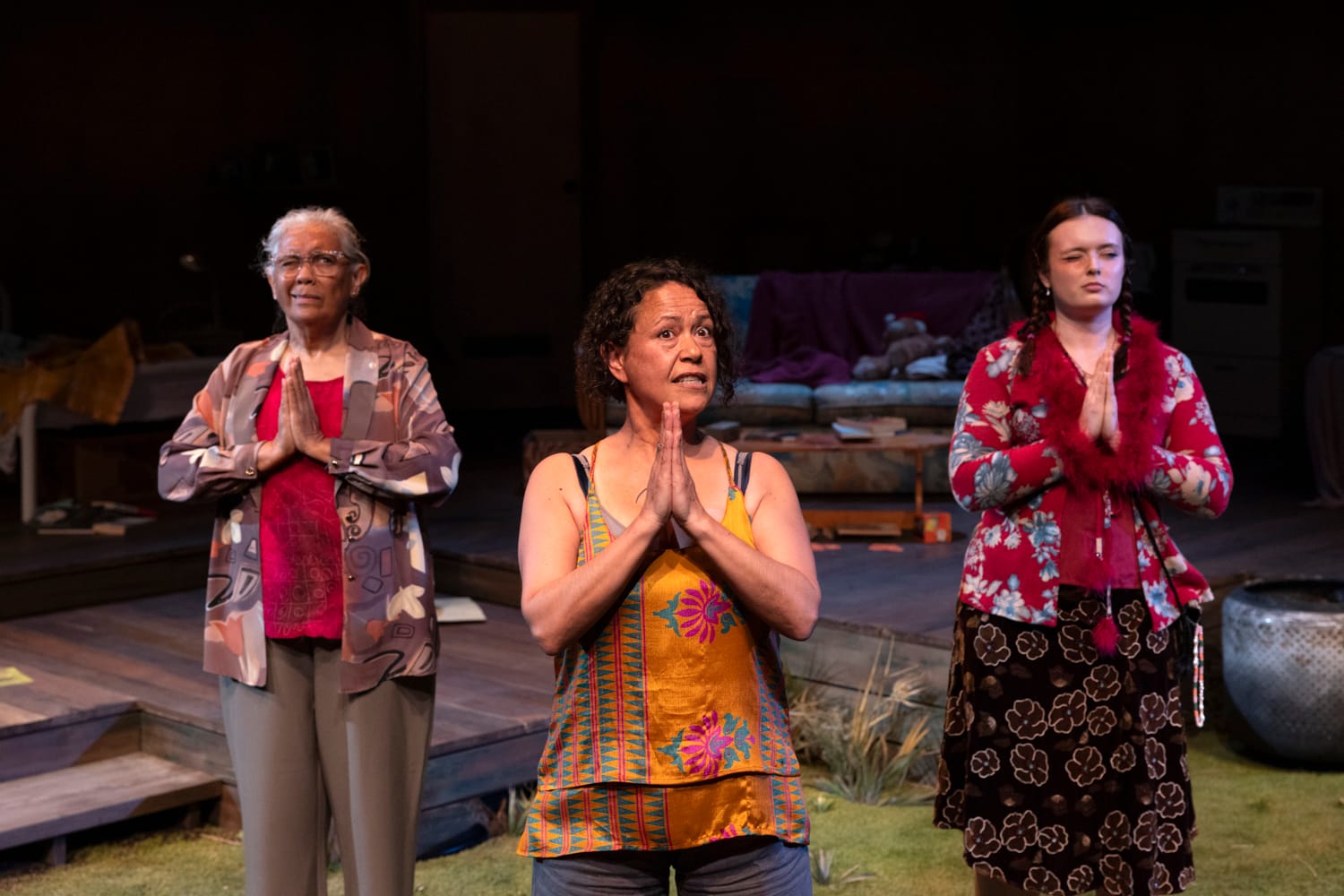
Which brings me back to the living eulogy. What strikes me now is how much more it accomplishes than the affectionate, slightly mischievous gesture I first took it for. Hope creates an occasion in which Faith's life can be remembered while Faith herself is present to participate in the remembering. She can hear what others have to say about her, but she can also speak for herself. The family is doing something for Faith, certainly, but Faith is also doing something with and for them. She still has a part to play in the telling of her own life.
I don't imagine Bell-Wykes is proposing that such moments solve the difficulties of dementia care. Karma's responsibilities remain, as do the financial and institutional pressures bearing down on the family. Nor would I want to romanticise family care, particularly when women so often carry its practical and emotional burdens. Asking families to compensate for the shortcomings of public services is one of the ways those shortcomings are allowed to persist. A culturally responsive system would need to provide the material support, flexibility and decision-making authority that allow care to be organised in ways meaningful to the people receiving and providing it. Otherwise, cultural responsibility risks becoming another obligation placed on people who are already doing too much.
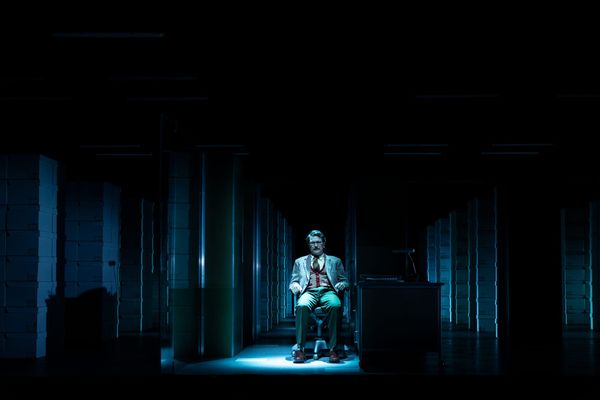
All of this has made me reconsider my response to the play's theatrical form. There is much to admire in the production itself, particularly the strong performances, which give the family's competing needs a convincing emotional life, and the set and lighting, which bring moments of considerable beauty to an otherwise recognisable domestic world. Yet I found the naturalism a little limiting at times, particularly when the arguments between family members returned to familiar grievances without substantially developing the dramatic relationships.
There were moments when I wanted the production to take us somewhere less predictable, and I found myself thinking of Jada Alberts's Black Light, which premiered at Malthouse Theatre earlier this year. Also concerned with Aboriginal matriarchy, intergenerational relationships and dementia, Alberts's play places four Larrakia mothers in a family home on the outskirts of Darwin, where an increasingly unstable world presses in upon them. Its eldest character, Nan, is living with dementia. Alberts uses a more surreal theatrical language, allowing dream space, memory and relationships with Country to complicate the domestic setting. I wondered what might happen if Bell-Wykes took us further into Faith's shifting experience of the world.
I still think that's a reasonable question. The subjective experience of dementia offers extraordinary possibilities for theatre. Time can misbehave, space can rearrange itself, memories can intrude upon the present. An audience can find itself as disoriented as the person whose experience it has been invited to share. I am drawn to that kind of theatrical experiment. There is nothing inherently individualistic about wanting to understand another person's subjective experience. Indeed, theatre can make that experience extraordinarily rich. But I began to wonder whether my enthusiasm for what might be happening inside Faith's mind had distracted me from what Bell-Wykes was showing me outside it: the relationships through which her life continues to have meaning.
There is a further difficulty here, and it concerns criticism itself. We acquire our tastes through experience, through the theatre we have seen and the things we have learnt to value. Eventually those preferences can begin to feel like principles. I don't intend to apologise for mine. But there is a danger in becoming so accomplished at recognising what we believe a work lacks that we fail to notice what it contains.
As a non-Indigenous critic writing about a First Nations work, I need to be especially conscious of the assumptions I bring with me. Rachael Swain's writing on the dramaturgies of listening to Country has been helpful here. Discussing practices of intercultural performance, Swain describes an attention that requires audiences to remain receptive to unfamiliar experiences while actively seeking the knowledge necessary to understand them. Listening, in this sense, involves work. It asks us to recognise the limits of what we know, to tolerate uncertainty and to question the habits through which we make meaning. I wonder whether my own expectations of theatre had been doing rather too much of the listening.
Taking such an approach seriously doesn't require me to abandon my critical judgement. Quite the opposite. Bell-Wykes has made choices about structure, characterisation and theatrical form, and those choices deserve close attention. But surely that attention must extend to questioning the assumptions through which I judge them. Otherwise, I risk mistaking my own expectations for the measure of the work.
Perhaps this is why the ending affected me as it did. Bell-Wykes has been preparing it almost quietly, through the words drawn from Jeanie Bell's dictionary. They belong to the theatre's soundscape, but also to a history reaching beyond the room in which these women argue about houses and care arrangements. Something is being carried between them, even when they are too preoccupied with their disagreements to recognise it.
Then Hope brings the three women together. They stand on grass, looking up towards the stars, and speak the words that have been travelling around them all evening. The house is still being sold. Karma will still have to contend with the arrangements for her mother's care. The institutional failures haven't obligingly disappeared because three women have gathered around a fire.
But something has happened. The words have passed between generations, through a history of dispossession and the painstaking work of keeping language alive. Faith's memory is changing, but her place in that history, and among these women, remains. She is speaking, and they are speaking with her.
There's a whole understanding of belonging contained in that little word with.
Before I Forget, presented by Melbourne Theatre Company, plays at Arts Centre Melbourne's Fairfax Studio until 28 November 2026.