Eliza: One thing leads to another
A machine learns to ask questions. People supply rather more answers than anyone bargained for. In Tom Holloway's Eliza, directed by Paige Rattray, a modest experiment attracts the lonely, the ambitious and the dangerously well-connected. The machine is the least complicated thing in the room.

My grandfather used to say, “One thing leads to another.” Taken literally, it's a fairly unremarkable observation. You do something, something happens as a result, and then you have to do something else. But I suspect he meant something less orderly. That the smallest action can set all manner of things in motion, involving people and circumstances you never imagined, until the connection between where you began and where you find yourself becomes almost impossible to trace.
He was a Welshman, born to poverty in 1914, and later became a Prisoner of War, so I suspect he had a few opportunities to observe events spin wildly out of control. Out of everyone's control.
* * *
There are birds in the Sumner theater. Or so I think, having arrived unusually early, before the audience's chatter has gathered enough force to drown out the faint twittering somewhere overhead. Perhaps a few have found their way into the building? It's an odd possibility to entertain while waiting for a play about artificial intelligence, though the birds turn out to be considerably more important than they first appear.
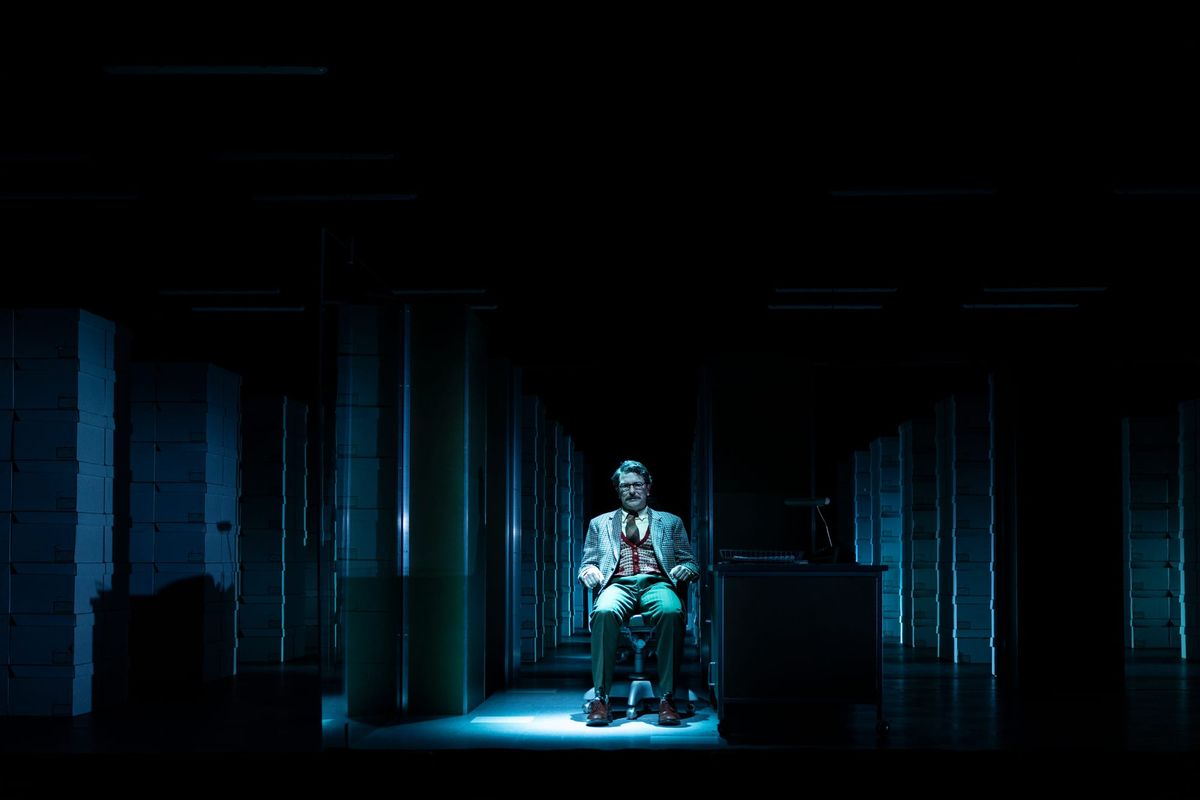
Onstage, a compact glass-walled office sits beneath a ceiling that seems to have been installed several metres too low. Beyond it, ranks of pale archive boxes stretch upwards into the fluorescent gloom. Doors slide upwards without anybody touching a button. This is MIT in the 1960s, where, in Tom Holloway's Eliza, computer scientist Joseph Weizenbaum (Dan Spielman) is trying to teach a machine to converse. His secretary Becky (Manali Datar) would rather he occasionally catch some sunshine.
When Becky describes her therapist's habit of responding to everything with another well-rehearsed question, Weizenbaum hears a solution to his programming problem. A few simple rules, some linguistic substitutions, and ELIZA is born: a computer program that mimics a psychotherapist, turning people's statements back into questions that encourage them to keep talking. He regards it as a demonstration of how readily people mistake the appearance of understanding for the thing itself. Almost everyone else sees a miracle.
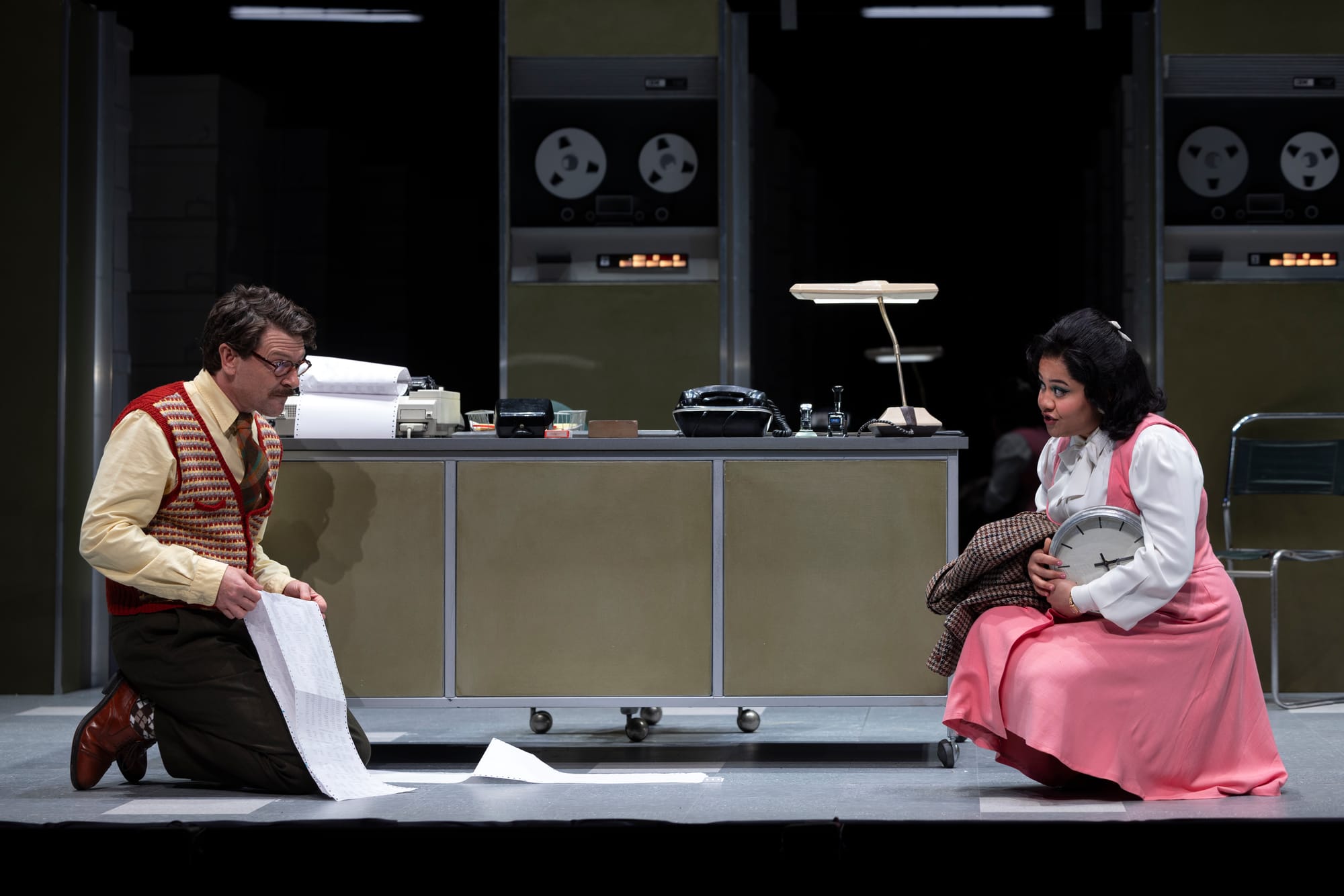
Weizenbaum wants to publish his code and get on with the science. The prospect is rather less attractive to the people gathering around him, who have begun to see possibilities he never intended. His colleague Ronald wants recognition; the university wants prestige; elsewhere, more powerful interests are considering what might be done with a machine to which people willingly surrender their private thoughts. Hamish Michael plays Ronald alongside an increasingly peculiar procession of institutional figures. His transformations are marvellous. He can be halfway through another character's scene, wearing another man's clothes, and become Ronald again with the smallest alteration of his face. For a moment, the clothes seem to belong to the wrong person.
The trouble, as Holloway so astutely recognises, is that ELIZA's effects are neither uniformly beneficial nor uniformly alarming. Becky finds the program genuinely useful. Where a human therapist has responded to her distress with patronising assumptions about women, the machine's more neutral prompts give her room to recognise something about her own life. Weizenbaum, meanwhile, grows increasingly desperate to persuade people that his invention understands nothing. Spielman makes his agitation both funny and painful, a man whose considerable intelligence offers him remarkably little authority over what happens to his work.
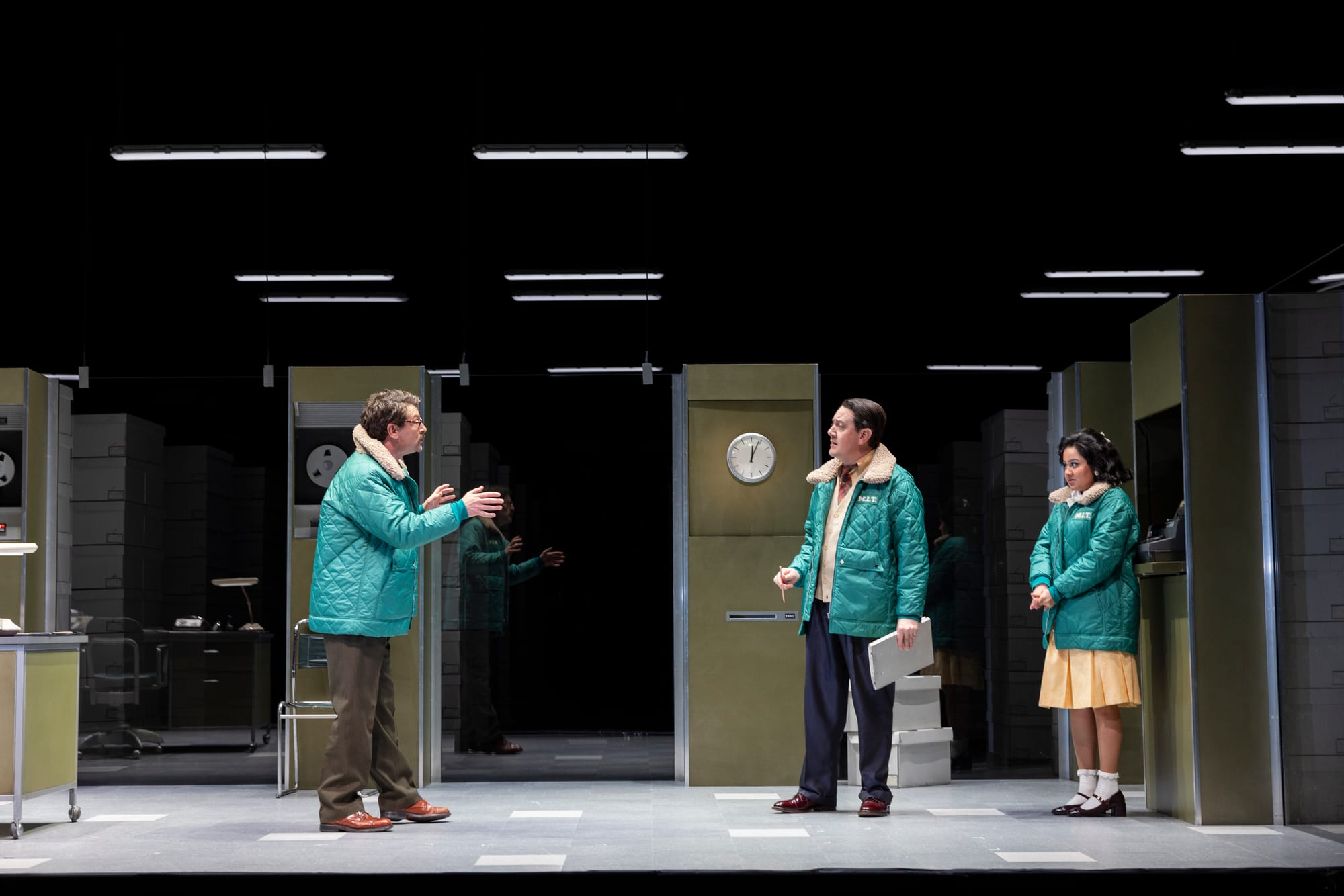
Paige Rattray's production grows stranger as the invention acquires a life beyond its inventor. The low ceiling rises, exposing the height of the theatre and making the little office seem more vulnerable within it. At a concert featuring Messiaen's Quartet for the End of Time, the audience appears projected across those towering archive boxes. During the performance, their faces and bodies undergo peculiar distortions. One spectator seems to melt into his chair; another develops impossibly long, tapering fingers, which he slowly interlaces in an unnervingly elaborate gesture. Weizenbaum talks through the music, urgently explaining its human significance to Becky, who would have preferred the chance to absorb the quartet.
Continuing with the surreal, after the quartent, a great black flock sweeps across the stage and up into the Sumner itself. In the projection, hundreds of birds turn and wheel, gathering into dense formations before scattering and drawing together again. Their movement travels beyond the stage, across the auditorium ceiling, until the theatre seems to have acquired a sky of its own.
A murmuration is one of nature's more extraordinary demonstrations of collective behaviour. There is no leader directing the flock. Each bird responds to the movement of those immediately around it, adjusting its speed and direction in relation to its neighbours. From these countless small responses emerges a vast, fluid choreography. The whole possesses an order that no individual bird has conceived, much less commanded.
Something similar has happened to ELIZA. A scientist devises a modest experiment; a secretary finds solace; a colleague wants recognition; a university sees prestige; others glimpse opportunities for influence and control. Each pursues a comprehensible interest. Collectively, they create something whose consequences exceed anybody's intentions. The program hasn't become independently intelligent. The world around it has become extraordinarily complicated.
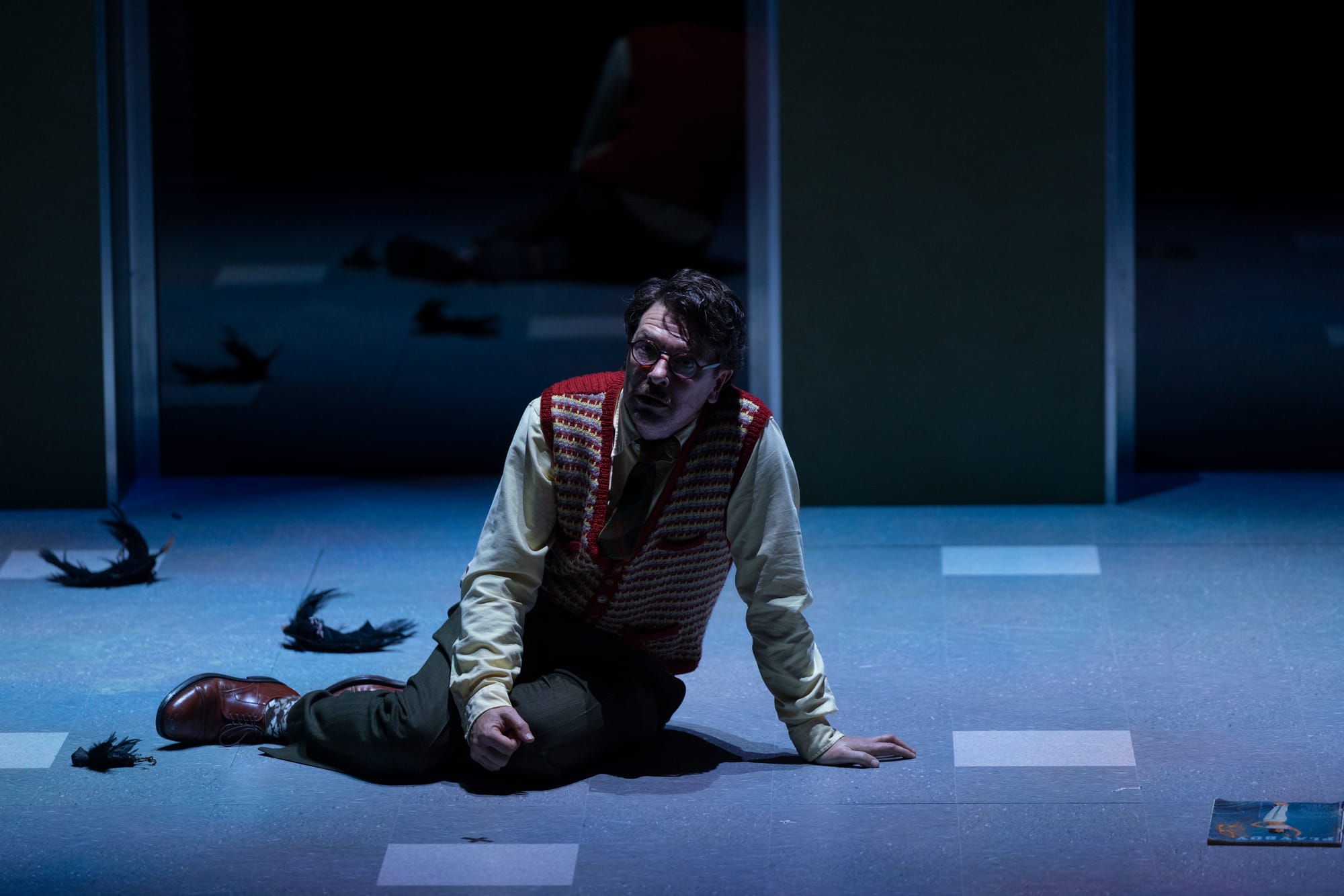
And then the birds fall. Perhaps twenty black bodies drop from above, provoking a startled shudder through the audience. They lie scattered across the immaculate office floor, ungainly and slightly misshapen. Nobody clears them away. For the remainder of the play, people conduct their business around the dead.
Dale Ferguson's set, Paul Jackson's lighting, Kelly Ryall's sound and Rhian Hinkley's audiovisual design work together with exceptional assurance. A fixed office becomes, by turns, a workplace comedy, a place of psychological exposure and an increasingly porous enclosure within a much larger, less knowable world.
* * *
For all its intimate disclosures, Eliza moved me less than it stimulated and unsettled me. Its most persuasive achievement lies in the extraordinary theatrical imagination brought to bear on a deceptively small invention. Weizenbaum knows precisely how his program works. He has rather less success explaining what everyone else is doing with it. Each new admirer understands ELIZA a little less and wants a little more. The scientist who made the thing finds himself reduced to a rather inconvenient witness.
Sixty years later, the machines have acquired considerably better conversational manners. They write our letters, answer our questions, keep us company at three in the morning. We pour our private troubles into them, and they respond with such obliging fluency that it's easy to forget there's nobody listening. Meanwhile, the companies building them are racing to stake their claims; governments are sizing up the possibilities; institutions are discovering how conveniently a decision can be made when nobody quite has to own it. The interests multiply, collide, breed new interests. Weizenbaum worried that people would mistake the simulation of understanding for understanding itself. We have gone considerably further. We've begun rearranging the world around the mistake, and nobody can say with much confidence what sort of creature we're making.
Eliza, presented by Melbourne Theatre Company, plays at Southbank Theatre, The Sumner, until 31 October 2026.