The abundance of almost nothing: Holy Fool
Exceptional physical comedy opens into a spiritual reckoning in Holy Fool — a wildly funny, profoundly moving and utterly sublime piece of theatre, exquisitely directed by Giovanni Fusetti and performed by Fabio Motta with breathtaking skill, generosity and soul.
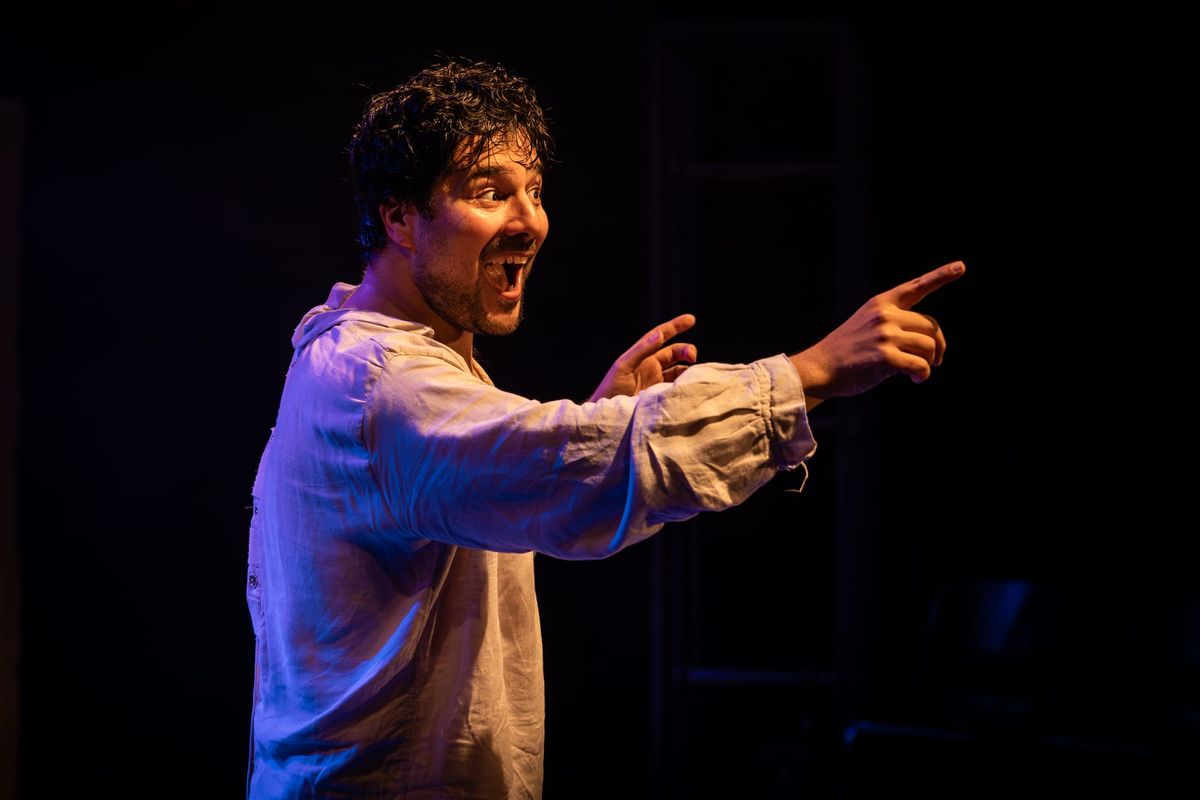
I feel the need to rave about Holy Fool. A bit like the “ugly cry”, I think I’d go so far as to say, I need to “ugly rave”. The “oops, did I just accidentally spit on you?” sort of rave. Hands gesticulating wildly in absolute rapture. That kind of rave.
Because Holy Fool is very, very (dare I add another very?) good. Superb even.
For much of it, Fabio Motta is also very funny.
Early on, in complete mimed silence, he rides an imaginary horse into battle. The horse dies. Its head comes off. Motta attempts to put it back on and administers increasingly hopeless mouth-to-mouth, only for the force of his breath to send the body skidding away. Eventually, he abandons it and finds another horse — unfortunately, a teeny tiny one.
Later, imprisoned and strung up by invisible shackles, he backs up his rear end towards the front row and recruits members of the audience into his “torture”. Presented with a bowl of imaginary gruel, he plunges his fingers into something we cannot see, supplying the wet, revolting sound effects himself. Around me, the audience groans.
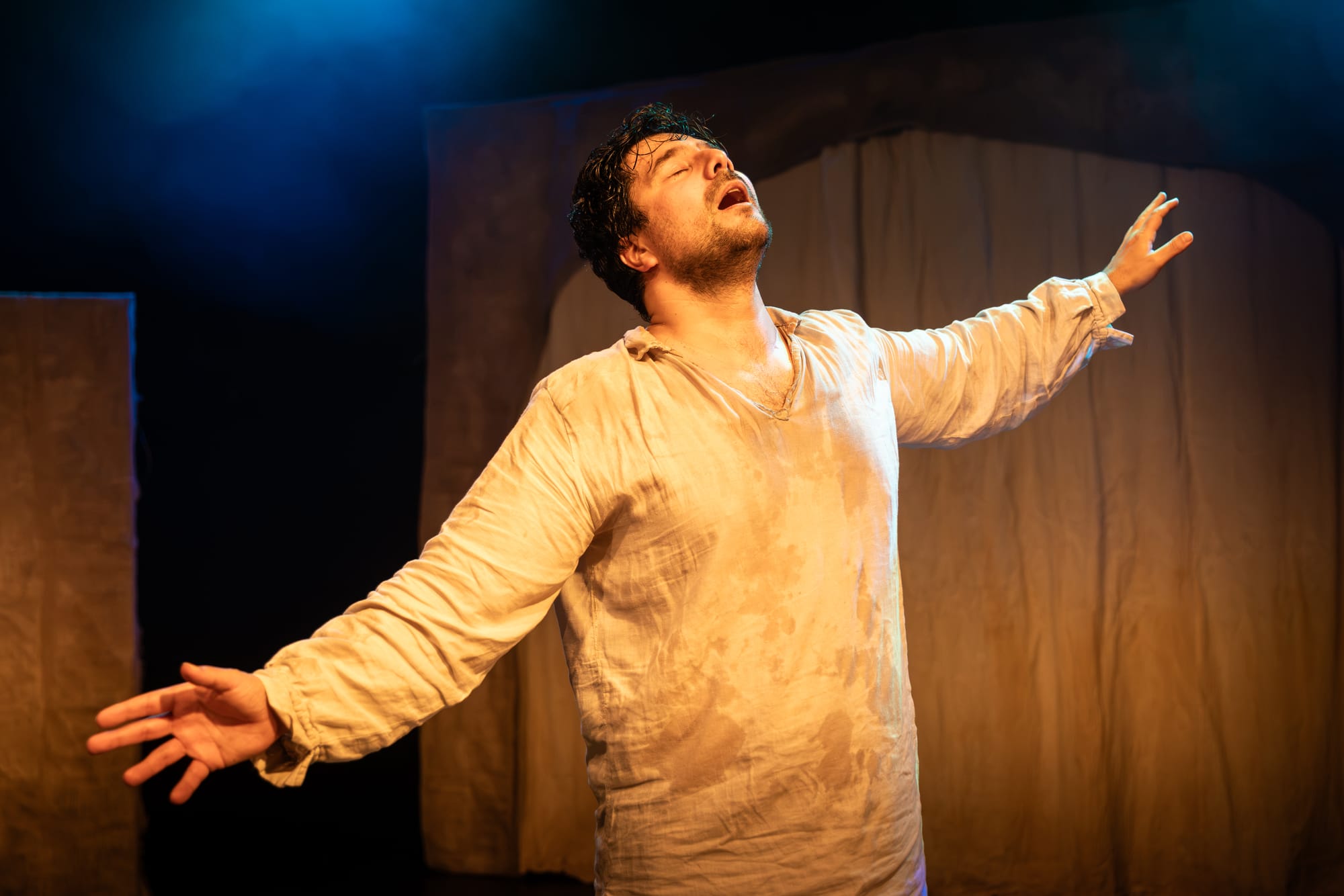
Motta needs almost nothing to make any of this happen. A few pieces of coarse, pale fabric constitute Em Jevons’ beautifully sparse set. Costumes appear and disappear. Max Woods’ lighting moves us between worlds. Jack Burmeister’s sound design punctuates them. But mostly there is Motta’s body: astonishingly precise, perfectly timed, extravagantly expressive, already dripping with sweat while the show is young.
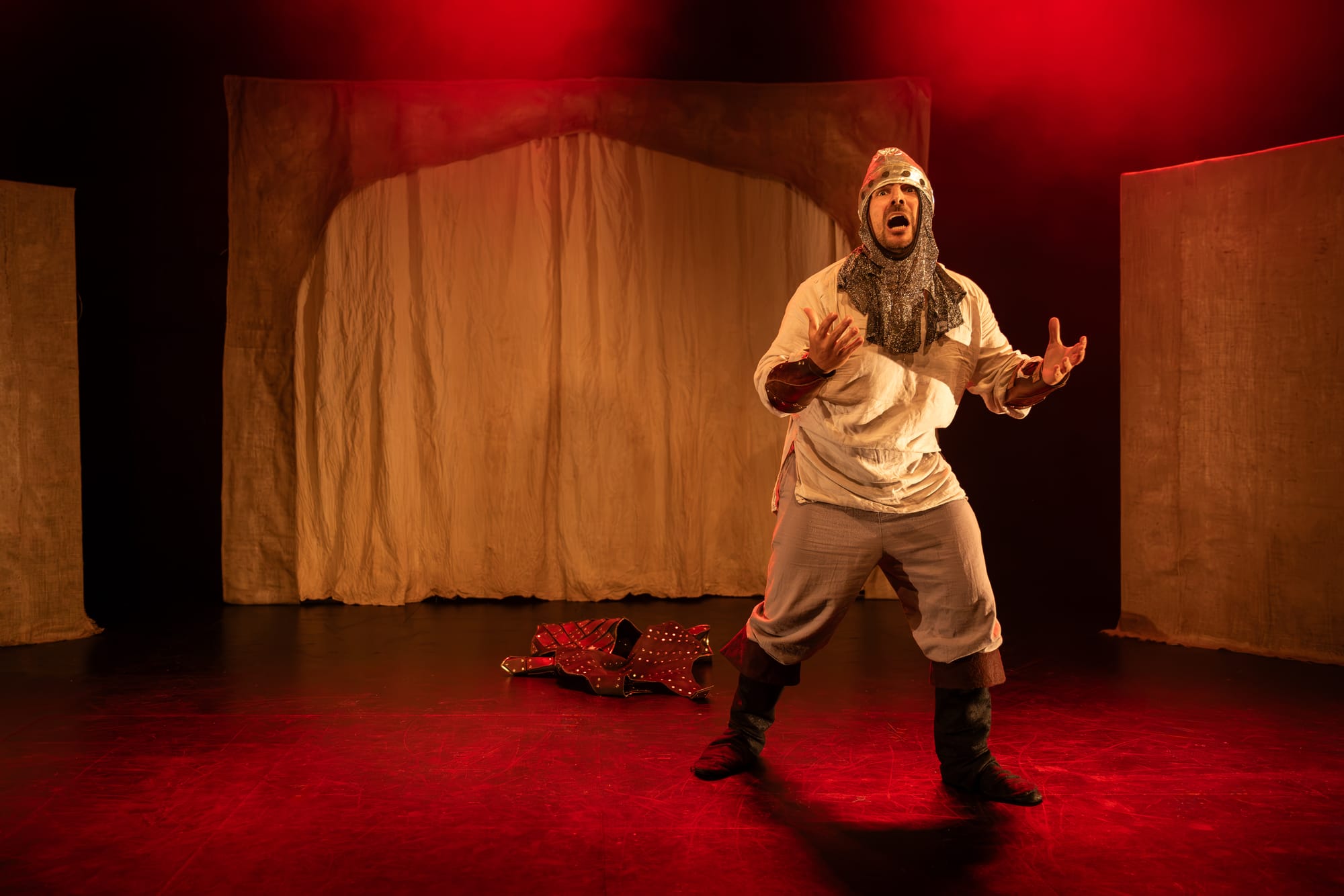
Then, somewhere near the centre of Holy Fool, the exceptional physical comedy opens into a spiritual reckoning. We are asked:
Who would we be if we were no longer afraid of losing everything?
Until this point, Motta’s spiritual physical-comedy, inspired by the life of Saint Francis of Assisi, has largely given us the fool. Francis has gone to war, been captured, suffered imprisonment and returned to the exasperation of his father. Showing us his extraordinary comedic range, Motta conjures the latter by collapsing and compressing his body, becoming short, squat and crotchety. Outrage travels through him in tiny, tightly controlled jumps, like bodily exclamation marks.
But Francis has encountered something his father cannot understand. He begins to shed the world he has inherited: status, possessions, the fear of poverty itself.
And through the fool, Motta begins to show us the holy.
It happens first through wonder. Francis encounters the world as though seeing it for the first time: sun, rain, wind, soil, the tiny life moving through it. He lowers himself to the floor to marvel at a caterpillar, joining the dance and slinking alongside it. He scoops up imaginary earth and luxuriates in it, rubbing it over his face, blissful — then spits bits from his mouth. The joke survives. So does the ecstasy.
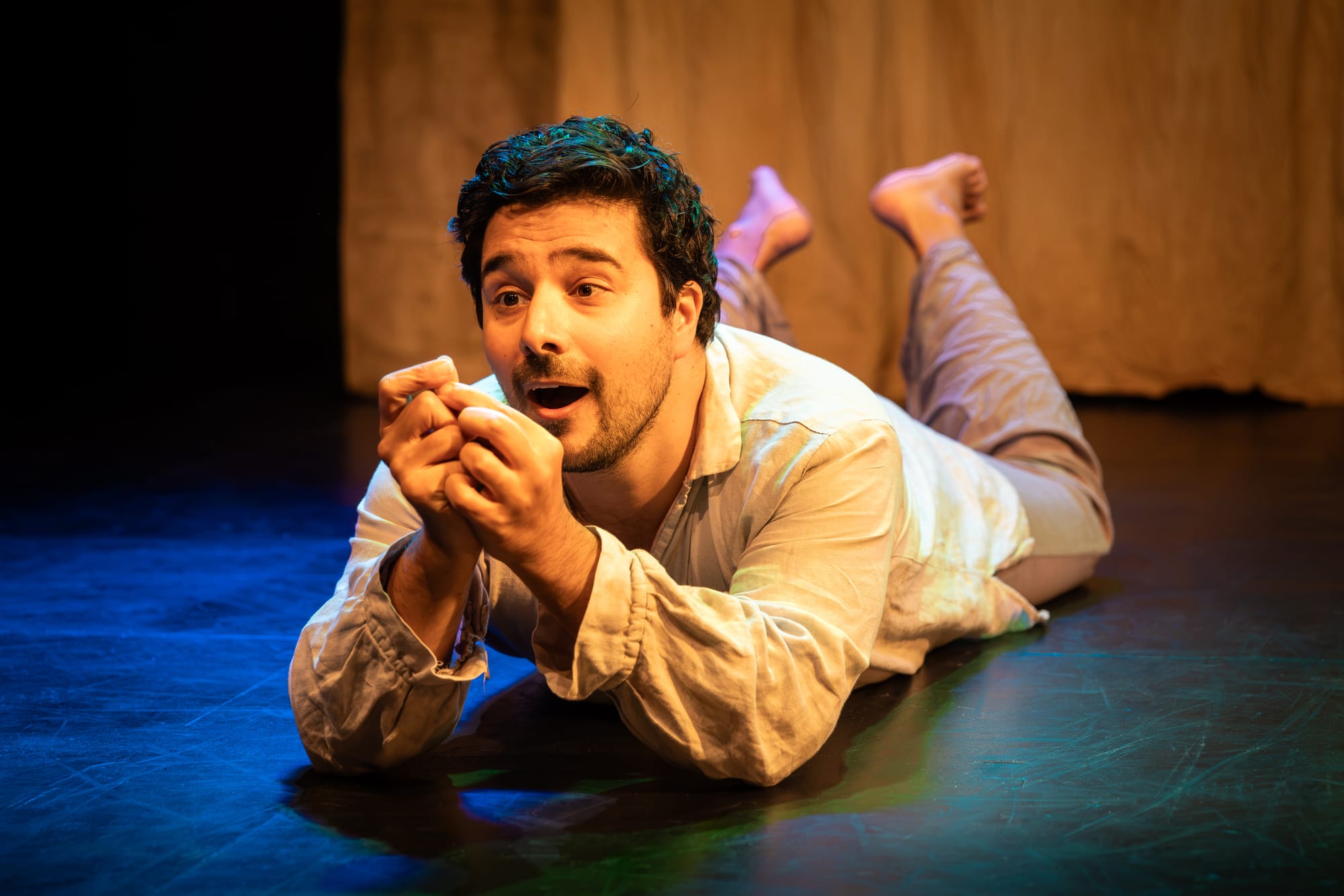
This is one of Holy Fool’s immense achievements. Motta never asks comedy to step aside so that profundity can enter the room. The ridiculous and the sacred share the same breath.
Directed by Giovanni Fusetti, the performance is extraordinarily controlled, but somehow its precision never hardens into containment. Motta is continuously attentive to the room and allows the audience to change what happens within it. His crowd work begins as comic play and gradually becomes something far more consequential.
We are torturers, paupers or subjects required to kiss the Pope’s ring. Sometimes we are Francis himself. We are the congregation attempting medieval chant, badly — until one audience member responds with an unexpectedly magnificent operatic voice and the joke temporarily escapes Motta’s hands. And he delights in that escape, riding it like a wave until it breaks.
As Pope, Motta turns obedience into a gleefully vicious game. Kiss the ring correctly and receive the appropriate blessing; hesitate or resist and the punishments escalate. At one point he produces an imaginary chainsaw and dispatches a recalcitrant subject with movements that retain the shape of the cross. Ecclesiastical ritual and violence merge in ironic perfection.
The satire matters. Holy Fool is not offering gratitude as an easy wellness practice, nor Francis as an eccentric medieval mascot for appreciating the little things. Motta seems fascinated by what happens when spiritual wonder becomes an economic and political proposition. What if abundance has very little to do with what we have materially? What if our terror of losing what we do possess is precisely what prevents us from discovering what is already here?
The Church, inevitably, has a problem with this.
So does Francis’s father. His compact, clenched physicality becomes a counterpoint to the increasingly open body of his son. One contracts around possession; the other becomes porous to the world, ecstatic in response to its every change.
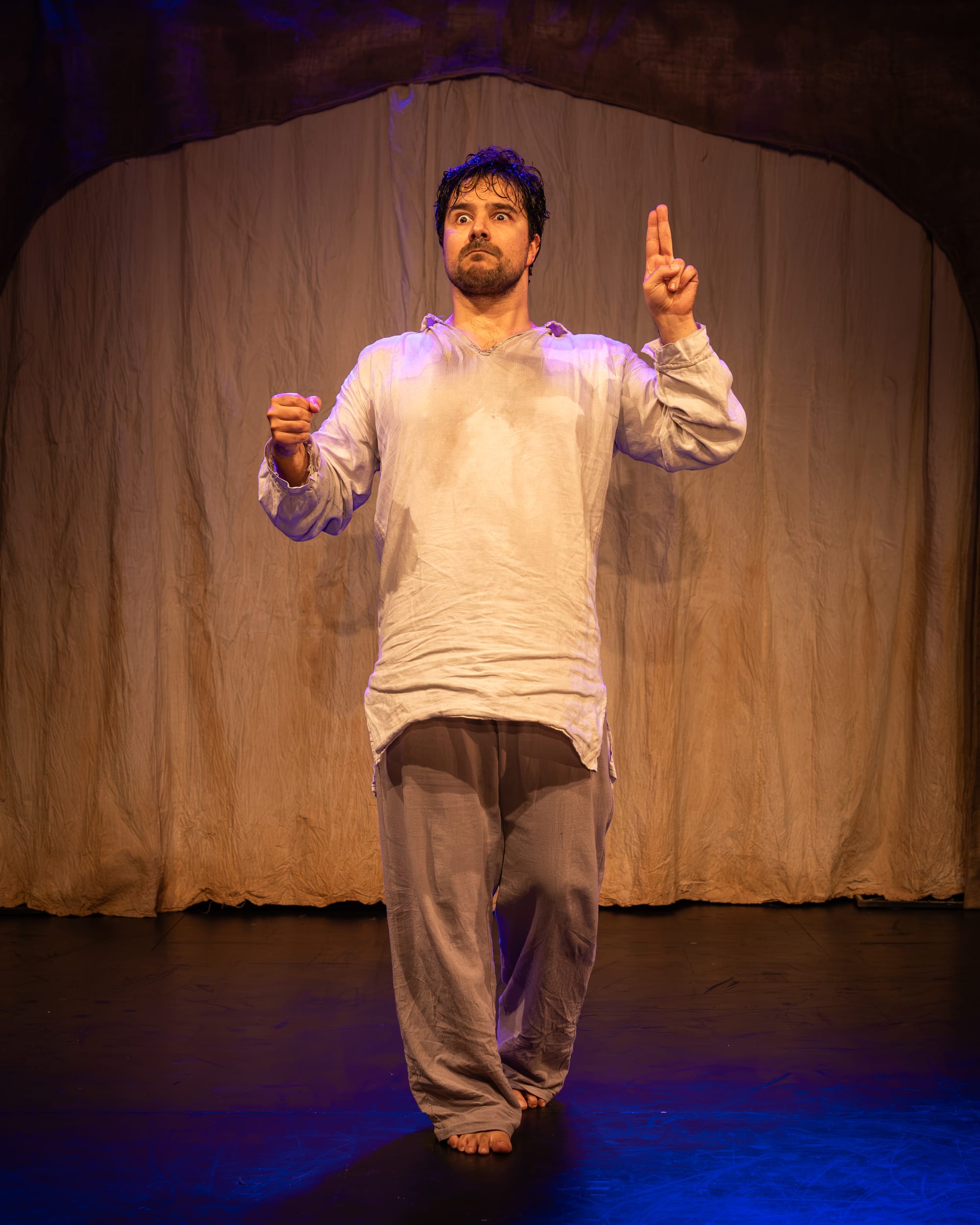
Motta brings that proposition directly to us. He invites us to think about what matters. What are we grateful for? The perfectly off-the-cuff answers tell us something about how closely we are following Motta through this delicious journey: someone says their breath; someone else, their children. He takes these offerings and makes a song from them, dividing the room, conducting us, coaxing strangers into singing together.
Then he asks whether anyone is lonely.
With exquisite vulnerability, someone says yes.
This could be unbearable. In another performance, perhaps, it would be. But Motta has spent the evening earning the sincerity of this moment through foolishness. He does not make a joke of the answer, nor inflate himself into someone capable of solving it. Instead, he asks us to do something extraordinarily simple. Hold hands. Look to the person beside you. Look the other way. Notice the people who are here.
Do you feel more connected?
By now, the question lands because Motta’s audience participation has never simply meant forcing spectators to perform. His attention is unusually tender. When he selects one woman for an embrace, he quietly checks whether she is comfortable, then checks again as he comes closer. When a man sits alone at the back of the room, apparently reluctant to be drawn into the action, Motta finds another way to acknowledge him: a moment of contact, a head briefly rested against a shoulder, and then he moves on.
This level of care is incredibly important. Holy Fool does not merely break the fourth wall. It spends 90 minutes making the wall increasingly irrelevant.
Woods’ lighting understands this movement. Blackouts give the performance its punctuation, while small shifts create whole new environments: the greenish, broken light of Francis’s imprisonment suggests confinement without crudely illustrating it. The warm light during Francis's discovery of soil holds us in his wonder. Just as importantly, the audience itself is illuminated when it becomes the site of the action. The visual field expands. We are no longer only watching him. We can see one another.
The theatrical economy of the production begins to look increasingly like its argument. Holy Fool is materially sparse and imaginatively abundant. Horses, prisons, battles, fathers, Popes, earth and entire landscapes appear from almost nothing. Motta provides a body, a sound, a gesture; we complete the world.
He then asks far more of us:
Who will join me?
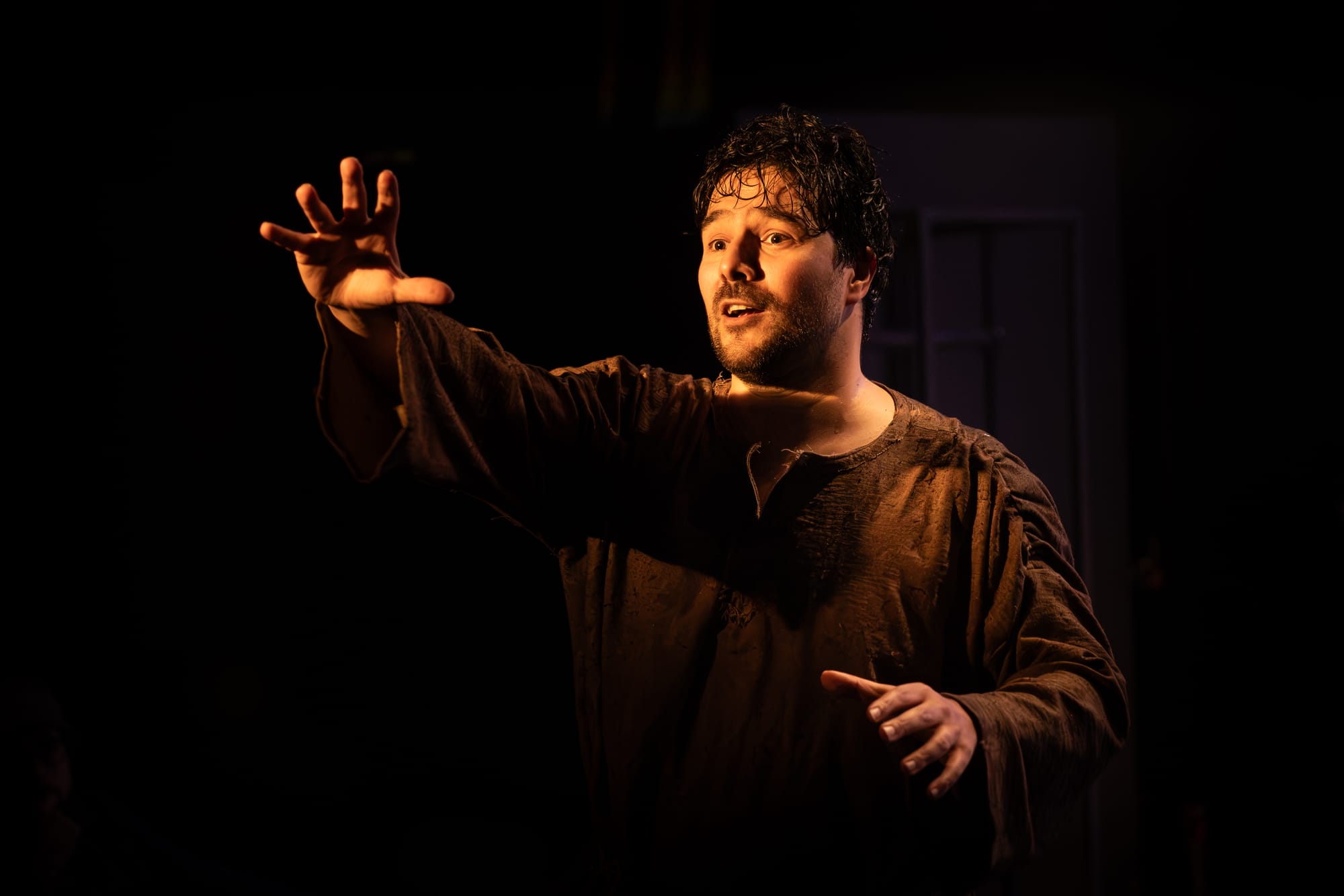
The question belongs to Francis's material modesty, but it does not remain merely historical. Contemporary references — including the cost-of-living pressures that make the idea of relinquishing material security feel particularly preposterous — keep intruding on any comfortable fantasy that voluntary poverty is merely the strange business of medieval saints.
Near the end, Motta brings the entire audience onto the stage.
We crowd around Francis as he prepares to die. Some sit on the floor. Others stand behind them. Small biscuits are passed around, prompting jokes about gluten and nuts that somehow do not rupture the solemnity of what is happening. We have moved from spectators, to participants, to something resembling a temporary community gathered around a beloved body.
Francis speaks of finding love in creation and creation in love; of an abundance that has become available only after he ceases to organise his life around the fear of its loss.
Then Motta takes us out of the theatre altogether.
We collect our belongings and follow him down the stairs of Theatre Works Explosives Factory into the laneway outside. He returns to one of his comic characters and then, finally, to Francis. The institutional Church, he suggests, knew what to do with a man like this: make him a saint. Sanctify him. Turn a radical way of living into something exceptional enough to admire from a safe distance.
And then Motta gets onto a scooter.
Delightfully, two tiny wings spring up from its handlebars. He rides away down the laneway, briefly doubling back with the impeccable timing of a cartoon character, and disappears.
We applaud. And keep applauding.
He does not return.
Eventually, producer Tim Sneddon comes downstairs to let us know that, yes, the show really is over. We can go back upstairs for a drink or leave from here.
There will be no bow to restore the normal order of things: performer here, audience there; theatre finished, proposition discharged. Motta has gone.
What remains, burning inside me, is Motta's question:
Who would we be if we were no longer afraid of losing everything?
Holy Fool plays at Theatre Works Explosives Factory until 19 September 2026.
Disclosure: A complimentary ticket to Holy Fool was provided to Melbourne Stage Review for the purpose of review. Melbourne Stage Review retains full editorial independence.