Stop: How to Eat Rabbit
In How to Eat Rabbit, two friends burrow away at the end of the world, rationing power, sorting tins, craving chocolate and trying to keep each other alive. Between tenderness, betrayal and a two-headed rabbit, survival is one problem. What makes survival worthwhile is another.

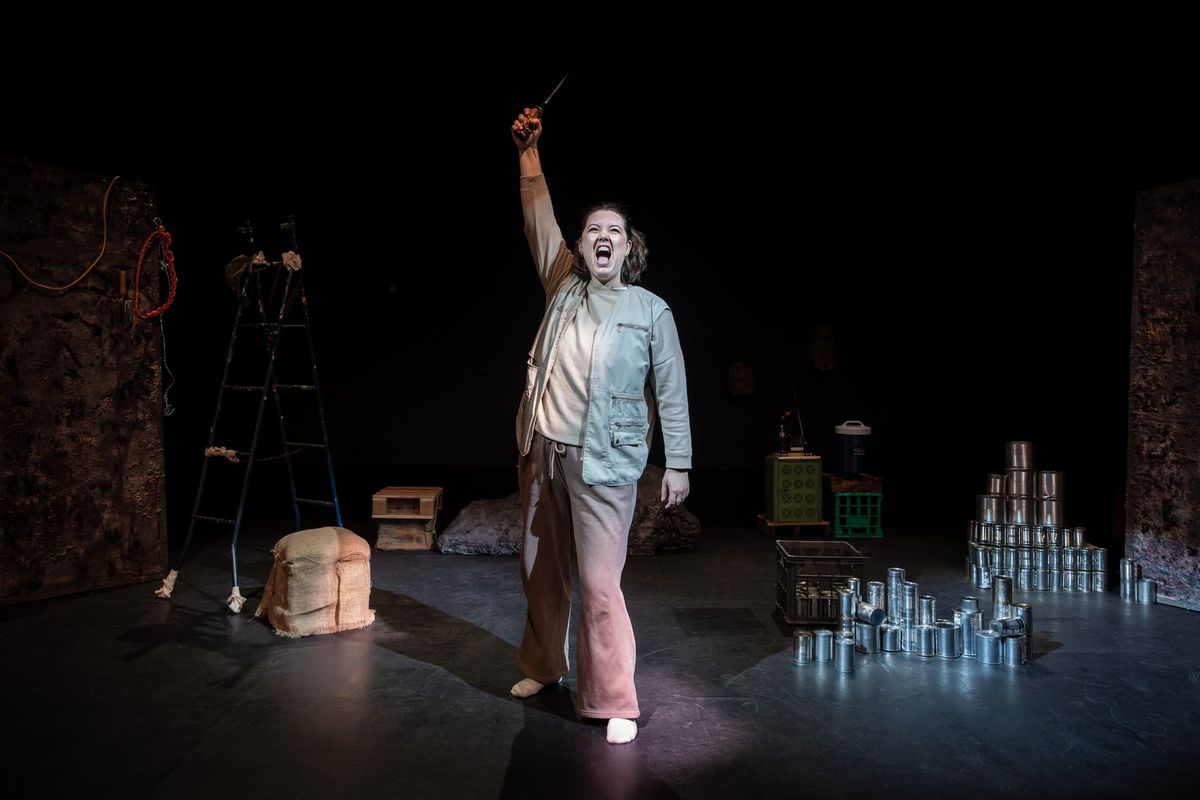
Near the end of How to Eat Rabbit, Jamila Main stops the play.
Not metaphorically. Cam is bleeding heavily. Alex is trying to reassure them that it is only menstruation; Cam knows that it is not. A call to an emergency health line offers the dwindling possibility of help. The scene has gathered the momentum of tragedy: a body in crisis, a failing world, someone who may be about to die.
Then Main, who wrote the play and performs Cam, looks out of the fiction and says “stop.”
The interruption landed before I entirely understood it. The gear change is almost a slap in the face: the fiction drops away and, for a moment, there is the disorientation of not quite knowing what kind of encounter this has become. Main moves close to the audience and peers into our eyes.
There is that small charge of adrenaline that comes when the comfortable distance between performer and spectator suddenly crumbles. We are no longer watching Cam bleed from safely outside the frame of fiction. We are being looked at, and implicated in what it means to sit here and watch.
* * *
Before this startling encounter, Main's play has spent most of its 80 minutes underground. Best friends Cam and Alex (played by Nory) are sheltering in a cave-like burrow after an unspecified social and environmental collapse. Whatever has already happened is bad; whatever is still coming, we have been led to understand, will be worse. Resources are scarce and the world above is dangerous enough that survival has become the way of life.
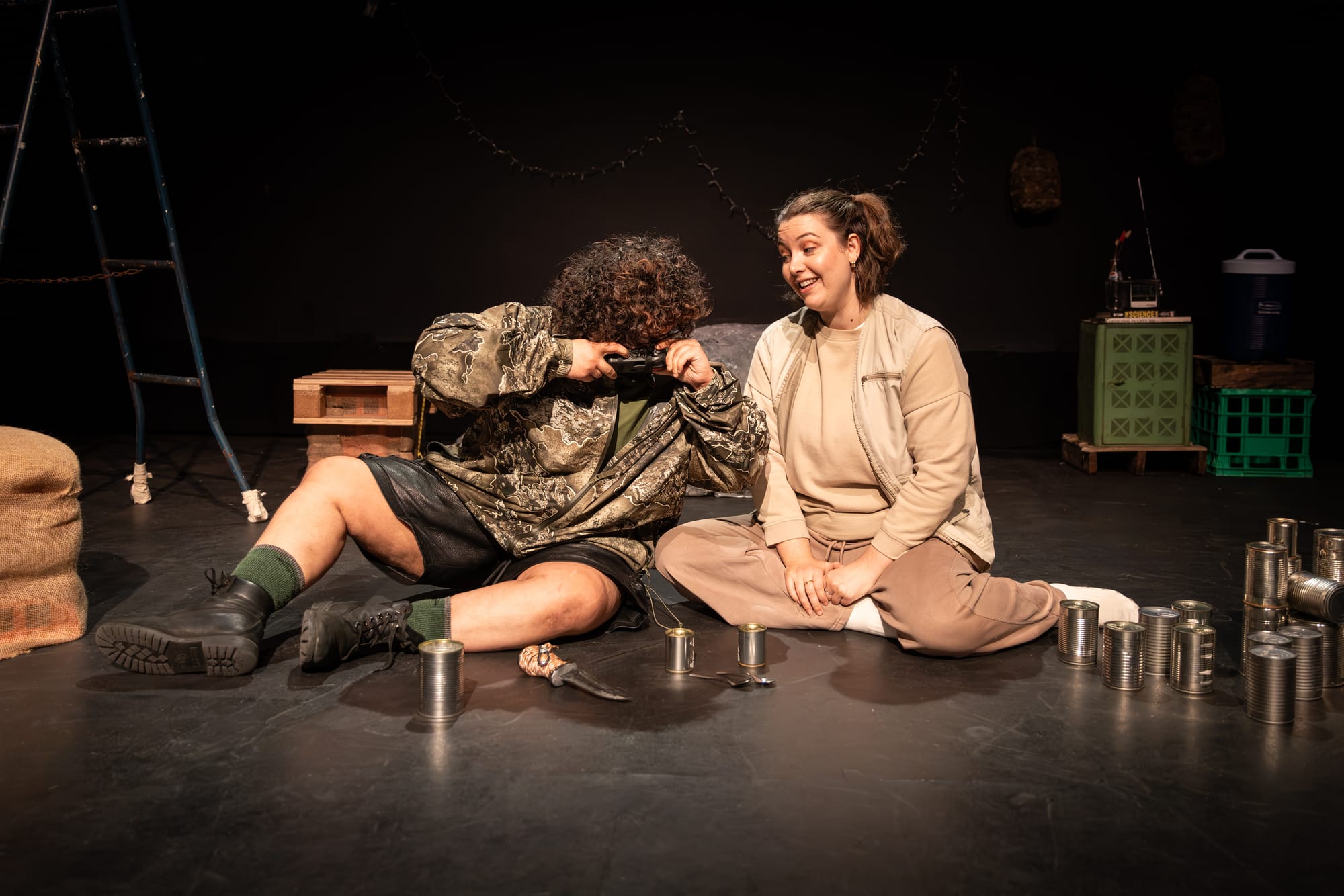
For Alex, survival requires discipline. Their days are divided into cycles: exercise, work, rest, power conservation. Supplies must be rationed and tins of food properly ordered. When Alex brings home a two-headed rabbit, another calculation brews. They need protein. Food is food. The no-meat commitments of the old world may no longer be relevant.
Cam is appalled.
The question in the play's title is therefore presented early and viscerally: when circumstances become sufficiently extreme, which values are you prepared to surrender to stay alive? And Main doesn't leave that question at the level of an ethical thought experiment. Between them, our two characters describe, in uncomfortable detail, what preparing and eating the rabbit would involve: the twist of a neck; the entry point of a knife; the removal of entrails.
Later, despite Cam's refusal, Alex secretly mixes rabbit into their food and lets them eat it without knowing. It is one of two betrayals that puncture the uneasy intimacy the pair have built inside the burrow.
Cam has betrayed Alex too. While Alex is on a supply run, Cam uses precious electricity to post, via phone, an advertisement for a new burrow-mate. At first the act seems almost casually cruel: Cam secretly making plans to bring a third person into their carefully contained world — their “family” of two. But Alex does not know what the audience knows.
Cam is sick.
Again and again, when Alex leaves the burrow, Cam folds over in pain. In one of the production's stranger and more effective surreal gestures, the stacked tins begin speaking to Cam, mocking them, voicing thoughts that grow increasingly hostile and despairing. We learn that the advertisement is not about Cam's future at all, but Alex's: someone will need to be there when Cam no longer is.
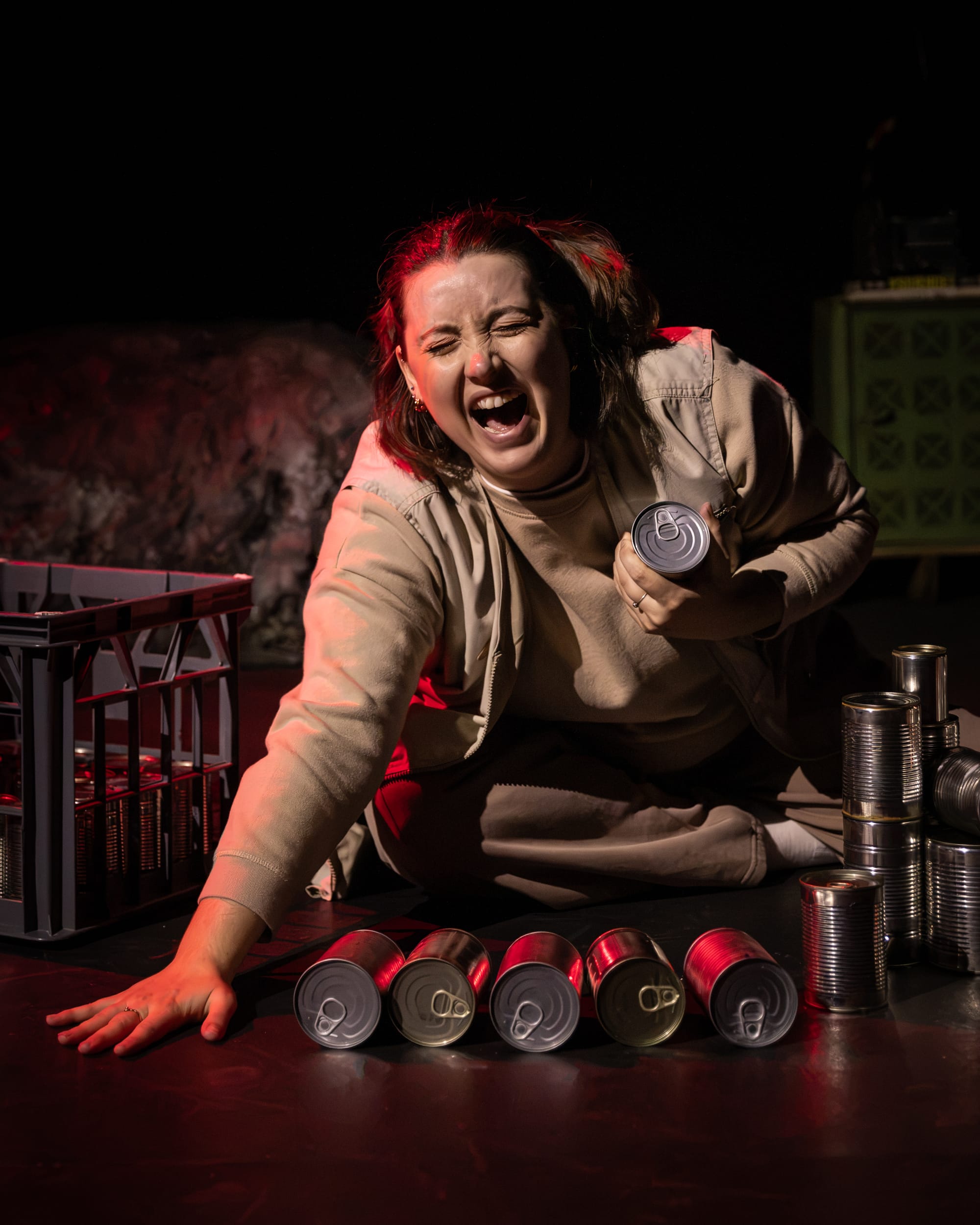
The betrayals consequently begin to mirror one another. Cam decides, without Alex, what Alex will need to survive their death. Alex decides, without Cam, what Cam's body needs to survive now. Both override the other's wishes while believing themselves to be acting from care.
That tension — between care and control — gives How to Eat Rabbit a rich emotional and ethical complexity, each new compromise making the distinction harder to hold.
Nory's Alex is the architect of survival, relentlessly organising the conditions in which these two people might continue. Yet private moments disclose the vulnerability behind that competence. Alone with the rabbit, Alex is not untouched by what killing it means. The certainty Alex presents to Cam vanishes when nobody is watching.
Cam pushes in the opposite direction. They want chocolate. Candles. To paint. To play. Small pleasures which look ridiculous measured against dwindling supplies, and become increasingly necessary the longer the play continues. In one particularly absurd image, the pair undertake a “relaxation cycle” wearing moisturising face masks, cucumber slices over their eyes: wellness culture surviving, apparently, even the end of civilisation.
Director, Lilah Benetti, lets these tonal shifts breathe, finding space for joy and silliness without releasing the pressure building underneath. But the wellness cycles also establish the limits of Alex's approach. Repeated often enough, they build the impression that survival can be made manageable: anticipate what is coming, prepare for it, put a system around it. Food, power, exercise, rest. Even in preparation for Cam's coming menstruation, Alex has stolen period underwear.
What the system cannot plan for or manage is the whole of Cam's body. The audience has been watching Cam's pain escalate for some time before Alex finally becomes aware of it. When the bleeding begins, Alex reaches first for reassurance: it is a period; it is normal; it will be all right.
There is something particularly forceful in this progression, in a work developed by queer and disabled theatre-makers and explicitly concerned with disability's proximity to danger. Catastrophe is not evenly distributed. Alex can travel above ground, acquire supplies, hunt and return. As Cam becomes sicker, the forms of care they need become harder to access as the surrounding social order deteriorates. The survivalist fantasy begins to expose the assumption that survival can be secured through individual resourcefulness and self-sufficiency.
And then the play approaches the ending its world appears to have already prepared for Cam: death.
Except Main will not let it.
* * *
Only afterwards, walking home, did I properly start piecing together what Main and Benetti had done. The interruption challenges more than the fate of a character. It challenges the contract under which we have been watching the play: the expectation that Cam's increasing vulnerability will supply the play with its tragic climax, and that we will sit together in La Mama's Courthouse and watch it happen.
There is something deeply affecting about watching a playwright refuse the ending they have, themselves, constructed. How to Eat Rabbit doesn't grab for a last-minute mechanism by which Cam can be rescued. It simply declines to complete the familiar equation in which precarity plus disability plus catastrophe must culminate in death.
That refusal reaches back through the play. Survival has repeatedly been used to justify the suspension of other claims. Alex can kill the rabbit because survival demands it. Alex can feed Cam meat without their consent because survival demands it. Bodies, principles and choices become negotiable when the alternative is death. At the last, Main refuses to let theatrical inevitability make the same move. Cam's suffering does not have to become another thing for an audience to consume simply because tragedy appears to demand it. Main doesn't argue their way out of the ending. They withdraw consent from it.
And then, at curtain call, Main returns wearing a different T-shirt: “Save a rabbit. Eat a pussy.”
It is gloriously silly, queer and, after everything that has preceded it, unexpectedly apt. But the final refusal seems, to me, to be about more than refusing death.
If How to Eat Rabbit begins by challenging us to think about what we must give up to survive, its last gesture turns us towards what might be kept: pleasure, humour, sex, companionship, care, absurdity. Maybe these are not luxuries postponed until after survival has been secured.
They may be part of what survival is for.
How to Eat Rabbit plays at La Mama Courthouse until 11 September 2026.
Disclosure: A complimentary ticket to How to Eat Rabbit was provided to Melbourne Stage Review for the purpose of review. Melbourne Stage Review retains full editorial independence.