Masterpieces of the Oral and Intangible Heritage of Humanity: What might we become
In a world of extraordinary brutality and beauty, Heather McDonald’s Masterpieces asks what human beings preserve, what they destroy, and what they might yet become.
A nuclear mushroom cloud blooms before us. Faces contort in suffering. Cities lie in ruins.
Human beings did this.
Nadia Tass’s production of Heather McDonald’s Masterpieces of the Oral and Intangible Heritage of Humanity begins at the scale of catastrophe, confronting us with images of war and human suffering. McDonald’s writing does something perhaps more unsettling. It makes the scale smaller and more recognisable.
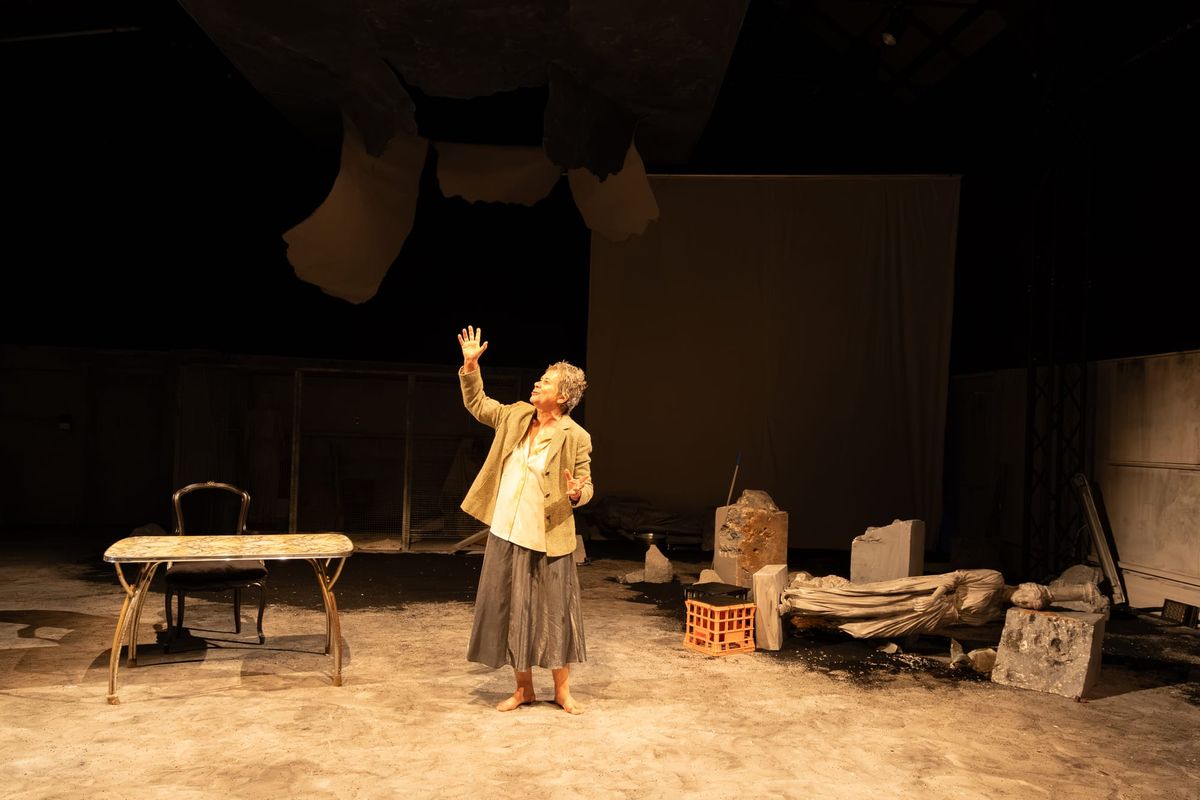
An art restorer stands captive, arms outstretched and shackled. A soldier interrogates her. A third woman stands nearby, apparently a nurse. Around them, Vivekanantham’s set bears the scars of war: rubble, grubby walls, classical statues among the wreckage, a great jagged hole torn through the roof, occasionally surrendering more fragments to the rubble below.
Here, violence has hands. But so does beauty.
The contradiction aches through Masterpieces, never quite healing. Human beings destroy cities and paint Rembrandts. They torture and tell stories. They break bodies and gently tend to them. McDonald offers no comforting division between the kinds of people capable of one and the kinds capable of the other.
That makes for an extraordinarily dense evening: demanding, unsettling and deeply rewarding.
Masterpieces moves initially between fragments of film, relational drama and direct-address lecture, and it takes a little time to learn its grammar. One moment Montgomery-Griffiths is the captive, her cream silk shirt stained with bodily fluid, infected wounds on her wrists; the next she pulls on a tweed jacket:
“Good evening, ladies and gentlemen.”
The house lights rise. She speaks of cultural masterpieces: in the face of profound destruction, what does a society choose to preserve? Then the question becomes personal. Imagine a fire: if everything we could save had to fit inside a shoebox, what would we choose in the moments before catastrophe?
We had each been handed a small bag on entry containing a pencil, a tiny piece of paper and a stone. We scribble our answers while Montgomery-Griffiths continues speaking. I miss some of what she says.
There is something fitting about this. McDonald’s poetry spills out quickly, one exquisite morsel following another before there is enough time to digest the last. Trying to hold onto it is like putting your hand into a river and expecting to possess the water. Stay too long with one image and another has already flowed by.
Some images remain in memory, days after the play: six headless horses encountered on a walk. A bicycle for two. A professor buried to the waist and stoned to death with books. Rembrandt's self-portraits confronting mortality in his own sagging flesh. A mother drowned. Stones saved from journeys in more peaceful times. Roses grown from the ashes, now fed with blood. A butcher of smiles, with a love of opera.
There is something extraordinary in the accumulation: Masterpieces is brutal and delicate, intellectually restless and deeply affecting. It is a remarkable piece of theatre.
As its formal shifts become less insistent, the relationships among its three women take over. The abstractions of war contract into bodies, objects and story.
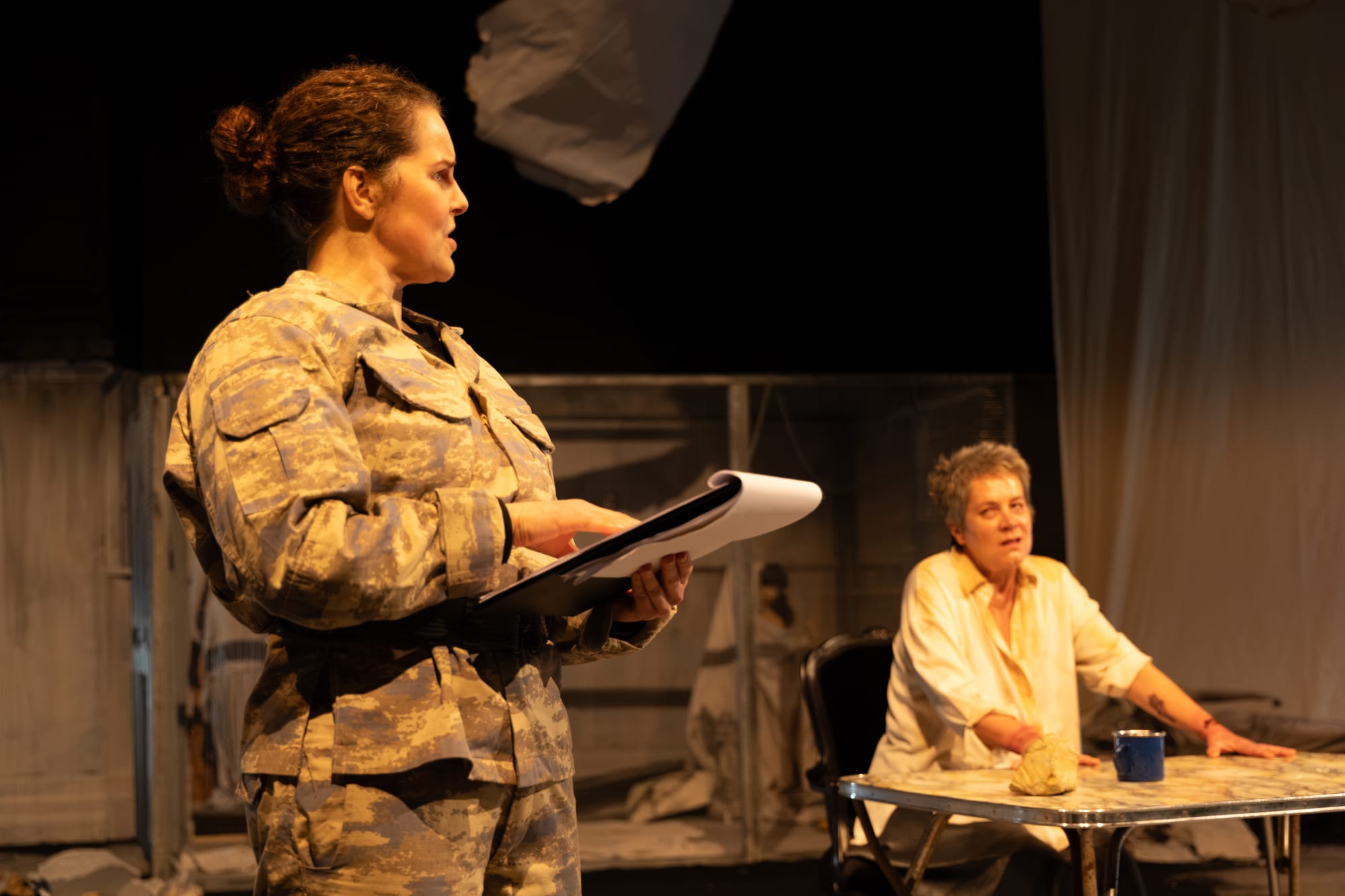
Montgomery-Griffiths is extraordinary as Layla, the captive art restorer. Violence remains in her body, well after the moments that inflict it have passed: a convincing limp, the painful wince that seems to arrive before thought can mediate it. She moves between defiance, rage, callousness, tenderness, grief and black humour with such fluidity that the seams between performer and character are impossible to see.
Kate Cole’s soldier, Mitra, takes longer to settle. Her accent is a little difficult to place and, to my ear, remains unresolved. Nor does she quite summon the early ferocity needed to spar with Montgomery-Griffiths and match her roar. But as the plot turns and certainty gives way to vulnerability, Cole finds something much more powerful. Fear, bitterness, grief and dependence seem to draw the performance more deeply into the body; the soldier becomes more complex, more exposed and, for me, considerably more convincing.
The expansive set creates an interesting tension with this increasingly intimate drama. For much of the conflict, Tass keeps the three women largely within its centre, and I found myself wondering what greater spatial compression might have done: how a smaller playing space might have usefully suffocated their dynamic, forcing bodies already caught in relationships of captivity, coercion and dependence into still more uncomfortable proximity.
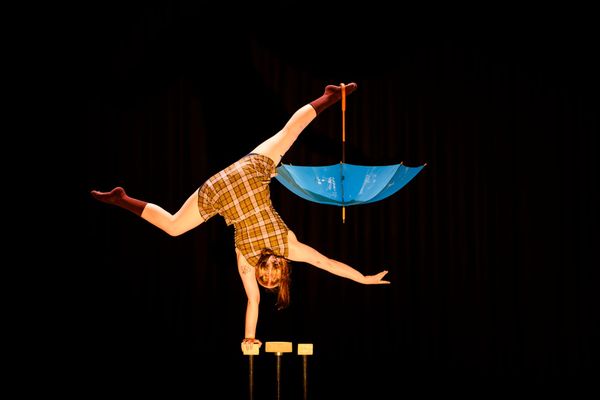
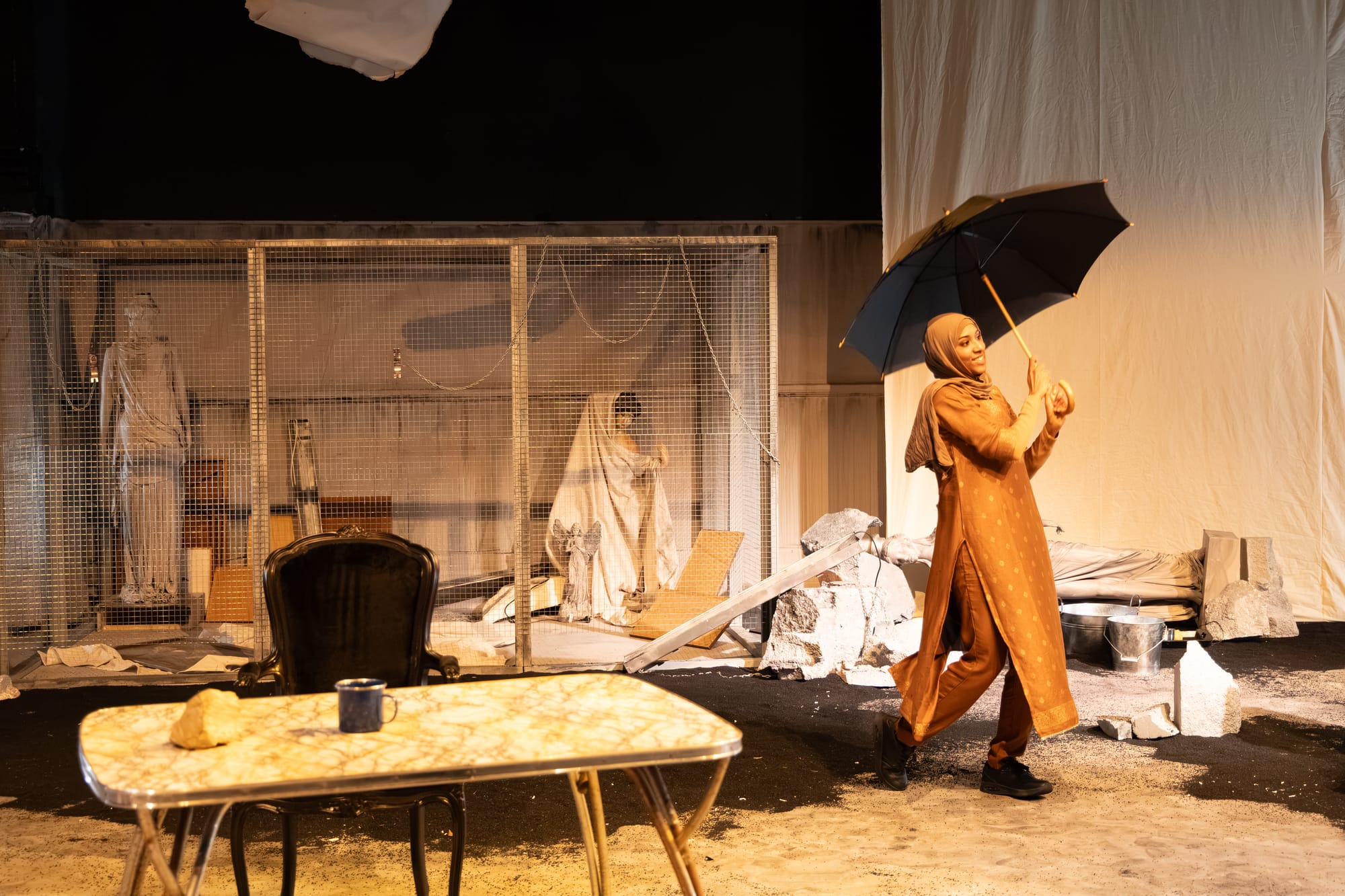
Laila Thaker is superb, bringing a different kind of force to the character, Nadia. Her guise as nurse is playful, reverent, pragmatic and capable of sudden ferocity. Thaker’s gesture work is particularly lovely: the subtle physicality accompanying a recitation from the Qur’an; an exasperated flick of the wrists — I give up — in the middle of heated debate; water spun from an umbrella to amuse the captive, conjuring remembered rain.
Her storytelling is equally deft. One account moves from the ordinary remnants of family life to almost unbearable violence, and in telling it Nadia changes the moral pressure in the room. Her story recasts her: a grieving daughter and a weathered mother, tortured by her own daughter's silence — her little eyes had witnessed too much and the girl no longer speaks.
Earlier, Layla had resisted Nadia’s call to kill their captor: if they did that, she argued, they would be no better than 'them'. Now the suffering is no longer abstract, and neither is our captive's moral choice.
Objects gather weight throughout Masterpieces. Books. Paintings. Stones. Uniforms. Small things asked to hold histories much larger than themselves.
A uniform carries authority, belonging and dignity, but inevitably, violence too. When Mitra’s uniform passes to another body, its meanings travel with it. So does her expectation that its new wearer should rise to what it represents: “Stand taller.” Even an enemy, once inside the uniform, is asked to honour it. And with the transfer, moral categories muddy too.
Hands become particularly charged in Masterpieces. They create and restore. They hurt and can be hurt. They can refuse. They can fail. Mitra has tortured the body whose skilled hands she later needs. The body you damage may belong to the very person whose capacities you later depend on.
"Go figure."
Montgomery-Griffiths returns to this phrase throughout the production, a bleak little shrug at the absurdity of human behaviour. Masterpieces contains humour, but almost no comic release. A few people laughed intermittently at the performance I attended; more often its black jokes produced rueful recognition. This is humour from somewhere near the point where the alternatives are to cry or scream.
Joy does not have much purchase here either. And yet beauty does.
The art restorer speaks of her father: a man who looked at a world of extraordinary horror, cruelty and suffering and asked a question that lodges somewhere inside the production: given all this, why is there so much beauty?
Not despite the horror, exactly. That would make beauty its consolation.
The question is stranger than that. Why are creatures capable of one, also capable of the other?
A Rembrandt does not compensate for the dead. A beautiful sentence cannot restore a family. The little shower of umbrella rain alters no material fact. Yet McDonald keeps placing acts of destruction beside acts of making, remembering and tending without allowing either to cancel the other.
The question of beauty gradually becomes entangled with another: why tend at all when nothing can be restored?
As captive and captor discuss a Rembrandt depicting women making their way to Christ’s tomb, they confront another question: why make an arduous journey to tend to the dead when nothing can bring them back? By now, both women know something of that futility: the soldier’s mother and the restorer’s father lie in the same mass grave.
"No, not love."
"Duty."
The distinction landed heavily for me. Love might explain care born of attachment. Duty makes a more austere claim: what is required of me now?
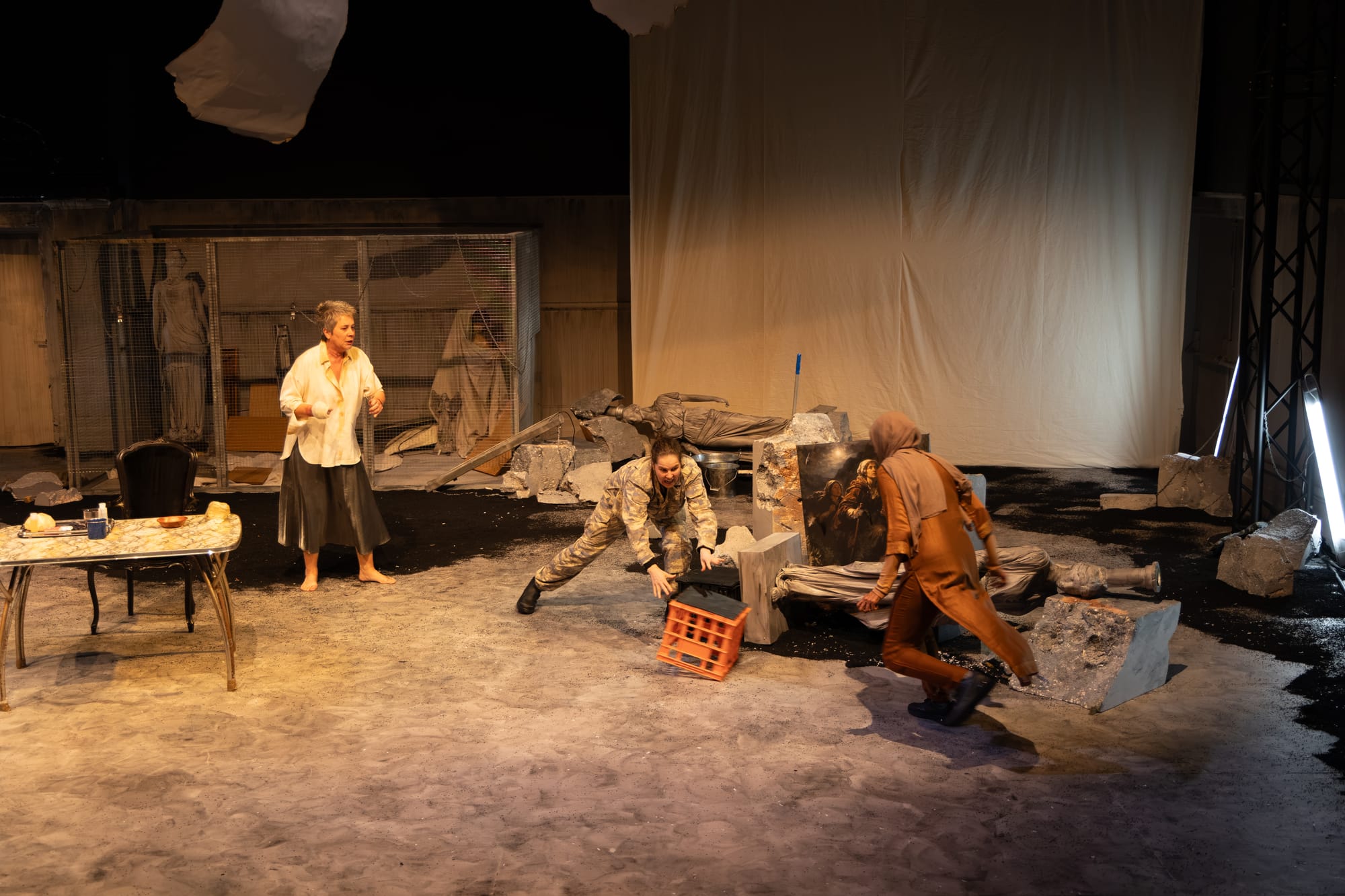
Towards the end, we are offered a poignant image of what that duty can look like: an almost exquisite act of care for something human beings have made and deemed worth preserving. I wished we had been left there. McDonald, however, returns once more to a recurring absurdist motif. For me, that final callback breaks a spell that did not need breaking.
But despite this rude interruption, what the play has unsettled in me does not dissipate. Our nurse can be playful, kind and reverent, and still ask another person to kill. Our soldier can torture, then appeal to her victim to save her. Our captive can condemn violence, then choose it.
These are not revelations of some hidden self underneath the roles of civilian, captive or enemy. Nor does war expose some essential human nature beneath civilisation. The possibilities multiply instead.
I left Masterpieces sobered. Quiet, perhaps even a little meek.
The play does not strip these women back to reveal who they really are.
It keeps asking what they might become next.
That is considerably more disturbing. And more hopeful.
Masterpieces of the Oral and Intangible Heritage of Humanity plays at Theatre Works, 14 Acland Street, St Kilda, until 1 August 2026.