Worth the wait: Waiting for Godot
Janice Muller’s Waiting for Godot is superbly performed: funny, affecting and completely absorbing. Tim Heath and Gus Read-Hill are glorious as Vladimir and Estragon, while Tim Rogers and Luke Lennox bring comic extravagance, menace and astonishing force to Beckett’s strange world.
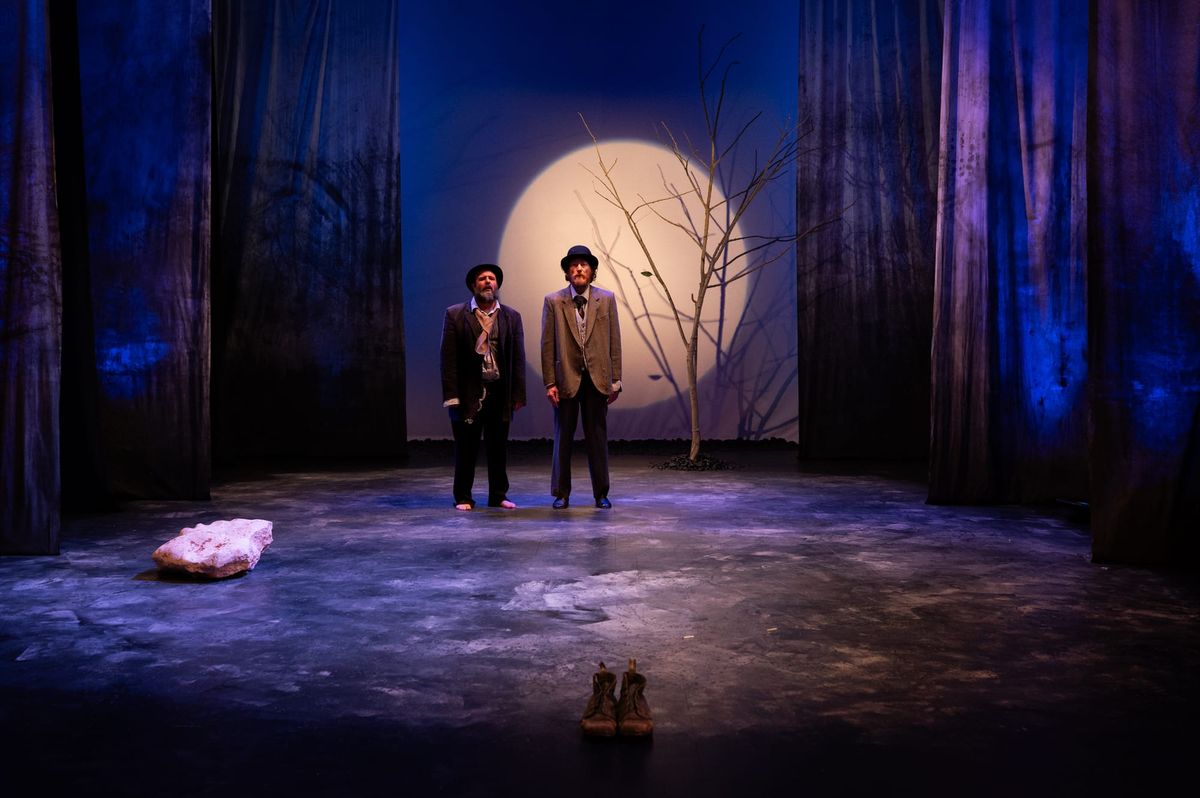
Dare a critic admit that this is the first time they have seen Waiting for Godot? Sacrilege, surely?
For those who have perused our credo, this will not be a startling revelation. I come from the arts, but I am a relative newcomer to theatre. I have never trodden the boards, directed a rehearsal room or studied the theatrical canon. My credentials for pronouncing upon Samuel Beckett are, frankly, dubious.
Waiting for Godot, though, is difficult to remain completely ignorant of for long. I knew the tree. I knew the waiting. I knew, in broad strokes, the two men beside the road and the man who never arrives. A theatremaker I knew very well had, over years of conversation, filled in considerably more of the detail. But I had never actually sat in a theatre and watched Vladimir and Estragon wait.
Beckett himself is another matter. I have fallen asleep during Samuel Beckett twice.
This sounds like an insult. It isn't.
My first encounter with his work was Worstward Ho, directed by Richard Murphet and performed by Robert Meldrum at Theatre Works' Explosives Factory in 2023. It was, in retrospect, a rather peculiar entry point. A late prose work adapted for the stage, Worstward Ho is almost gibberish. The words are recognisable, but Beckett assembles them into fractured sentences that refuse to behave as sentences should. And yet the gibberish is delicious: rhythmic, repetitive, strangely poetic.
I slipped into a strange liminal space between sleep and waking. My head lolled forward, but I could still hear the words. I wasn't bored, and I hadn't stopped listening. If anything, the opposite was true. I was drinking in the language while somehow relinquishing the ordinary effort to make sense of it. It was like being hypnotised.
Not long afterwards, I saw Melbourne Theatre Company's 2023 production of Happy Days, starring Judith Lucy as Winnie. It happened again.
Krapp's Last Tape, at Adelaide Festival in 2025, was different. I suppose its stronger narrative thread gave my waking mind something to grasp: a life excavated through recordings, memory and regret. That, and who could close their eyes to Stephen Rea? But I don't value that encounter more than the others. There was something extraordinary in surrendering ordinary consciousness to Beckett's language, in receiving it somewhere between comprehension and dream.
So, driving to Castlemaine to finally see Waiting for Godot, my own wait for Godot was nearly over. I wondered less whether I would like it than how I would experience it.
The answer, this time, was wide awake and laughing.
Janice Muller's production for The Ravens Theatre Company is extraordinarily funny, its comedy keeping me tethered to every moment even as Vladimir (Tim Heath) and Estragon (Gus Read-Hill) struggle to find ways to fill theirs.
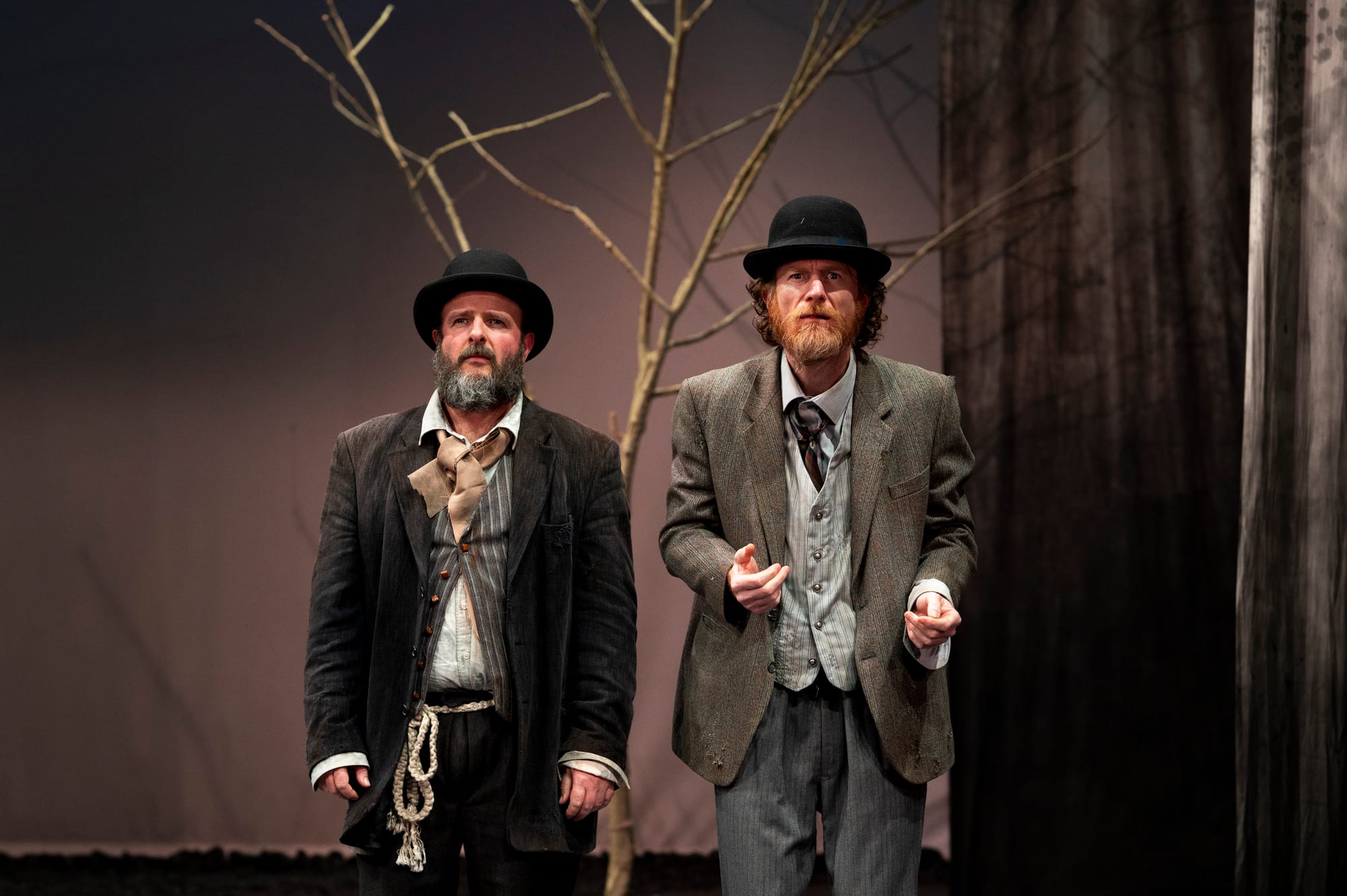
Heath and Read-Hill allow Vladimir and Estragon to be gloriously outsized. Faces stretch and crumple; postures sharpen and sag. Vladimir is bright-eyed and buoyant, while Estragon seems perpetually on the verge of drooping under the weight of some new indignity. At times, they resemble a pair of particularly bedraggled Muppets. Yet there is remarkable precision beneath the exaggeration: every grimace, pause and small adjustment of a bowler hat becomes material.
The comedy thrives on the problem Beckett has set them: how to fill time when the thing that matters is always going to happen later. Heath and Read-Hill find seemingly endless variations on this predicament. Even suicide can be contemplated as a way to pass the time.
I kept catching a glimpse of sorrow underneath the laughter. The possibility of hanging themselves is funny until, suddenly, it isn't. The same is true of their waiting. Beneath all the comic business is the creeping recognition that these men have surrendered their lives to the future. Happiness, purpose, action: everything deferred until Godot comes.
Pozzo (Tim Rogers) and Lucky (Luke Lennox) complicate the picture. Until their appearance, Vladimir and Estragon can seem close to the bottom of things: shabby suits, failing boots, little to their names and nowhere in particular to go. Lucky, tethered by the neck and burdened with Pozzo's possessions, casts their predicament in a different light.
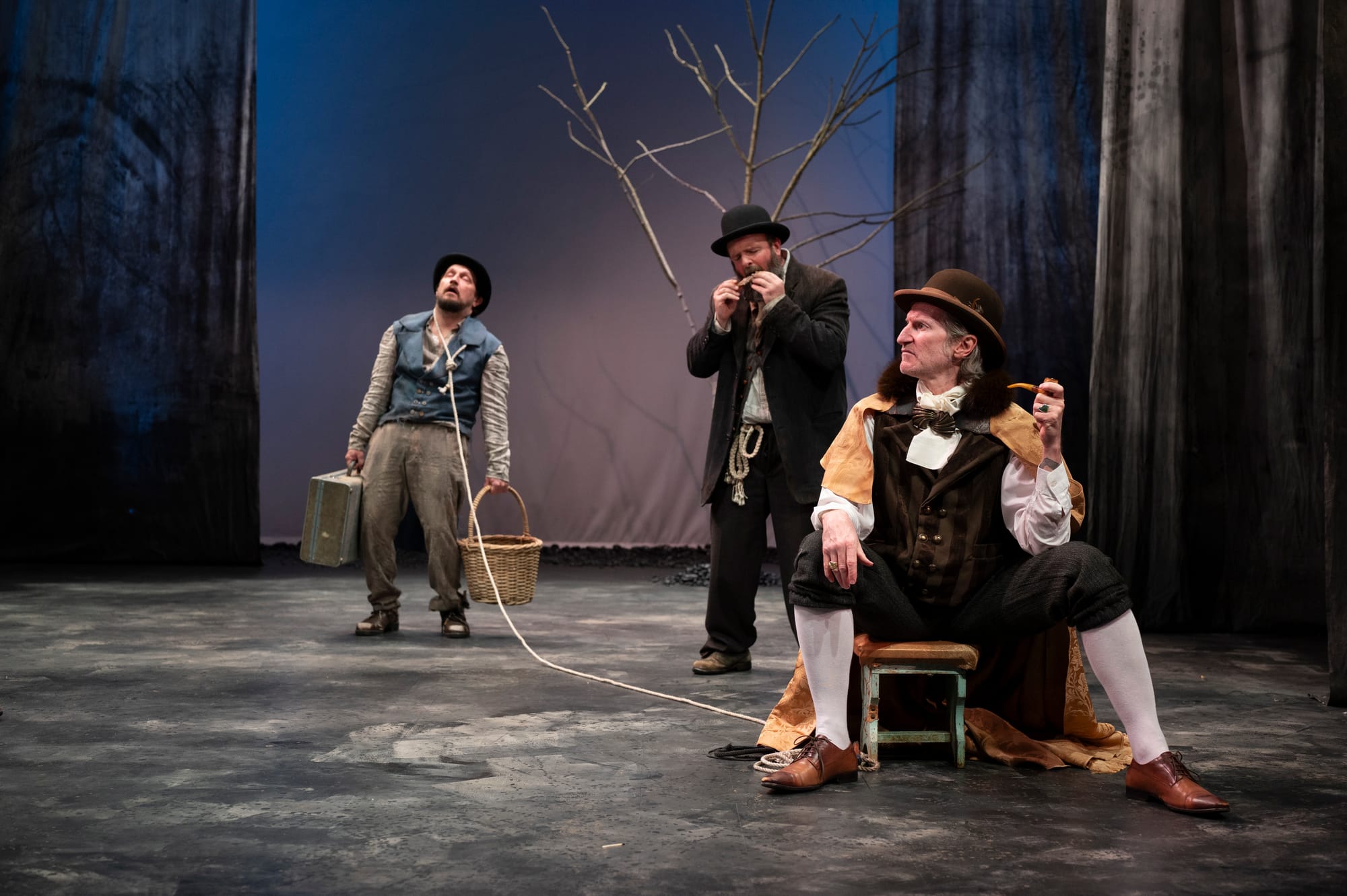
In fact, I found Lucky's arrival a little horrifying. Rogers gives Pozzo's authority a wonderfully pompous theatricality. He swells into the space, luxuriating in his own importance; even the business of being helped into his cape becomes an event. Rogers pitches the extravagance beautifully, finding the comedy in Pozzo's self-regard while making the power beneath it entirely credible.
Lennox's Lucky bears the material cost. The rope between them makes that power brutally concrete.
And then Lucky speaks.
Lennox's monologue hits like a punch to the face. Language comes in a torrent: fragments of argument and apparent sense accumulating, colliding and disintegrating almost faster than they can be apprehended. After Lucky's long silence, its force is startling. Lennox does not simply recite the famous verbal avalanche; he seems overtaken by it. The effect is potent, frightening and strangely exhilarating.
Against this, Vladimir and Estragon's apparently meagre existence begins to look different. They may be waiting, but at least they are free to leave. Except, of course, they don't.
By the second act, the relationship between power and dependence has shifted again. But it was the play's treatment of time and memory that began to get under my skin. Again and again, certainty about what has already happened dissolves. Repetition offers no reassurance; it seems instead to make one day less distinguishable from another. I found myself wondering what becomes of a life when the past cannot quite be held onto and the future is always where meaning is expected to arrive.
Then Vladimir names something I had been feeling for much of the play: “But habit is a great deadener”.
The line landed hard in my stomach. Habit gets them through. It also makes getting through enough. There is something frightening in the ease with which repetition can become existence: not choosing unhappiness exactly, but becoming sufficiently accustomed to it that tomorrow can continue to carry the promise of something different.
Perhaps this was what disturbed me most about their waiting. Godot began to matter less to me than the conviction that whatever might make life meaningful was somewhere other than here.
Muller's visual world is spare. A bare tree rises over the landscape; a rock provides somewhere to sit, sleep and wrestle with recalcitrant boots. Tall, blue-grey panels frame the space with indistinct organic forms. By the second act, the tree has produced a single, almost comically inadequate leaf. Night arrives with equal economy: a moon appears, suddenly and unapologetically theatrical.
Yet the waiting itself is full of activity. Between Heath and Read-Hill, irritation slips into tenderness; separation is repeatedly imagined and companionship repeatedly resumed. They bicker, clown, care for one another and contemplate leaving, only to remain together. For all my unease at lives spent waiting for something outside themselves, I kept thinking: I suppose this is a life too.
Perhaps that is what made their waiting so painful to me. Not that nothing is happening, but that what is happening seems insufficient to them. I wanted them to recognise what was already there: to stop treating meaning as something that might arrive tomorrow and claim whatever could be made from today.
For someone arriving very late to Waiting for Godot, I could hardly have asked for a better introduction. Muller, Heath and Read-Hill find all the immediacy in Beckett's strange rhythms: the jokes land, the silences hold, and the repetitions gather weight as the evening wears on. Rogers and Lennox bring real force to the darker world that presses in around them. The result is exquisitely performed: funny, painful and completely absorbing.
There are worse things, it turns out, than waiting a long time for Godot.
Waiting for Godot plays at Phee Broadway Theatre, Castlemaine, until 3 October 2026.
Disclosure: A complimentary ticket to Waiting for Godot was provided to Melbourne Stage Review for the purpose of review. Melbourne Stage Review retains full editorial independence.