You can take the boys out of Great Britain: Lord of the Flies
Wright’s Lord of the Flies is a thrillingly accomplished production, going beyond modernising a familiar text: it unsettles the assumptions through which we understand it. What if the island experiment shows us a reproduction of the hierarchies and violence of the world they supposedly left behind?
I thought I knew what Lord of the Flies was about.
I first encountered William Golding’s story as a kid, maybe twelve years old, watching the film with my family. I read the novel perhaps a decade later. In the nearly twenty years since, I have carried around what I suspect is a fairly conventional understanding of it: remove a group of boys from the structures of civilisation and civilisation begins to fall away. Rules become harder to enforce. Violence becomes possible. Eventually, something supposedly more primitive emerges.
Steven Mitchell Wright’s production of Nigel Williams’s stage adaptation made me wonder whether I had it backwards.
* * *
The boys are already onstage as we enter Theatre Works, playing a version of “keepy-uppy” with a small red ball. They count together, jostle, compete, recover the ball and begin again. While we wait for the lights to dim, they gradually become passengers on a plane, perched in pairs on old brown suitcases along the narrow ledge at the top of the steeply raked stage. The crash unfolds in spectacular slow motion, bodies pitching through the cabin. It is the first of many moments of masterful ensemble work.
That rake becomes the production’s essential landscape. Hierarchy is marked spatially. In a quieter moment, a projection of a full moon slowly travels across it as the boys sleep. Later, live video is projected over the same surface, immersing us in the immediacy and horrific intimacy of brutal acts.
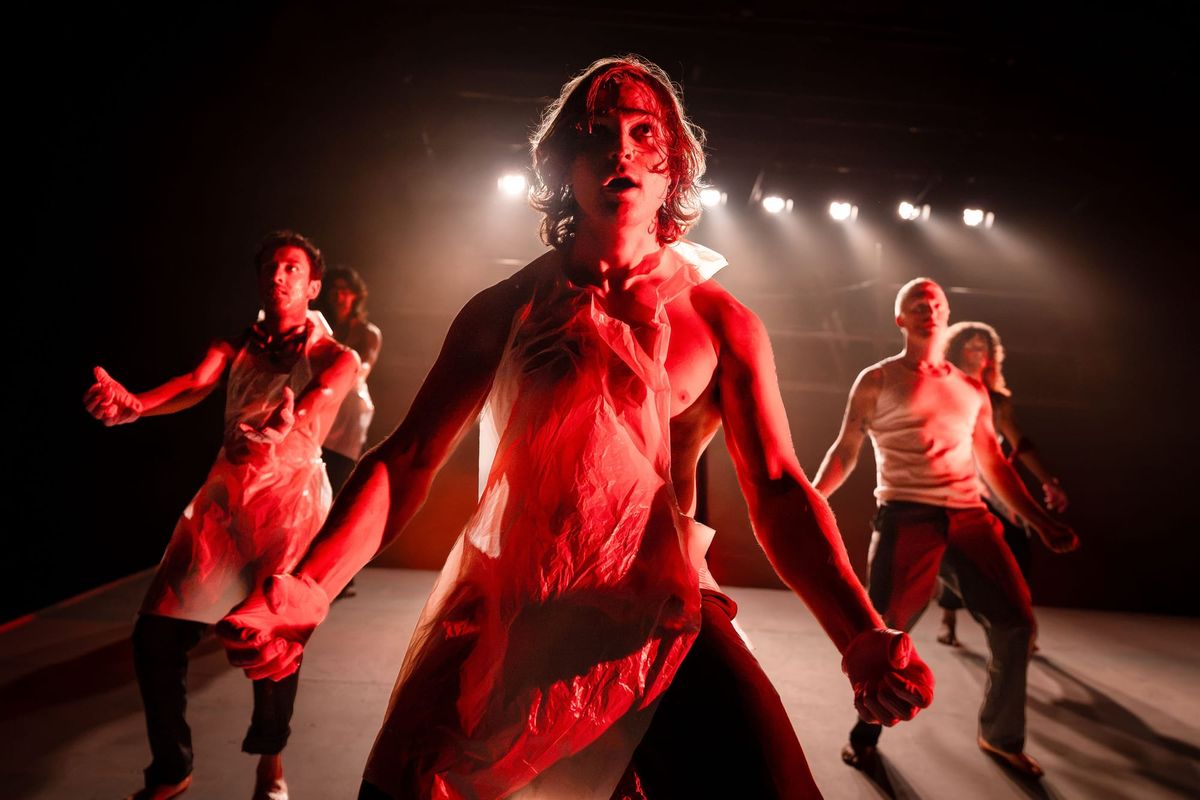
Indeed, the stage design is doing some very heavy lifting: deceptively spare, but capable of producing an astonishing complexity of levels, relationships and images. Wright makes full use of it, bodies continually reorganising themselves across its height and depth. The production’s sound and lighting are similarly muscular. At key moments, the stage floods with saturated red as a sonic impact seems almost to strike the boys down: reality hits, and their bodies take the blow.
Ralph, superbly played by Angus Leighton, emerges easily as a leader. There is something footy-captain-like about him: athletic, handsome, socially confident, capable of making authority look natural. He gains status partly through physical competition and, very early, strips to a pair of startling yellow briefs. For most of the first half, while the other boys remain substantially dressed, Ralph strides around nearly naked and entirely at home in his body.
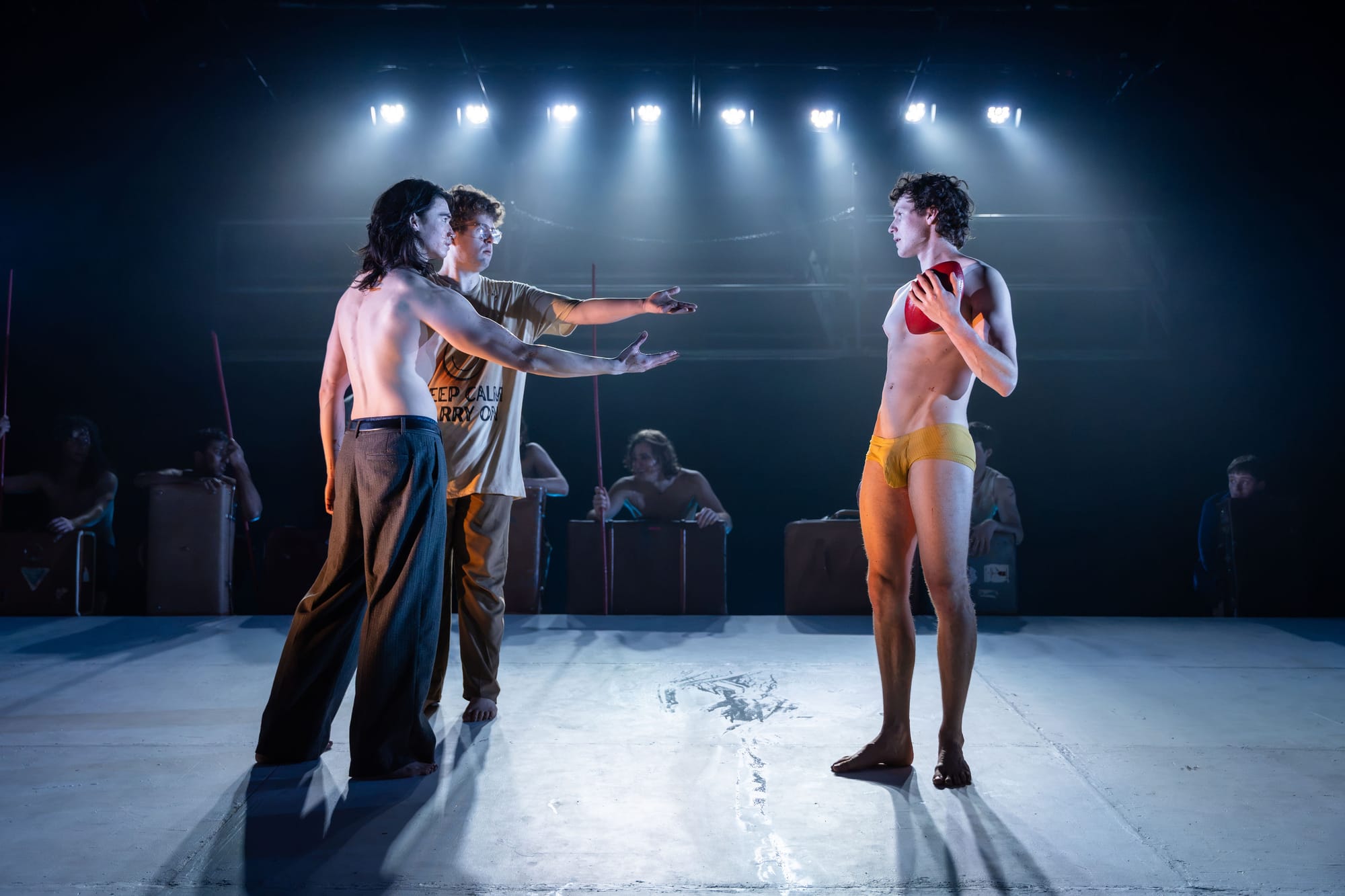
It would be easy to mistake that ease for innocence. Ralph is certainly no Jack. But neither is he outside the hierarchies forming around him. Early on, he takes Piggy’s glasses and joins in the joke at his expense. Piggy cannot see without them: his humiliation does not begin with the collapse of social order. It begins while everybody is still playing nicely.
The distinction is useful to draw, because Wright makes power more complicated than a contest between a good leader and a bad one.
Jack’s power is spectacular. Sean Yuen Halley finds true ferocity in the role, particularly as the production accelerates towards its end. Ralph’s increasingly prosaic concerns with shelters, fires and survival cannot compete theatrically with what Jack offers. Jack has ritual, danger, belonging. There’s part of me that understands why the boys follow Jack because, to an uncomfortable degree, there is something compelling about the sinewy spectacle of his power.
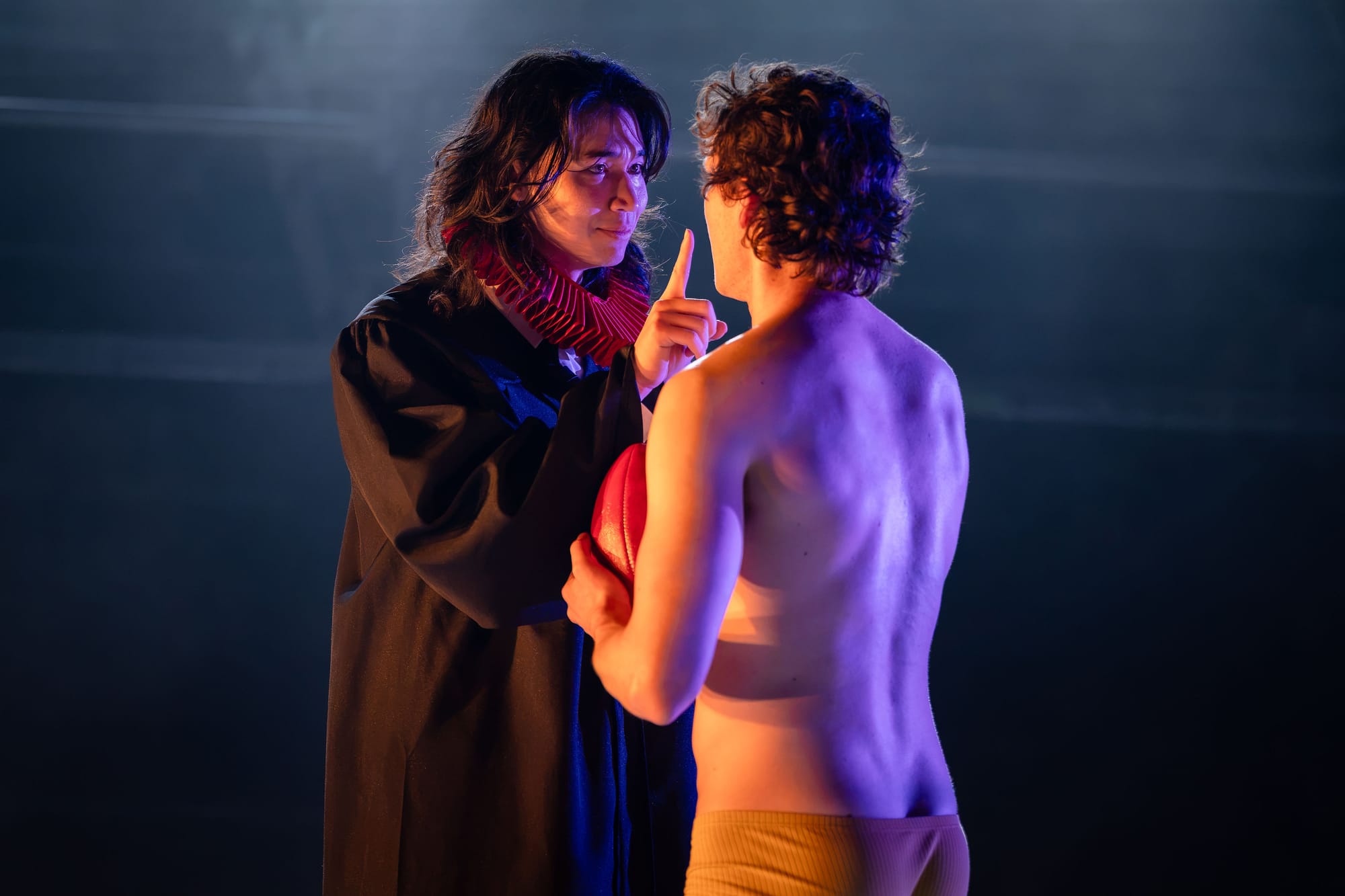
The island, meanwhile, is not abstracted as some remote, timeless place of imagined primitivism. A conch painted an improbable bright red is later replaced by an AFL football. Shelters are assembled from plastic and industrial tape. Plastic aprons and disposable gloves appear around the preparation of the pig. Music and movement draw on contemporary club culture; the boys dance with an exuberance that is sometimes camp, sometimes menacing.
And they film themselves.
A handheld camera circulates among the group, its images projected onto the rake beneath them. As the boys begin to turn it upon their blood- and pigment-covered bodies, its logic becomes apparent. They seem to be documenting their acts, recalling the peculiarly contemporary tendency to record and circulate criminal behaviour as a kind of experiential trophy.
At times there is almost too much to see. Wright fills the rake, and the scaffold behind, with simultaneous movement, images and competing centres of attention, and there were moments when I was uncertain where to look. Most significantly, Simon’s death did not initially register clearly for me. The boys are dancing — club lights, music, moving together — and somewhere within that frenzy Simon is killed. I understood fully what had happened only once his body remained still.
What follows is unmistakable, however. Rain falls across the upper part of the rake. Ralph and Jack stand beneath it while water begins travelling down the slope towards Simon’s body. Around them, the other boys face the audience in stunned silence.
And then, having spoken until now in impeccable, class-stratified British accents, the boys start speaking with Australian accents. Jack, though, remains conspicuously British.
It is an audacious intervention into the text. Rather than updating Golding and Williams through dialogue (which, I gather, the copyright holders did not permit), Wright works through bodies, objects, sound, image and voice. The accent shift resists a single explanation, but something theatrical has unmistakably slipped. Britishness, which had seemed simply to belong to these characters, suddenly becomes visible as something that can be performed.
I think it is this intervention that made something shift in my understanding of the story.
Golding’s 1954 novel was written partly against R. M. Ballantyne’s The Coral Island, an imperial adventure in which shipwrecked British boys reproduce the supposed virtues of British civilisation abroad. Watching Wright’s production, the familiar opposition between civilisation and savagery began to look like a considerably dumbed-down narrative.
These boys have not arrived culturally empty. They bring hierarchy with them. They bring class, masculinity, competition and ideas about who is entitled to lead. They bring a language in which the imagined “native” can stand for whatever exists outside “civilisation”. Even their attempts at becoming something supposedly more primitive are constructed from the social materials they already possess.
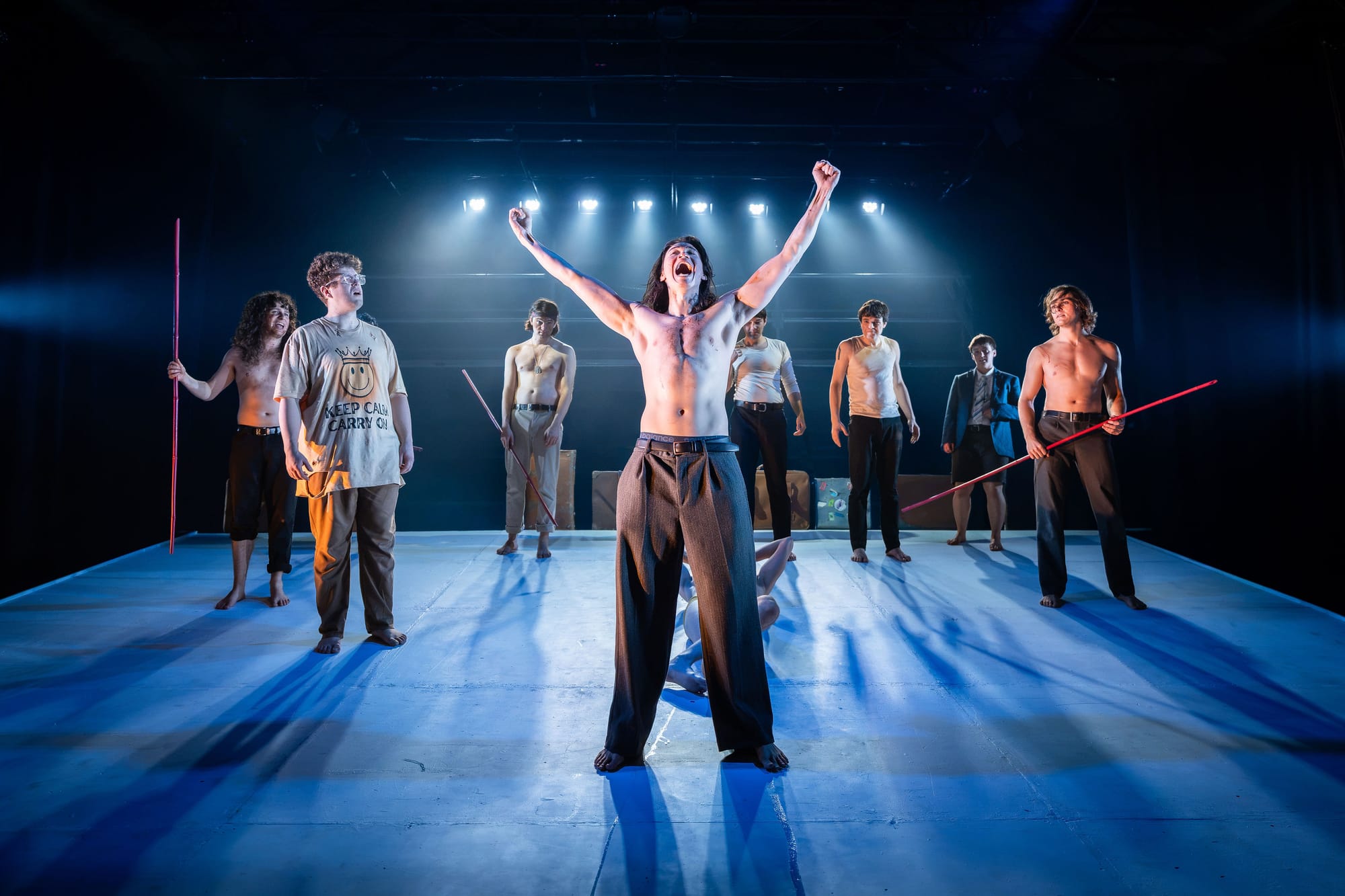
Perhaps the island does not reveal what remains once civilisation has been stripped away. Perhaps it shows how readily civilisation reproduces its own violence under altered conditions.
Even the feared beast resists easy separation from the world the boys supposedly left behind. When it appears, it wears the unmistakable form of a military gas mask. The thing imagined as existing beyond civilisation carries the visual history of modern industrial warfare: barbarism seen closer to the Western home.
Piggy, meanwhile, remains painfully himself. There is dignity in the performance without sanding away the qualities that make him irritating to the others. His commitment to rules does not make him socially fluent, and the production allows us to understand the irritation directed towards him without confusing that understanding with justification. His glasses become one of the production’s most potent objects. An aid he requires to see becomes a technology for making fire, something to steal and eventually a possession Jack carries tucked into his briefs.
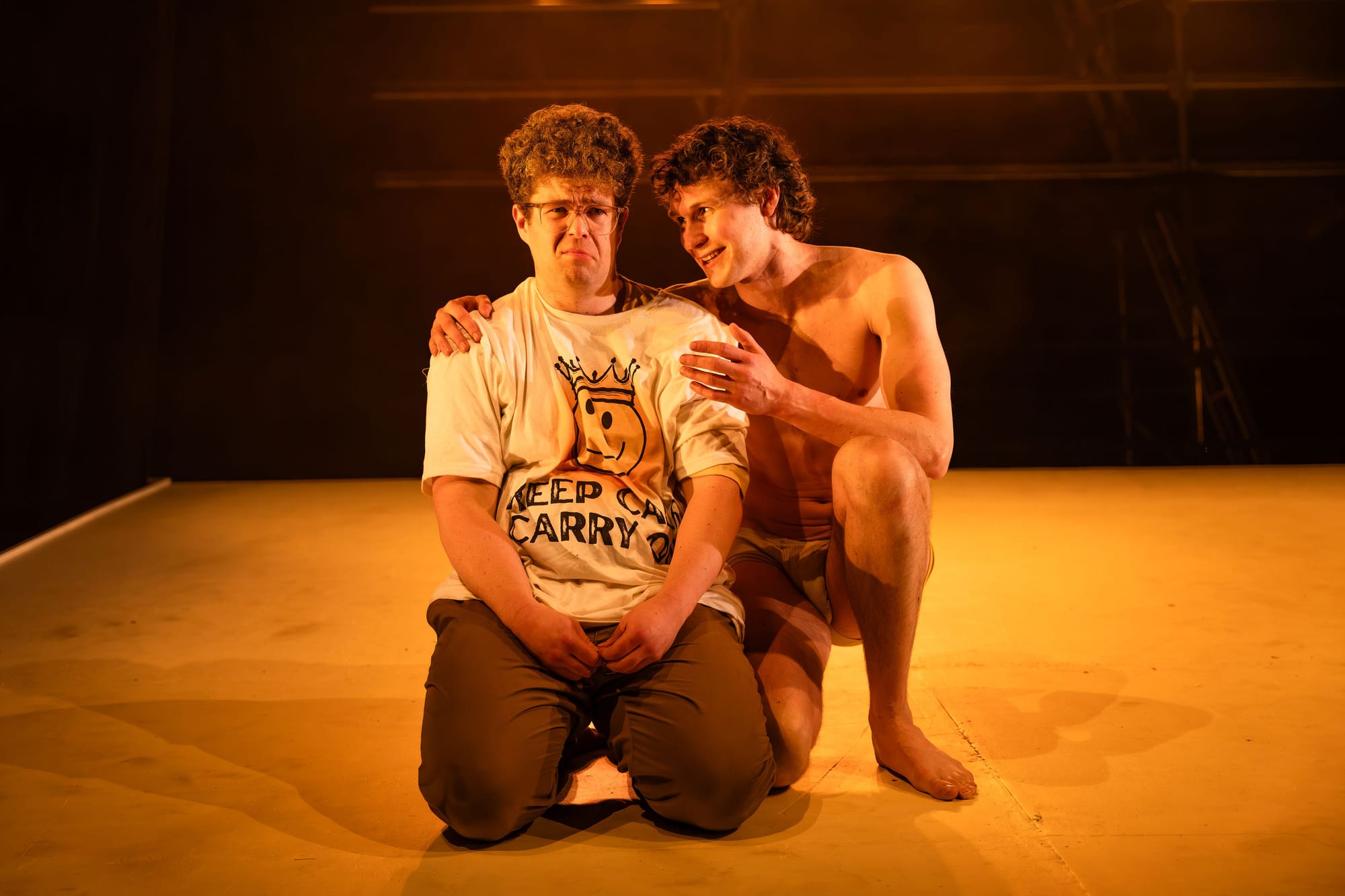
By the time Piggy dies, we know it is coming. That knowledge does little to prevent the stomach from dropping. And yet, there is another transformation still to come. The actor who played Piggy returns as their British saviour. He appears at the back of the audience, carrying a torch, and descends through the seating bank towards the stage. Now dressed in an officer’s coat and hat, he carries an authority Piggy could never command. He shines his torch across the filthy, near-naked children and regards what they have done with incredulity. Surely this was a game. Surely British boys should have managed better.
Hierarchy has not disappeared. It has simply become larger again. And the officer has not arrived from a world without violence. He comes from war. The British accents return. Jack gives Piggy’s glasses back to Ralph. Ralph takes them and collapses into grief.
* * *
There are ideas in Wright’s Lord of the Flies that I am still not sure I can resolve. I am not convinced every image lands cleanly, and its profusion of theatrical languages occasionally overwhelms the action it is trying to illuminate. But its strongest interventions do something far more interesting than modernise a familiar parable. It is in their accumulation — the accents, the objects, the bodies, the hierarchies, the traces of contemporary and military culture — that another reading can float to consciousness.
I walked into Lord of the Flies thinking I knew the experiment: take civilisation away and see what human beings become. I walked away with a much more complicated reading.
You can take the boys out of Great Britain, but can you take “Great” Britain out of the boys?
Lord of the Flies plays at Theatre Works, 14 Acland Street St Kilda, until 2 October 2026.
Disclosure: A complimentary ticket to Lord of the Flies was provided to Melbourne Stage Review for the purpose of review. Melbourne Stage Review retains full editorial independence.