The soil atop, the soil beneath: Distillation
Soil passes from hand to hand. Scent settles differently on each wrist. Luke Casserly’s Distillation makes an Irish bog sensuously present, while quietly opening questions about land, memory and place.

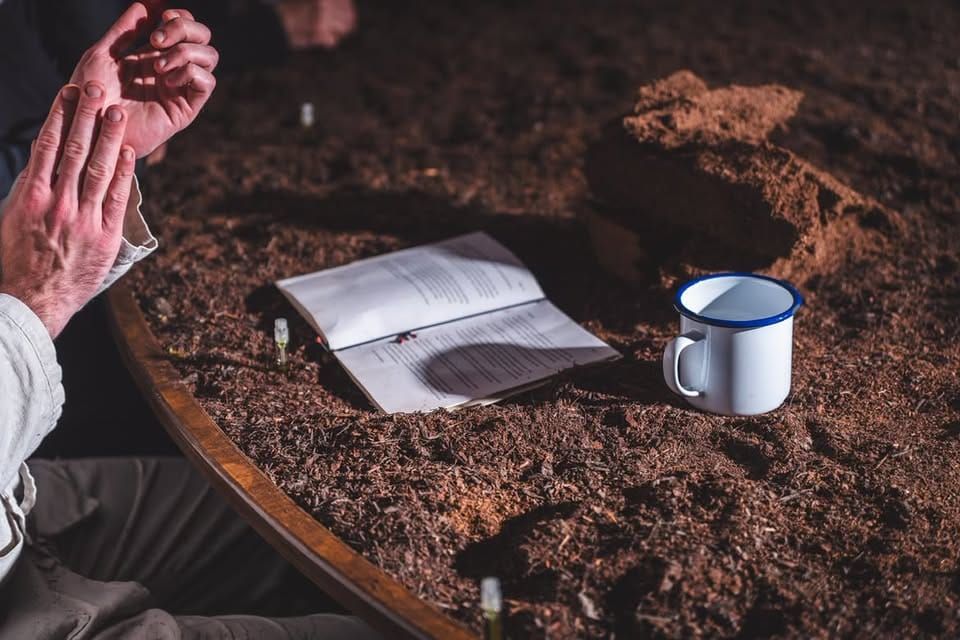
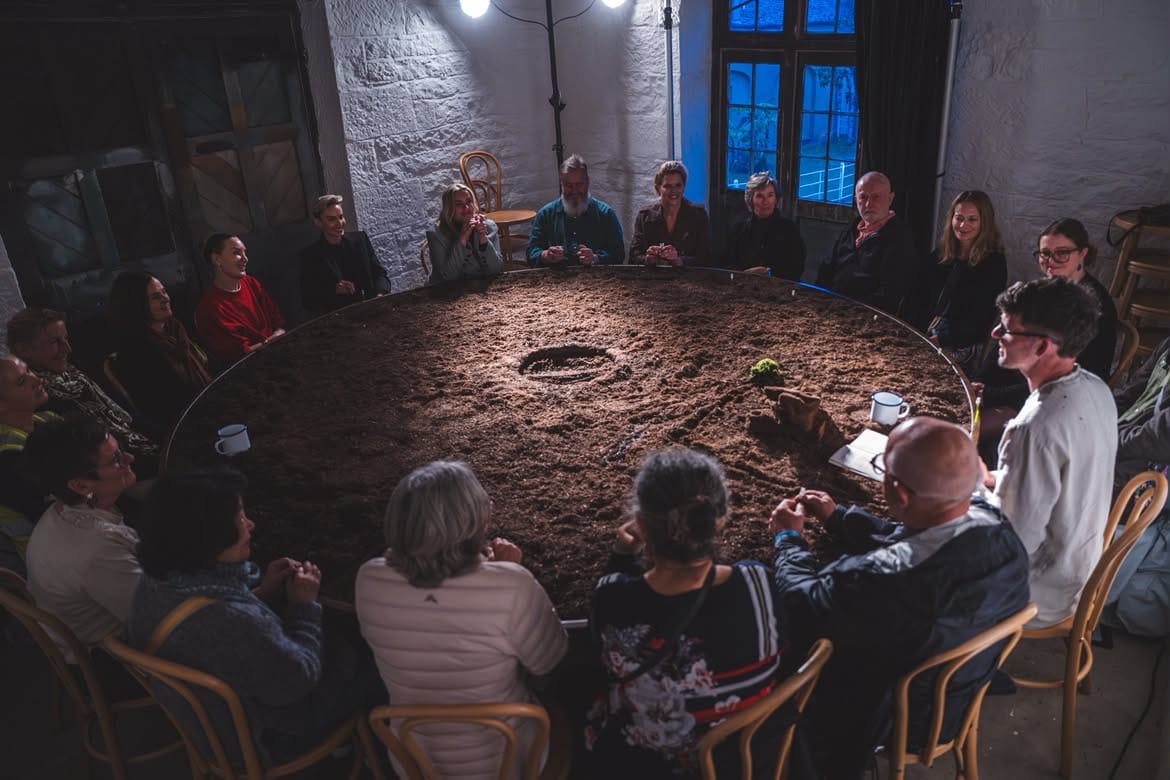
There is soil on the table. Twenty of us sit around it. Luke Casserly passes a small pot of coffee beans from hand to hand, saying nothing. A warm nod is enough: smell, pass it on. Then soil, loose in our palms. It takes a little care to transfer a handful of earth to a stranger without spilling it.
The room softens to meet Luke's rhythm.
Distillation comes from the boglands of the Irish Midlands, where Casserly grew up and where his father worked. It carries that landscape with it: its smells and textures, its industry and ecology, the knowledge accumulated by people who have worked it, and the grief of watching a way of life disappear.
Casserly tells us about having a cyst removed from his face. The scar remains. He turns his head to show us, puts a finger to it and begins to trace: down his neck and body, along his arm, through his hand, until the movement continues into the soil spread across the table.
He takes his time. The gesture becomes strange simply because it goes on longer than expected, part demonstration, part dance. A mark in the body finds its way into the earth.
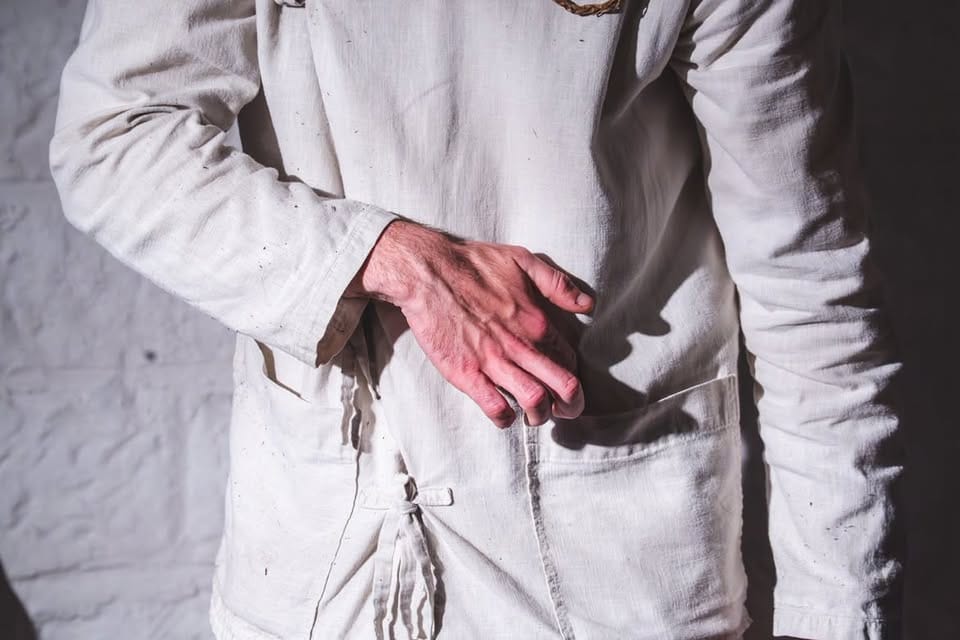
Much of Distillation happens like this, through touch, smell and the odd intimacy of twenty strangers gathered closely around one table.
Sphagnum moss travels from hand to hand. Casserly tells us about its old uses: for wounds, for babies, its extraordinary capacity to hold water. A declared cigarette break sends him under the table, from where an enormous cylinder of smoke eventually emerges, gloriously silly amid all this tenderness.
And buried in the soil in front of each of us is a tiny bottle of perfume.
It has been made to evoke the scent of the bog. We put it on our wrists. It is startlingly beautiful: round, warm, perhaps with a note of sweet citrus. Then Casserly asks us to offer a wrist to the person beside us, to smell the perfume on another's skin. I ask the man next to me if he's okay with that. He is. I lean towards his skin; someone else leans towards mine.
The perfume has changed, uniquely, on each of us.
There is something delightful about the scale of this. No spectacle. No attempt to manufacture transcendence. Just soil, moss, scent, stories, bodies; Casserly's gentle attention holding them together. He asks what the perfume evokes, and around the table people offer small fragments of memory: brief, unexpectedly poignant glimpses into other lives.
By the end Casserly speaks about the shared memory we have now made of a bog most of us have never seen, and the proposition doesn't feel fanciful. For an hour, some small sensory knowledge of that place has been held between us.
But the soil on the table has travelled.
At one point Casserly talks about the romanticisation of wild landscapes, set against the knowledge of those who have actually worked the land.
Listening, I am reminded of Kev Carmody at WOMADelaide in 2007, where I first encountered a song that has stayed with me ever since. Written with Paul Kelly, This Land Is Mine turns on a tiny shift in language. The settler voice says, “This land is mine.” Kev's voice: “This land is me.”
Those lines have stayed with me because they disturb the grammar of possession altogether. They suggest another way of thinking about land, one that doesn't sit easily within a choice between romanticising it and working it.
And today Distillation is not in Ireland. We are sitting at a timber table at Abbotsford Convent, handling soil from an Irish bog on Wurundjeri Country. There is a floor beneath our chairs, concrete somewhere beneath that; beneath all of it, earth with its own histories and continuities, its own relationships of memory, care, belonging, dispossession and survival.
That ground began to feel conspicuously present to me.
This is not an argument for making an Irish work less Irish. Its specificity is one of its strengths. This isn't generic earth. Casserly's bog has a history, and he belongs to that history. Nor would grafting an Indigenous perspective onto a touring work necessarily constitute meaningful engagement.
But, for me, a question remains: what happens when a work about place changes place?
What might Distillation discover if the ground it arrives on were allowed into the encounter? If, alongside carrying the bog out into the world, it became curious about the earth beneath each new table?
I leave the room slightly dreamy. Outside, Abbotsford Convent is all garden and October air: chilly in the shade, warm when I step into the sun. Birds above me in the trees. I've spent an hour breathing more deeply than usual, smelling soil and moss and perfume and another person's skin.
The bog comes outside with me.
So does the ground beneath my feet.
Distillation was performed 1-4 October 2026 at Abbotsford Convent, as part of Melbourne Fringe Festival 2026.
Supplied images are not from the Melbourne Fringe Festival production.
Disclosure: A complimentary ticket to Distillation was provided to Melbourne Stage Review for the purpose of review. Melbourne Stage Review retains full editorial independence.