A curious necessity: We Wanna Have a Lot of Forks in a Backpack
The lights are blinding, the sound unnerving, the dancers absorbed in some peculiar business. Their movements are fierce, precise and wonderfully strange. I was transfixed, though I'm still not entirely sure what I witnessed. Extraordinary stuff.
A man in the Dancehouse foyer tells me he's seeing the next performance for the second time. He's almost beside himself with enthusiasm. Is it really that good, I ask? Oh yes, he assures me. It's that good. I wonder what could possibly warrant another visit to a dance called We wanna have a lot of forks in a backpack.
Inside the Sylvia Staehli Theatre, I take my seat and find myself blinking into a bank of brilliant lights. Haze hangs in the darkness, and somewhere within it a low, rapid thudding sets up an irregular pulse. It has the mechanical quality of a helicopter, but muffled. I squint into the gloom beyond the lights. Gradually, two pairs of legs become discernible, folded wide on the floor. A metre or so in front of the figures sits a black backpack.
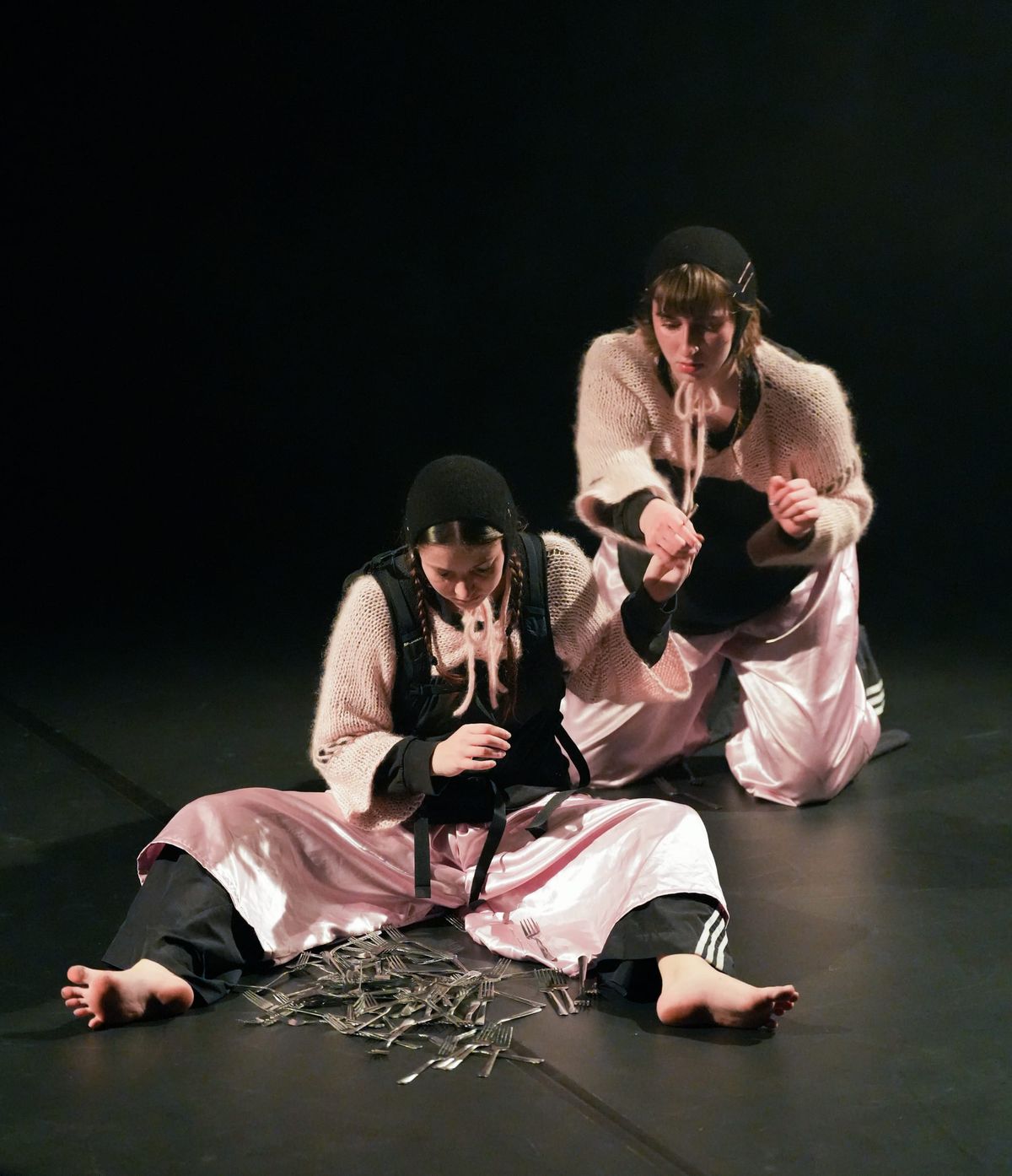
The figures are Lola Borroni and Hannah Vella, who created and perform this extraordinary duet. They wear black woollen skullcaps with pink under-chin ties, matching pink knitted abbreviated cardigans, and enormous satin-like pink shorts over black track pants. The costumes have the eccentric specificity of uniforms belonging to an organisation whose activities are none of our business.
They have work to do.
The dancers take hold of the backpack's shoulder straps and step through them, threading their legs in and out as they circle one another. They pull, drag, exchange places. The backpack goes over a head, around a body, across the floor. Occasionally both dancers look out at us, though they don't seem to see us, and chew vigorously on something that doesn't appear to exist. Everything seems perfectly reasonable to the two of them.
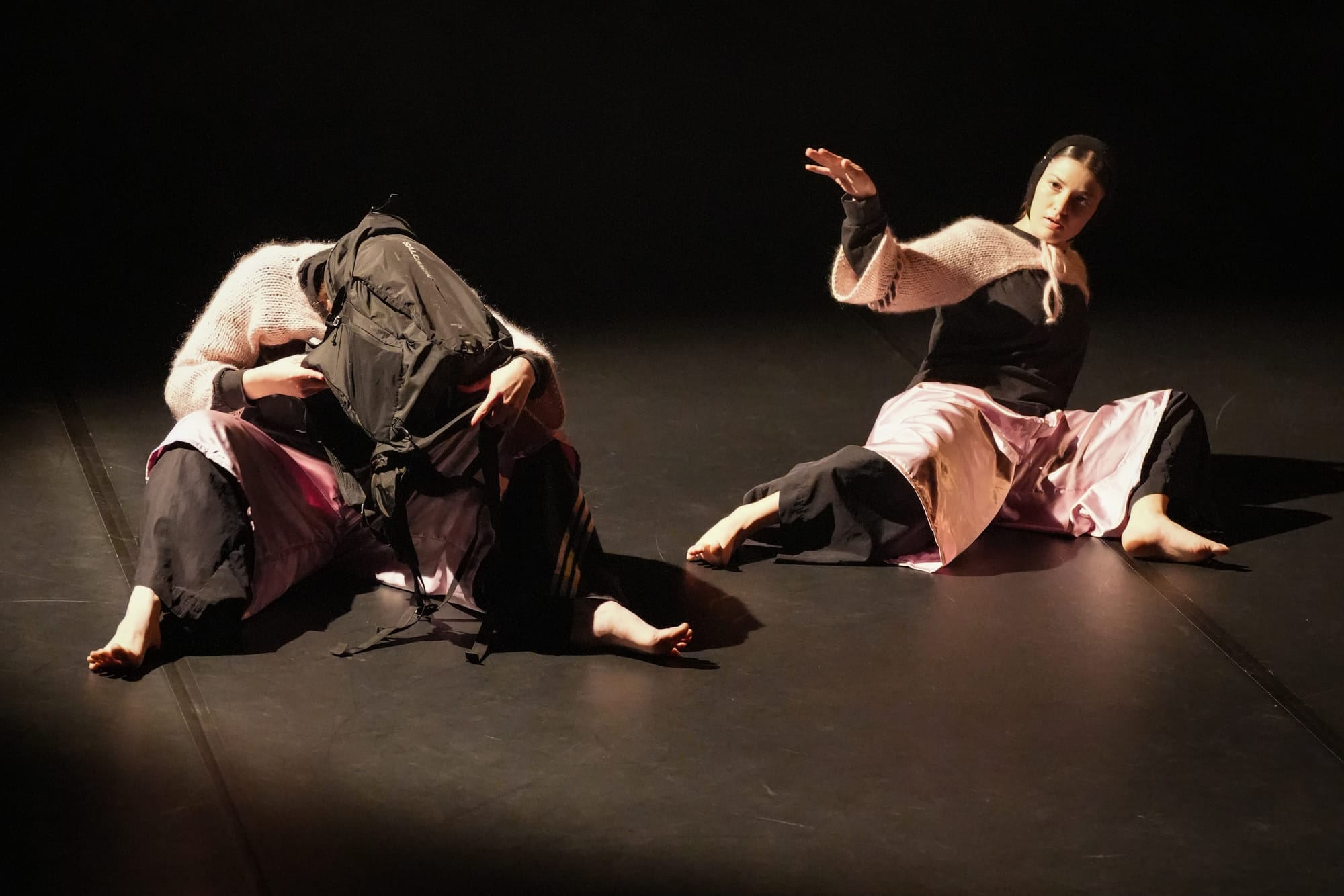
The backpack rattles as they move. There are forks inside, apparently a great many. Their metallic clatter joins Liam Bradford and Xavier Rako's remarkable soundscape, which moves through industrial rhythms, reverberations and noises resembling heavy drops of rain. The lighting picks out the dancers in small, softly bounded areas, leaving the rest of the theatre in unknowable darkness.
Borroni and Vella describe their work as an exploration of digestion, with food only one of the things we take in. There are choices to make, experiences to absorb, burdens to carry or reject, things that resist being processed. The backpack bulges with its accumulated contents; the forks have their own part to play in this peculiar economy of consumption. The chewing returns.
Eventually, the forks come out.
They spill out in a great metallic heap. After an inspection and some superb floor work, one dancer forces the other's face down into the pronged mess. The audience gasps, almost as one. It's a horrifying prospect, a face meeting all those unyielding fingers, and the action happens with such alarming conviction that I cannot imagine how it has been accomplished safely.
The dancers appear untroubled. They carry on.
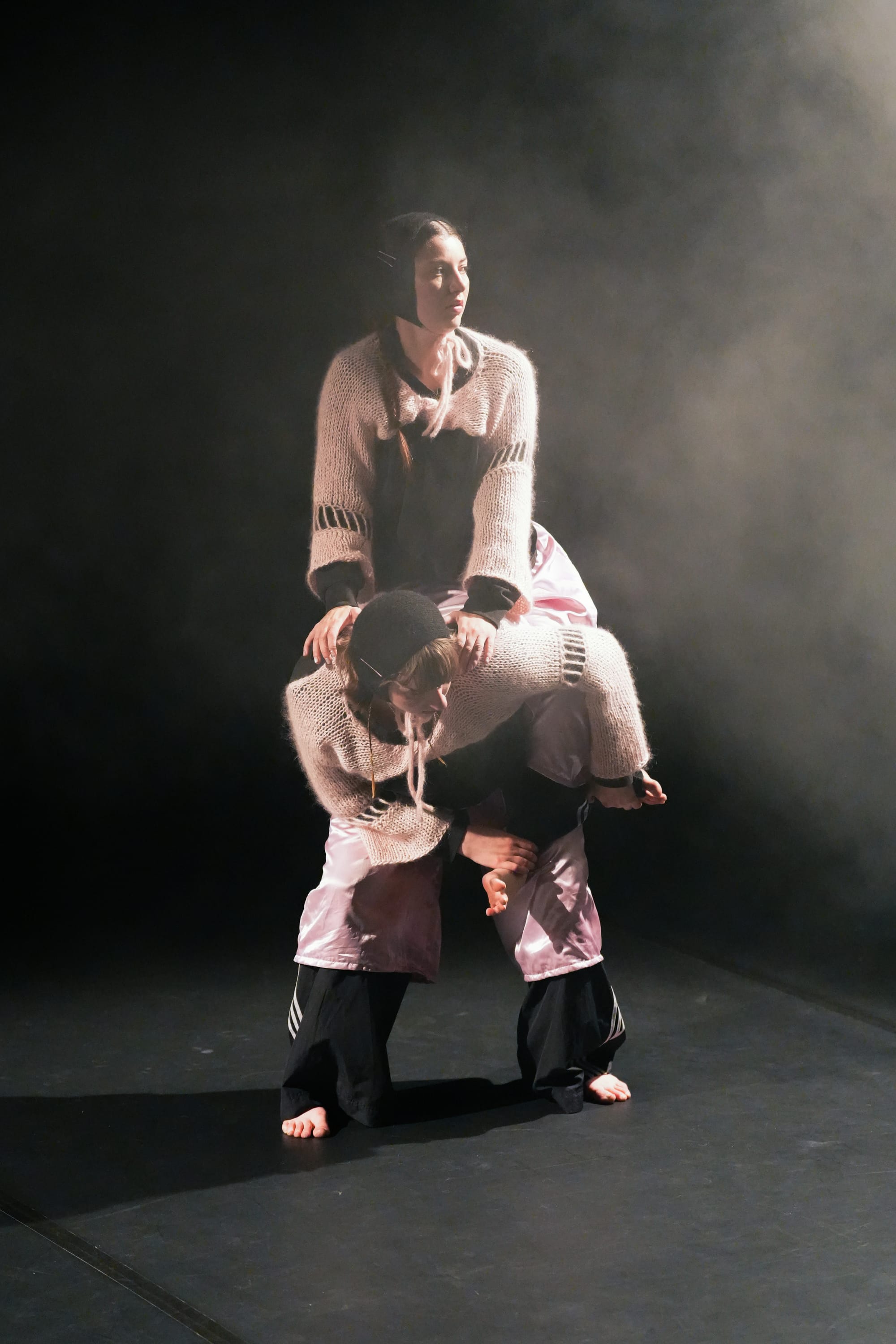
I'm reminded of the 1951 animated Alice in Wonderland, whose peculiar inhabitants pursue their inexplicable tasks with absolute conviction, and where nonsense has a habit of turning nasty. There's something of that same cheerful menace in the dancers' relationship. They tug at one another, grapple and shove. Nobody seems particularly angry. There are no injured feelings to attend to, no quarrel that needs settling. The violence belongs to their ordinary way of doing things, whatever those things might be.
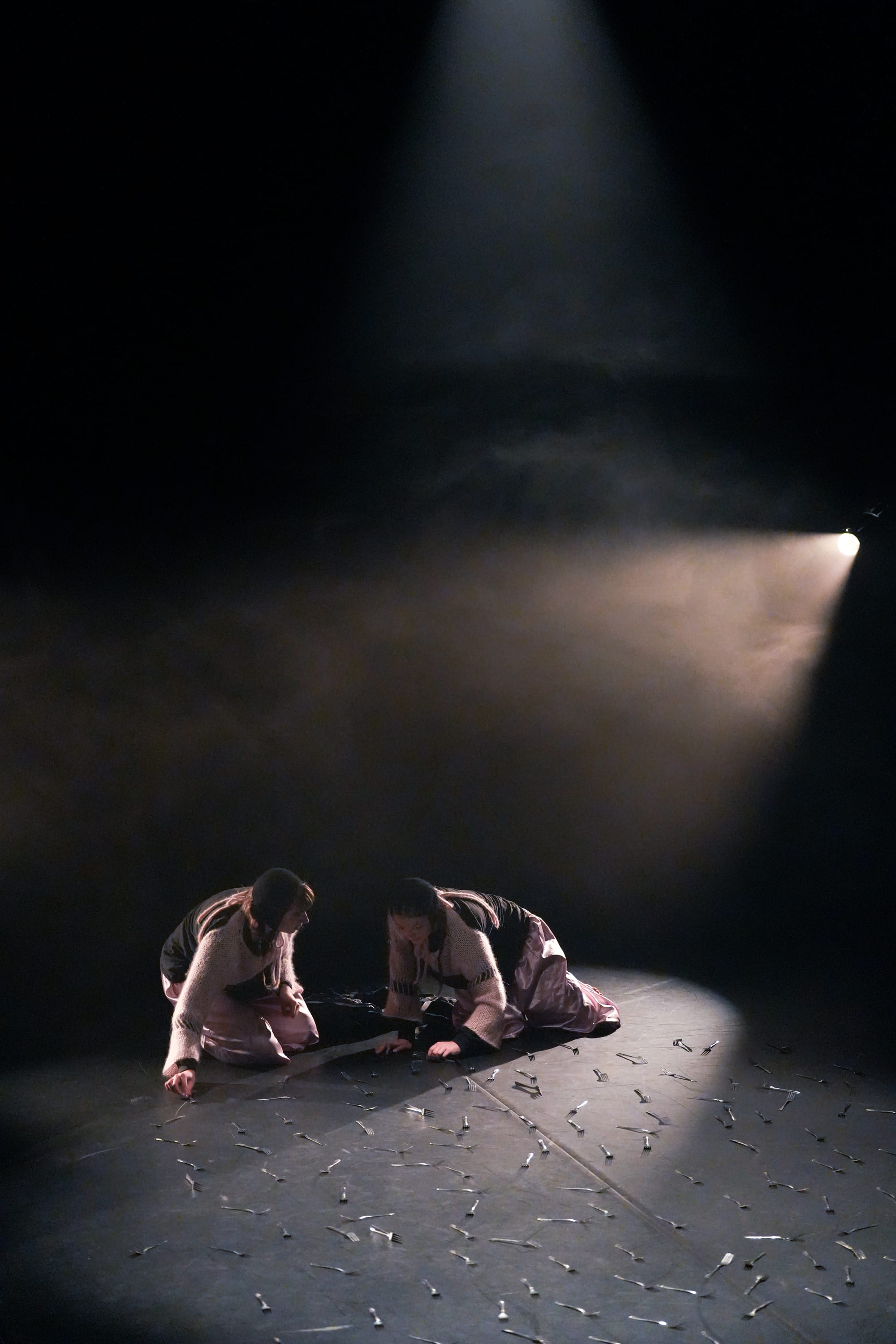
The forks come to acquire other occupations. Later in the work, they're laid out individually across the floor, their tines pointing towards us in a pattern of curious precision. Then comes the need to collect them. One dancer passes them over her shoulder for the other to pack away, fork by fork, until patience apparently runs out and fistfuls go flying backwards instead. Having been disgorged, examined and carefully sorted, the forks are swallowed back into the bag: an extraordinary amount of labour, considering how little nourishment they seem to provide.
At one point, the darkness opens to reveal a raised space behind the stage with ladders and various things hanging. I hadn't realised it was there. The dancers venture into it, and an earlier sequence returns. They step through the remembered loops of the backpack, although the backpack is elsewhere. Their legs describe its absent straps, their bodies retaining the choreography of something they no longer carry.
It's a beautiful passage in a performance of formidable physical invention. The dancers' timing is intricate, their exchanges wonderfully assured. They seem to anticipate one another's movements down to the smallest adjustment, even when the choreography turns rough. Sound and light continually alter the dimensions of the world we're watching. Its intensity is almost confrontational, and I'm absorbed by every strange manoeuvre.
I keep trying to work out what they're doing. The actions have purpose, of that I'm certain. Something needs arranging, carrying, retrieving, consuming, completing. The dancers know exactly what it is. I haven't the faintest idea.
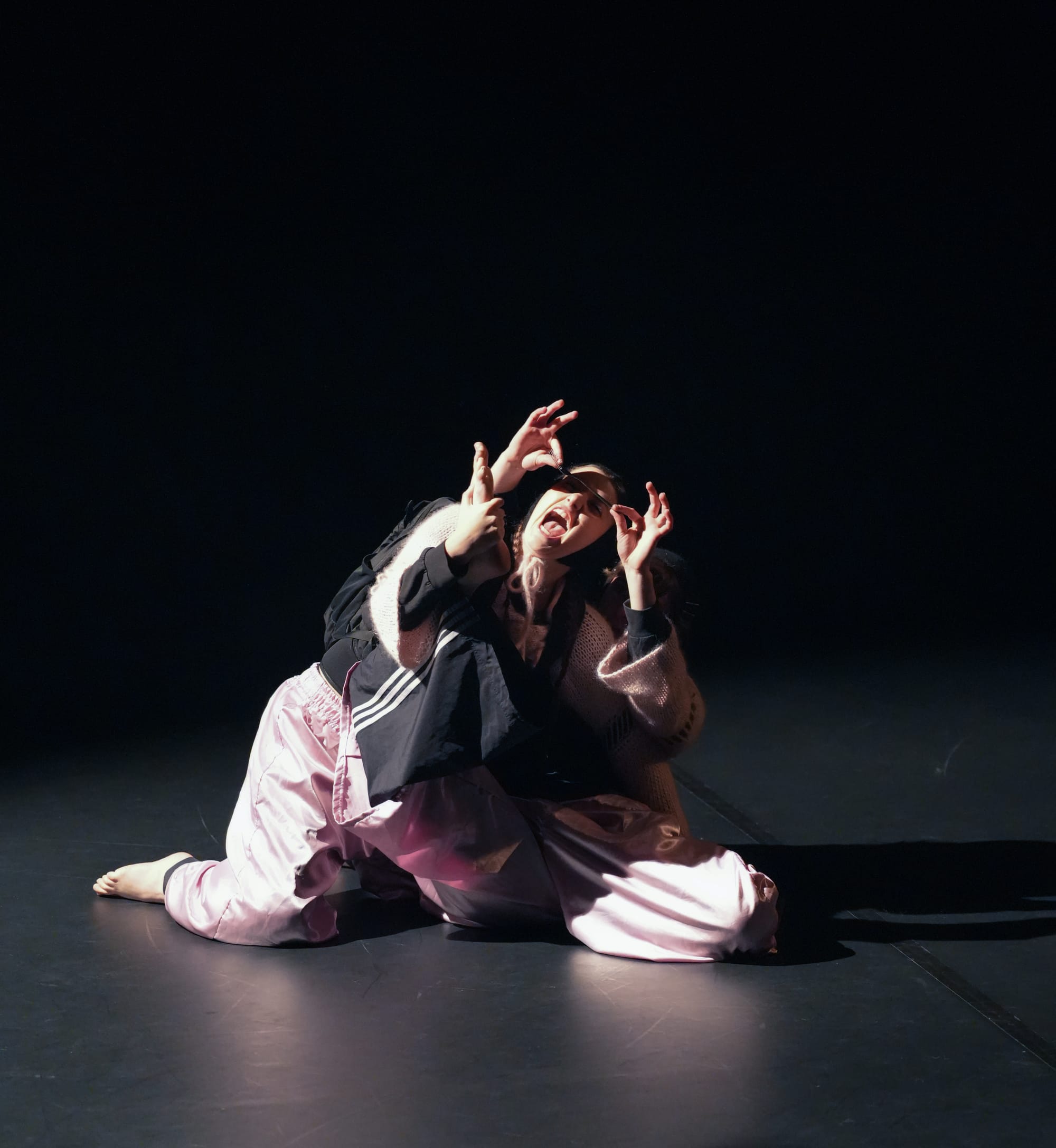
Afterwards, in the bathroom, I overhear two women discussing the performance. One says “I wasn't getting anything human from it”. I know what she means. These bodies are unmistakably human, and their intimacy is palpable, yet the world they inhabit seems to operate according to some other set of rules. Perhaps it belongs to the future. Perhaps it's been here all along, conducting its peculiar business just beyond our field of comprehension.
I think again of the man in the foyer, returning for another look. I understand him now. I'd like another hour in this peculiar world, watching its inhabitants go about their urgent work. I might even learn what some of it is for.
Already, some of its dark mystery has climbed inside me. I still feel it working away in there.
We wanna have a lot of forks in a backpack was performed at Dancehouse as part of Melbourne Fringe Festival between 14-17 October 2026. The production won the festival’s Best Dance & Physical Theatre Award and the Headroom Award, supported by RISING.
Disclosure: A complimentary ticket to We wanna have a lot of forks in a backpack was provided to Melbourne Stage Review for the purpose of review. Melbourne Stage Review retains full editorial independence.