A widening of the path: Not a Jam
Not a Jam gives the pleasures and dilemmas of contact improvisation an exquisitely judged theatrical shape. Speech, stillness, sound and shifting weight draw us into the intimacy of a shared practice, revealing how feeling at home in a body might become a way of belonging among others.

For a time before the pandemic, I spent nearly all my Saturday afternoons in a church hall in Fitzroy, learning to give other people my weight.
There were different facilitators each week, different ways of arriving in the body. We might begin with Alexander Technique, or attend to the small adjustments through which someone else’s touch becomes comfortable or even permissible. Once we began dancing, my awareness would sometimes gather wholly at the point of contact. A shoulder against a back, a shifting pressure: there was enough happening there to occupy me entirely.
I remembered these absorbing sensations while watching Not a Jam, Aimee Raitman’s thoughtful, sometimes cheeky, exploration of contact improvisation (or “contact”) at Dancehouse. I also remembered the small noises. Contact tends to be practised without music, leaving distinct sounds audible: breath, friction, a heavy footfall, small vocalisations of surprise and delight.
* * *
Raitman and Ned Nicolson arrive carrying backpacks and drink bottles, looking as though they have come for a jam. Belongings go to the side; outer layers come off, revealing clothes they can move in. Recorded voices, accompanied by the familiar sounds of bodies in motion, introduce us to contact and the Melbourne community that has sustained it for thirty years. Then the performers begin offering their own accounts of what they do, and why.
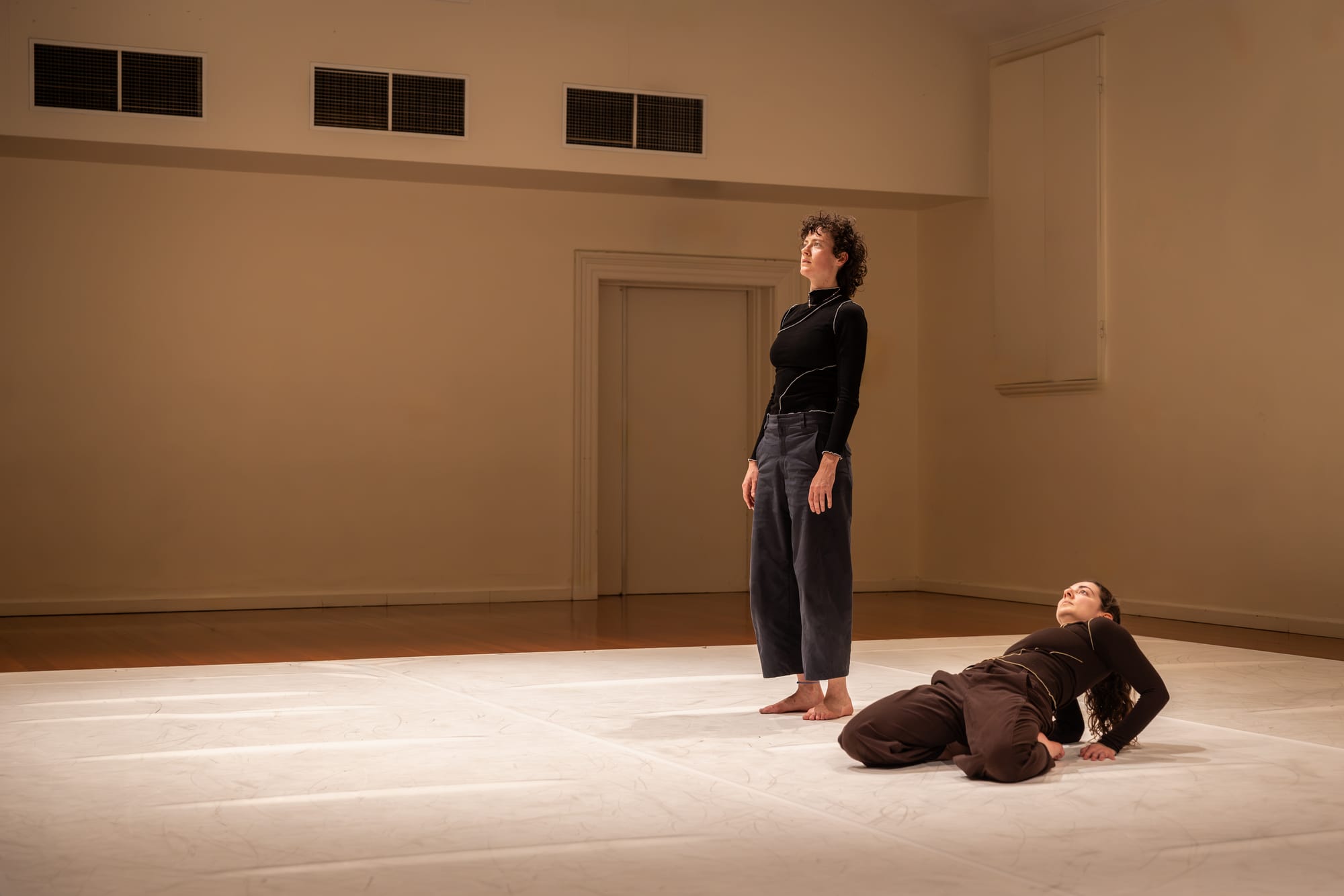
One speaks, moving on her own as she talks, then stops. Completely. Caught midway through an energetic gesture, she holds a shape. Each time, my eyes seem to travel a little further, then have to return to where she has stopped. The other continues speaking, circling the topic from a slightly different angle. Another account, another arrest. Thoughts circulate while bodies are briefly fixed in place.
Contact, we hear, offers a way into the “meat on our bones”: the substantial pleasure of having a body, with weight to feel and give. But there are disagreements about what else belongs in the encounter. Nicolson recalls being told that emotional expression and imagination had little place in a practice concerned with physics. What, then, are you doing when you imagine contact? How much can an idea change the way you move?
These questions have company. There are questions about community, inheritance, rules; about the desire to preserve something you love and the equally affectionate desire to see what else might emerge. Raitman and Nicolson turn these ideas over with the ease of people who have spent considerable time thinking through their bodies, and have yet to exhaust the subject.
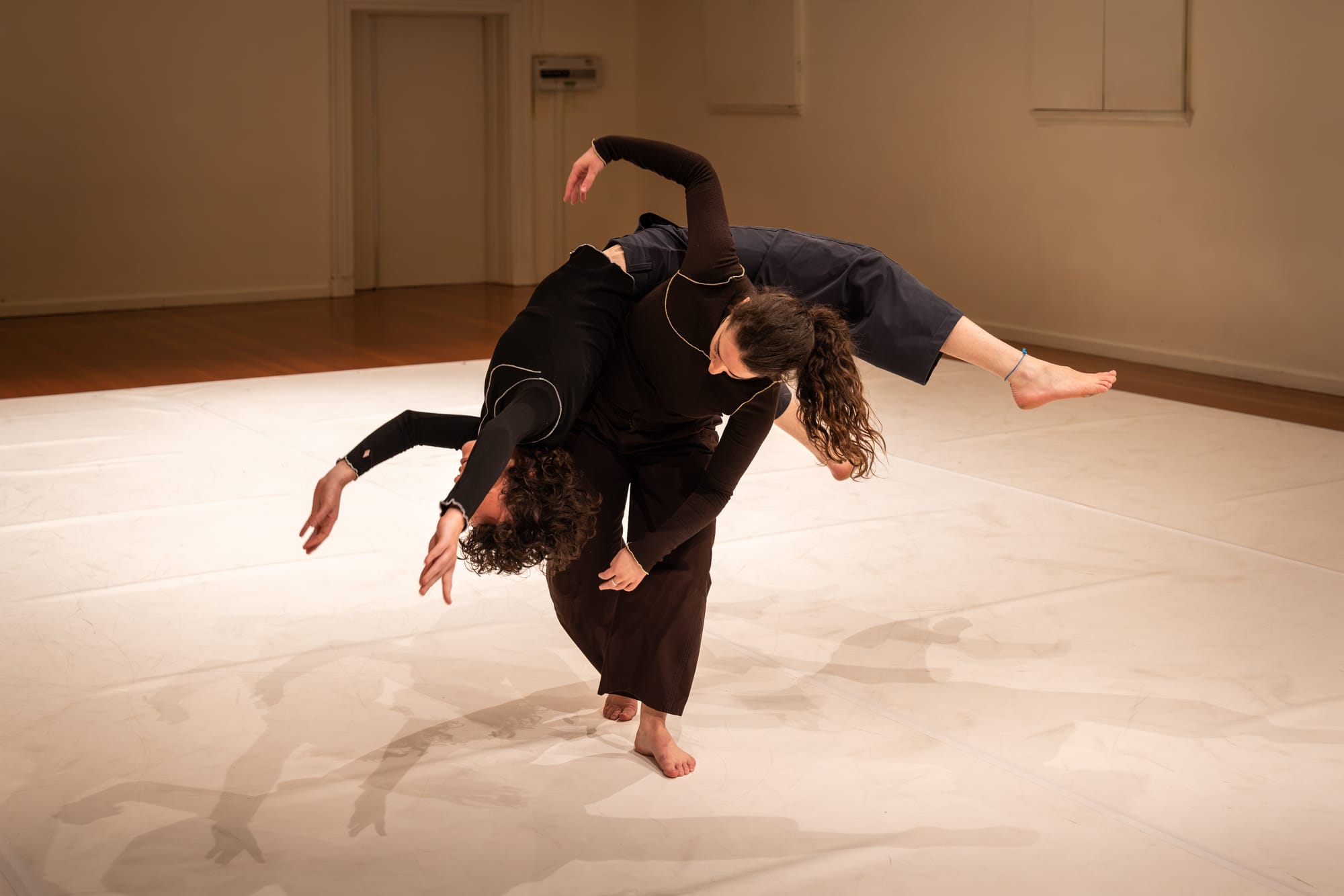
They are also alert to the practice's comic possibilities. Watching contact has been compared to watching white socks roll around in a tumble dryer. It is an excellent image to offer an audience currently engaging in this strange spectacle. Once planted, it is difficult to dislodge.
Then, dancing together, they begin talking over one another, two streams of thought continuing while weight passes between them and listening becomes its own small predicament: a phrase reaches me, another disappears, and meanwhile someone has somewhere to put a hip or slide an elbow. I stop trying to follow every word.
The dancing holds me. Much of it stays fairly close to the floor, with few of the spectacular lifts that can make contact look like an acrobatic proposition. Instead, there is a beautifully restrained simplicity. Bodies roll and fold, lean and accommodate. Separating again, the performers squirm across the floor with a loose, wormlike persistence; a limb encounters another limb, and the movement finds a shared course again. At moments they look directly at each other and sustain the gaze. These pauses are warm and intimate, and we are given time to notice them.
There is awkwardness, too. A balance involving a shoulder becomes precarious enough to prompt a small exclamation. Elsewhere, a hopping turn acquires a comic life of its own. The performers let us enjoy these things with them. Their seriousness has plenty of give.
As they discuss trust, I find myself remembering how much attention it takes to be carried. You cannot simply deposit your weight on someone and consider the matter settled. Even when the other person bears all of it, you are still participating: sensing where you are, where they are, what gravity may do next. Support remains an exchange.
We hear about contact as a practice for life, a practice in trust-giving and trust-receiving. Another account reaches back to a childhood love of dancing constrained by a parent’s concern about injury. Here, in adulthood, there is room to explore what the body might do. A discussion of safety makes space for risk, considering the conditions that allow people to attempt things and continue dancing as they move into their sixth or seventh decade.
Yet those conditions can become contentious. Rules that keep a practice available may also narrow it. Raitman and Nicolson describe competing attachments within the contact community: to its histories, its physical principles, its possibilities for development. The decision to choreograph can itself feel consequential, exposing the work both to fractious criticism and to the irony of planning for spontaneity.
Indeed, performance brings its own peculiar demands. A dance may need less time, or more time, than what is allotted to a show. An audience may be waiting for something impressive while the dancers are interested in a small development that has barely begun. There is also the unsettling business of being perceived. However carefully you attend to an encounter, someone watching may see something else entirely.
Not a Jam lets us feel the attraction of making a performance anyway. Callum Cheah’s sound design draws the recorded textures of dancing into a more rhythmic environment; Kyra Ryan’s lighting shifts the room’s focus with an elegant responsiveness. Beats and changes of light give the movement a pulse we can watch as well as hear.
The drink bottles are revisited. In low light, there is breathing, and time to register the bodies doing it.
Later, small pauses punctuate the dance. A shared movement proceeds, pauses, proceeds again. Contact’s characteristic flow is broken into brief sections, each interruption holding the dancers momentarily within something still unfolding. The pauses come faster. Momentum accumulates. What had looked halting eventually becomes fluid again.
By then, the claim that contact cannot be performed seems less interesting than the care with which these two people are performing it. Their choices make the encounter available to us: its physical negotiations, its humour, the pleasure of staying with something whose next development remains uncertain. The questions keep moving, too. Perhaps the practice has reached the widening of the path.
I loved being in this world again, hearing its small sounds and watching attention pass between bodies, discovering how the practice had travelled into the performers’ lives and how it ripples further. From my seat, I recognised the absorption I had once experienced on the church hall floor. I felt at home in the weight of my own body, and a sense of belonging among people who shared that same inexplicable feeling.
Not a Jam was performed as part of Melbourne Fringe Festival at Dancehouse, 14–17 October 2026.
Disclosure: A complimentary ticket to Not a Jam was provided to Melbourne Stage Review for the purpose of review. Melbourne Stage Review retains full editorial independence.