Notes from an unfinished exhibition
In Exhibition: First and Second, Caroline Lee offers a startlingly intimate glimpse of a performance still becoming — its uncertainty and workings laid bare.
At the end of Exhibition: First and Second, Caroline Lee bows. But it isn't quite the bow we are used to. At the corner of her mouth she gives away something slightly sheepish, almost questioning, as if to say: I hope that was okay?
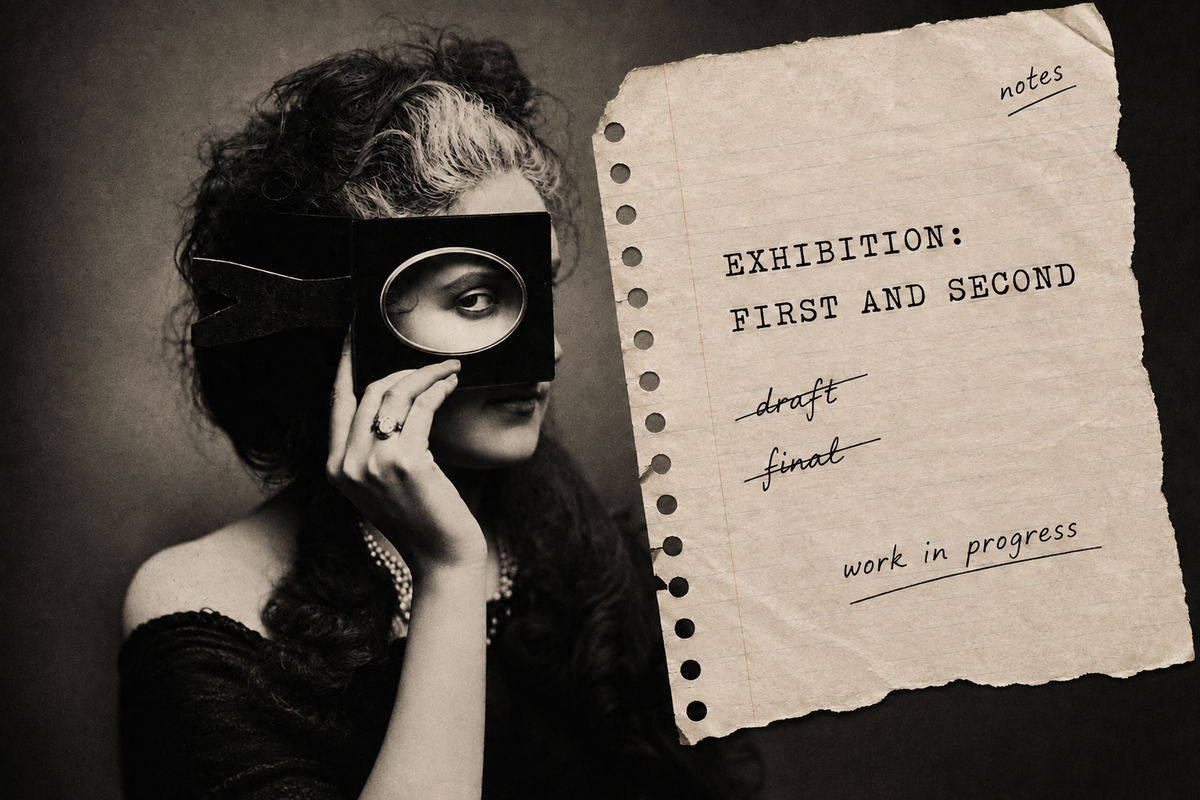
This is La Mama Explorations, a series in which everything presented is, by definition, unfinished. Lee performs with script in hand, its provisional state conspicuous: vast sections on some pages are crossed through with raw pen strokes. The palette is visible.
There is something startlingly intimate about being allowed to see it.
Before Lee enters, we see an enormous repurposed canvas backdrop hanging from a rail at the back of the stage, its long tail spilling into chaotic folds across the floor. We have to negotiate its rubble on our way to our seats. There is also a small dark-timber desk and lamp, books, framed family portraits, an old chair. Another chair will eventually emerge from beneath the canvas.
Lee enters barefoot in a white slip, clutching a white handbag. She approaches tentatively, puts on her shoes, finds a crumpled piece of brown paper on the floor, and reads.
What follows is a collage of women, images, memory and representation, drawing on Nathalie Léger's writing about women who have themselves made and inhabited images. Lee acknowledges the dizzying recursion: a woman playing a woman writing about a woman playing another woman. At times Lee plays Léger; at others, Léger's subjects.
The layers keep shifting. A nineteenth-century countess, La Castiglione, commands hundreds of photographic portraits of herself; Lee rolls through the poses in silence, first with infectious fascination and later with an almost aggressive exasperation. Barbara Loden writes, directs and stars in Wanda, a film inspired by the story of another woman, further blurring the boundaries between woman, character and image. Other women flicker through.
The work becomes easier to follow when you stop insisting on a narrative thread. Instead: follow Lee's attention. When some archival detail fascinates her, we lean towards it too. When she is amused, frustrated or frightened, the emotional logic remains clear even when the connections are not. Moving restlessly between narrator and subject, historical lives and imagined memories, Lee is a magnetic guide through the work's shifting layers, carrying us from fascination to frustration, fear and exquisite tenderness.
And then her own life enters the collage.
Her mother was a botanist. Lee reads from her book — a life compressed into a few lines of professional achievement. She imagines her mother as a child. Tasmania sits somewhere beyond a brick wall. She searches frantically for traces of her, left decades earlier in a guest book. Later, she becomes the daughter caring for her as death approaches. The gestures of care are exquisitely small: there you go.
All the while, Meg White's canvas design keeps changing. Under Laurence Strangio's direction, Lee walks across it, disappears behind it, crawls beneath it. It becomes costume and photographic backdrop; elsewhere, something suffocating. Its transformations are simple, precise and often startlingly beautiful.
Then it becomes breath.
Lee gently lifts a fold from the floor and lets it fall, her body slowly rising and falling with it. Again. Her mother's laboured breathing, made material in canvas and movement. It brought tears to my eyes.
Perhaps there is something particularly affecting about encountering such a moment before the work around it has hardened into certainty. We usually meet performers after the crossings-out have disappeared. Here, Lee is offering something deeply personal while still working out the shape in which to offer it.
That exposure feels extraordinarily generous.
I don't know what Exhibition: First and Second will eventually become. That is, after all, the point. But there is a peculiar privilege in being invited into a work while it is still becoming: seeing the uncertainty, the seams, the fresh edits — and watching it breathe.
Exhibition: First and Second is at La Mama HQ until 9 August 2026, as part of La Mama Explorations.