The clown gag inside the horror: Marginalia
Funny, disturbing and increasingly unhinged, Pummel Squad’s Marginalia uses grotesque clowning and poor theatre to expose a world warped by power, precarity and need.

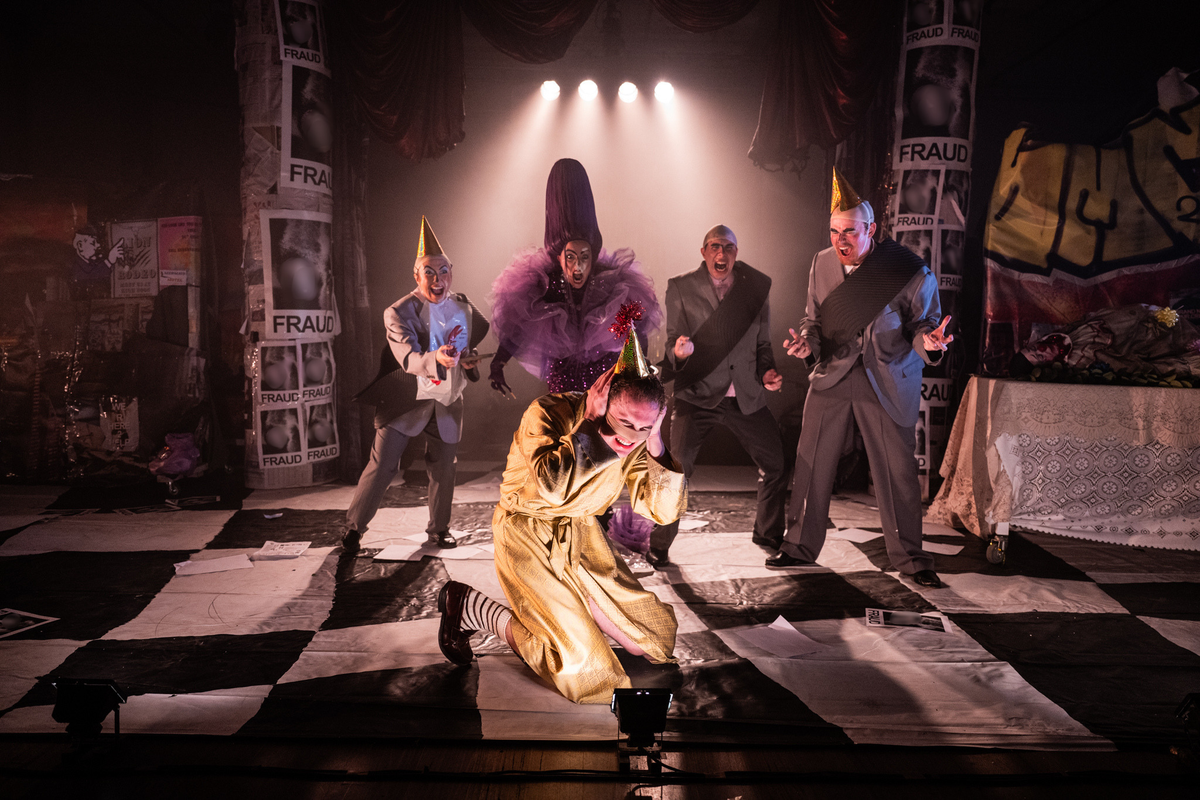
I leave Marginalia wound up like a spring, almost out of breath. There are, admittedly, a lot of stairs between the bowels of fortyfivedownstairs and Flinders Lane, but they aren't really to blame. I've just escaped the fever pitch of a deranged nightmare: funny, disturbing and possessed of a heady logic: better to laugh than cry.
That fever pitch is still some way off — it is a long jog to the first joke. Tyler (Ludomyr Kemp-Mykyta) runs in wide circles around the stage to Fatboy Slim’s Right Here, Right Now (I didn't time it, but I wouldn't be surprised if it were the full 6:27 track). Every transition in the beat registers somewhere in their body, however slightly: a shift in gait, a contortion of the mouth, a flick of the wrist in recognition.
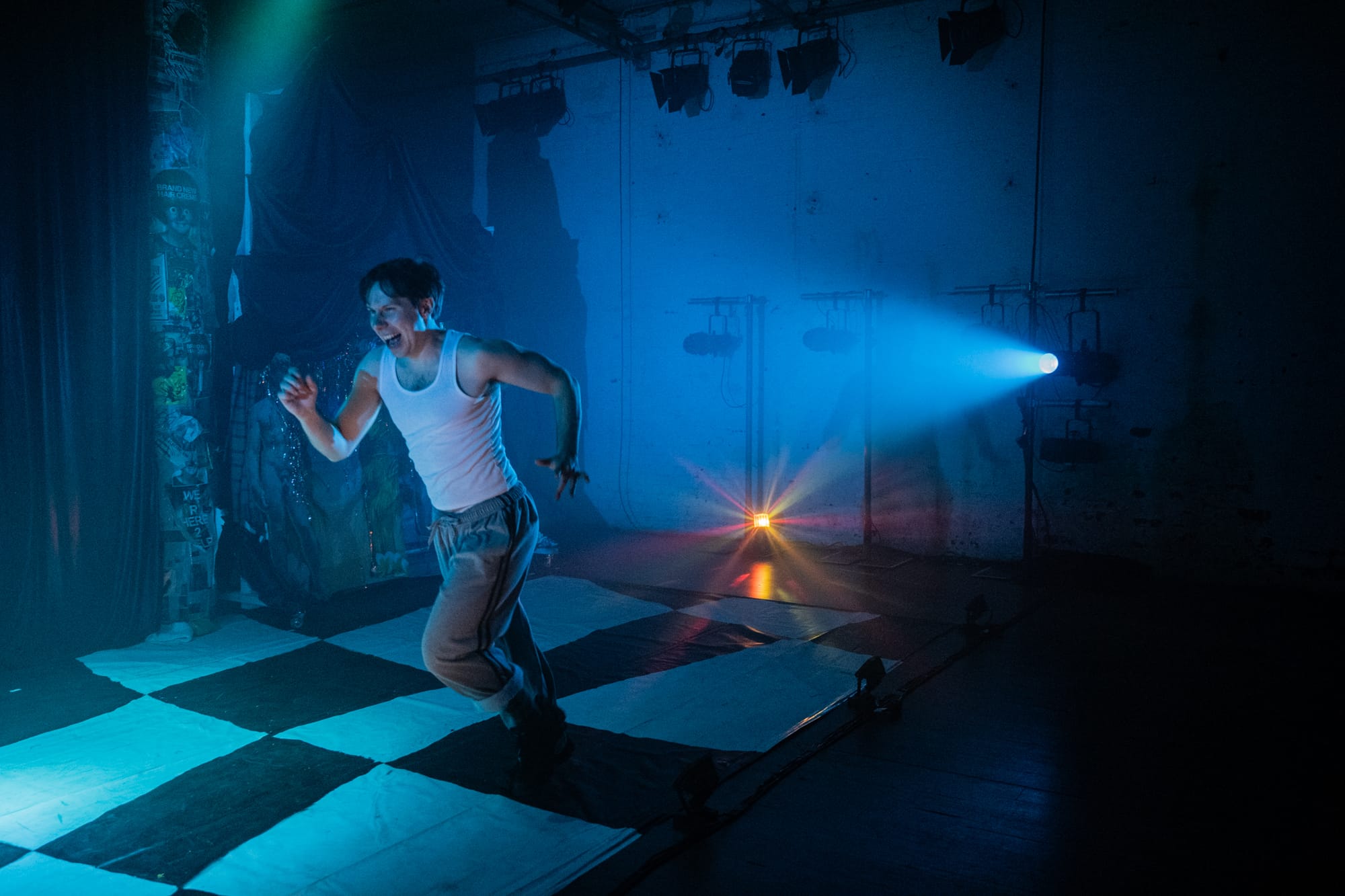
It ought to be banal. Instead, the repetition winds the room tighter. Nothing much is happening, but something surely must, and Kemp-Mykyta holds the audience inside that anticipation. Small ripples of laughter begin to break through — not because the running itself is especially funny, but because they are still running. And with such conviction.
When Tyler finally speaks, they confirm what they suggest we must surely have gathered already: they are a barber. They hate it. Like the rest of us, Tyler works because they have to; the job is merely a means to an end. What they really are, they explain with magnificent earnestness, is an artist. This — the running — is the art. And then Right Here, Right Now starts again.
By then, almost without our noticing, Pummel Squad has strapped us in for the ride. Two balaclava-clad figures carrying a semi-automatic weapon emerge from stage right; the irrepressible 'Clowno' (Molly Holohan) appears from the left. Tyler attempts to de-escalate whatever this is. They fail. Shots are fired. The temperature changes, and there is no going back: menace and hilarity will coexist until the end.
From here, Marginalia hurtles forward according to the logic of a nightmare. A disembodied voice begins narrating Tyler's actions as they eat a sandwich, first describing what is happening and then getting disconcertingly ahead of them: what's in the sandwich, what's in their mouth. A nose, it turns out. Gogol’s errant appendage belongs here to Major Pepsi (Cooper Donald McDonald), a fabulously wealthy government official whose absurdly expansive portfolio encompasses seemingly every arm of government — including, almost as an afterthought, the Arts.
Pepsi wakes noseless amid the imagined opulence of his bedroom, tucked into a shopping trolley dressed as a bed — the first of many ingenious lo-fi transformations in Savanna Wegman's design. From there, his search for the missing nose propels us through a civic landscape of socialites, bureaucrats, welfare recipients, police, prisoners, clergy and a prodigiously large nose with a mind very much of its own.
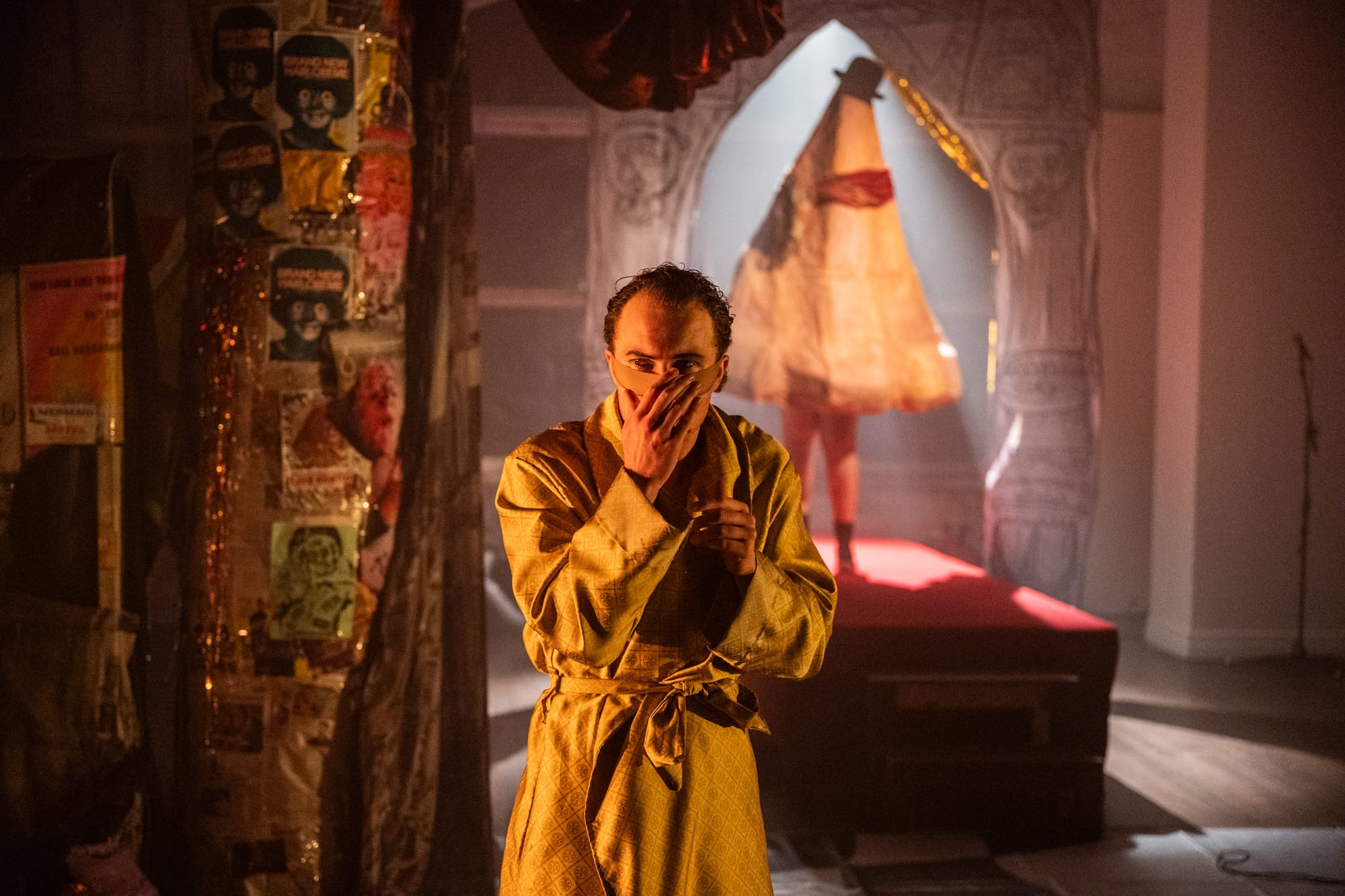
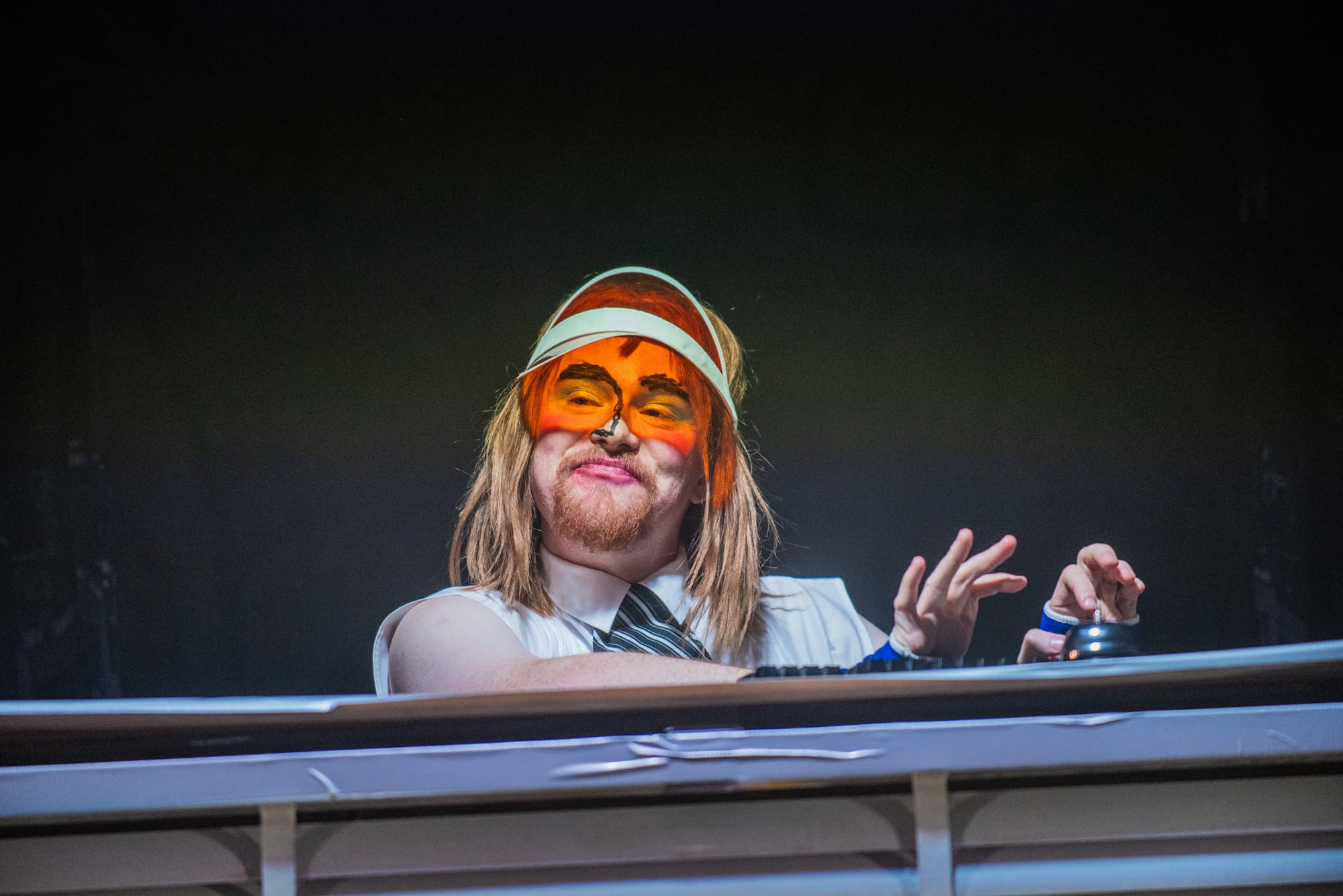
The aesthetic is gloriously ramshackle; the dramatic execution is anything but. Pummel Squad describes its practice as ‘poor theatre’, and Marginalia makes a virtue of theatrical scarcity. Rough-hewn set pieces are shifted, turned and repurposed in full view, continually remaking the space. White Y-fronts recur beneath increasingly outlandish costumes; faces acquire thick black cartoon noses, blue eyeshadow and smeared red mouths. As the nightmare escalates, so does the grime: makeup smudges, bodies dishevel, until the grotesquerie of this world seems written across the performers themselves.
Such apparent chaos requires formidable control, and director Katy Maudlin keeps the production’s escalating disorder on a tight rein. Kemp-Mykyta is magnetic. McDonald remains the fixed point as the ensemble transforms around him, giving Pepsi a potent combination of entitlement, vanity and childish desperation. Alexandra Aldrich is deliciously excessive as Pepsi's extravagantly coiffed mother, all hoity-toity vowels and mounting social horror. Moving through a succession of roles, AYA is particularly difficult to look away from: slight in frame but potent in movement, voice and presence.
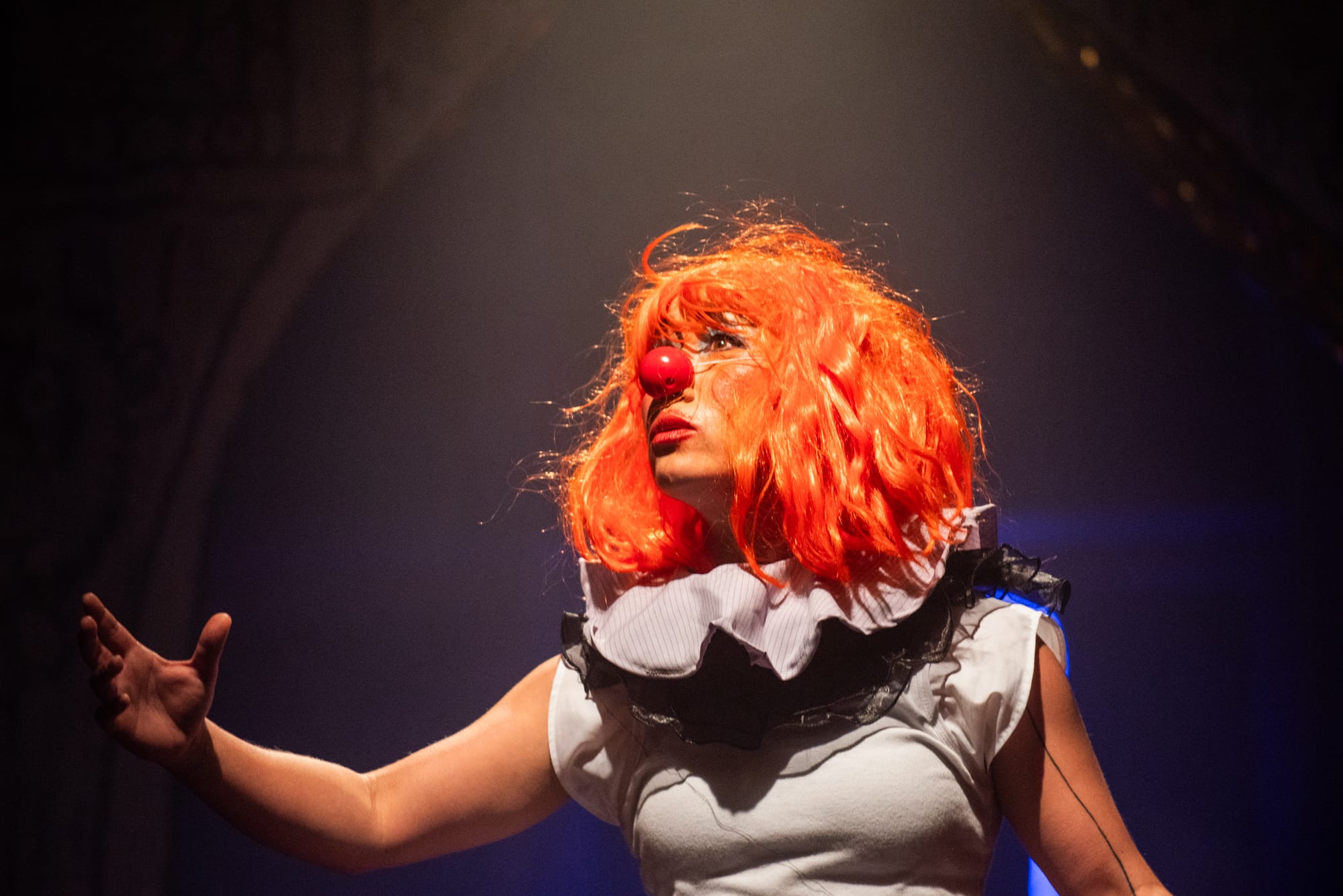
Across the ensemble, the rhythms of the form are impeccably handled: exaggerated faces, abrupt transformations, elastic accents and minute reactions are precisely timed.
The technical work is similarly assured. Justin Gardam’s sound design is particularly deft; music seems not so much to begin as to have quietly appeared, slipping scenes into familiar cinematic registers before we quite notice it happening. Amelia Lever-Davidson’s lighting can be unexpectedly beautiful amid all this grime: in the church, haze catches the light around the altar before an enormous nose on fishnet-clad legs emerges through it, like some gloriously profane apparition.
The satire finds its sharpest edge in a Centrelink-like welfare office, where Harry McGee is perfectly officious as a clerk perched above the supplicants queueing below. Nonsensical government forms are dispensed through horizontal blinds below him.
There is no sentimental portrait of the downtrodden here. Their needs are various, sometimes ridiculous, sometimes painfully ordinary. When Pepsi's insistence that — I need help — is taken up around the room, the phrase begins to exceed his own absurd grievance. Everyone needs help. What begins as one powerful man's demand becomes, almost despite him, a collective cry.
Elsewhere, the joke stops being quite so easy to laugh at. AYA's Police Superintendent periodically slips behind hanging yellow plastic strips; screams follow from somewhere we cannot see. In conversation with Pepsi, they reel off the policies he has authorised, each accompanied by the turning of an imaginary wheel or pulling of a lever — and another blood-curdling scream. The distance between bureaucratic authority and what is done in its name suddenly becomes horribly short.
It is here that something more painful begins to register beneath the farce, though Marginalia never gives that pain an easy place to land. There is little conventional pathos: instead, the unease accumulates across the world Pummel Squad has built.
At times, that relentless grotesquerie approaches saturation; the brutality of the Superintendent sequence, in particular, comes perilously close to overwhelming the comic frame around it. The laughter drains from the room. Watching Pummel Squad dance along that edge is electric.
And still, Marginalia is very, very funny. Pummel Squad keeps finding the clown gag inside the horror and the horror lurking inside the clown gag. Just as an image threatens to become unbearable, it can collapse into slapstick; a political grievance can balloon into ridiculous spectacle. The laughter offers little relief. Instead, it propels us through a world becoming ever more unhinged.
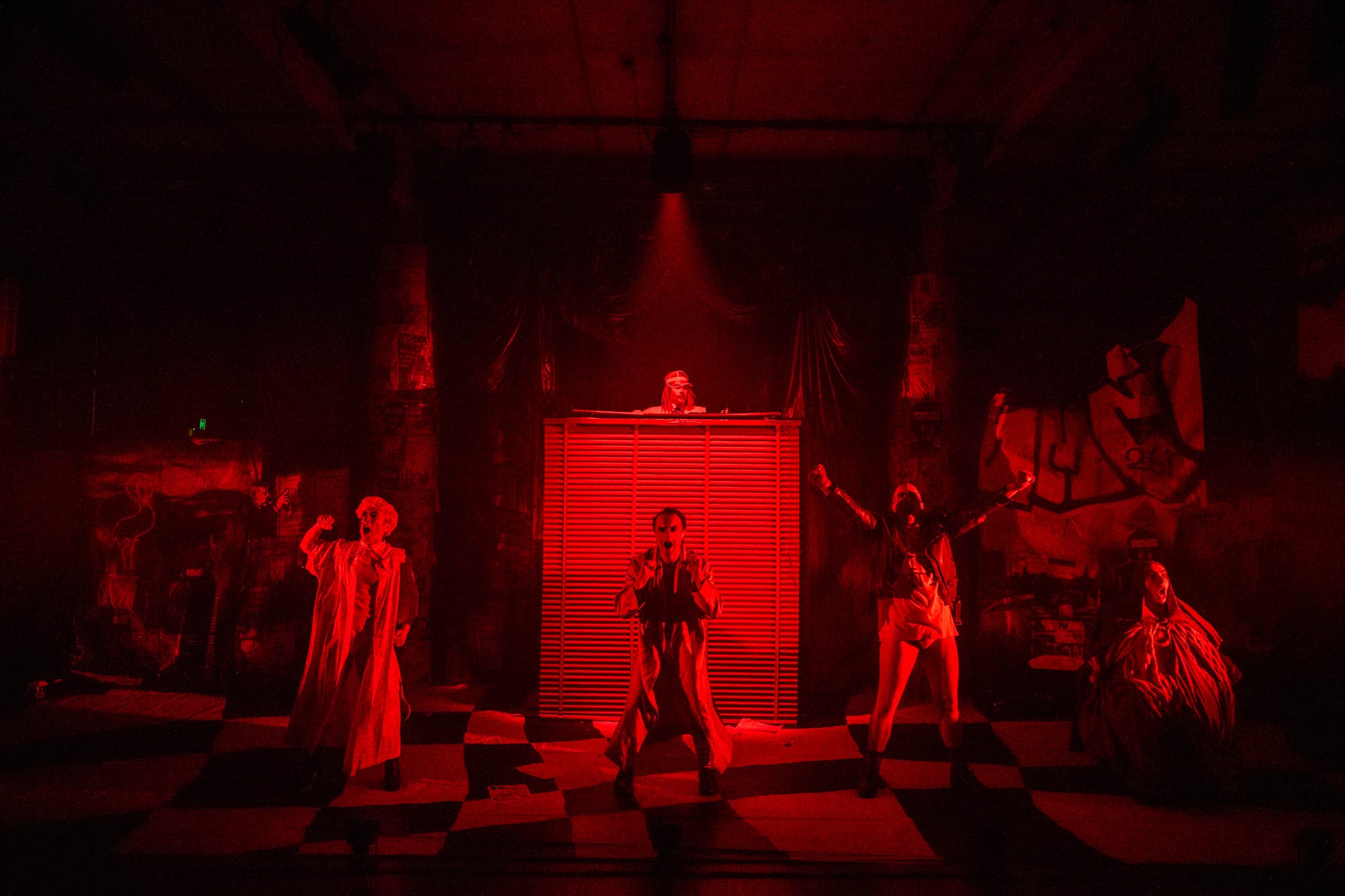
For all its cartoonish exaggeration, there is something horribly recognisable in the world Pummel Squad has assembled. Wealth accumulates at the top while everyone else queues to ask for help. Political authority is sufficiently removed from its consequences that those who exercise it need never witness them. Paid work, Tyler has already suggested, is something endured to make possible the life one actually wants; art is tacked onto the end of an impossibly long list of government portfolios. Even revolution proves vulnerable to vanity, spectacle and self-interest.
With a Victorian election approaching amid a political climate increasingly animated by disaffection, grievance and distrust, all this carries an uncomfortable contemporary charge. Marginalia takes aim everywhere, but its targets are connected by a common question about who gets to need, who gets heard, and who has enough power to make their own need everybody else's problem.
Perhaps this is why the pain amid all that hilarity is so difficult to pin down. It resides less in any one character than in the world accumulating around them. There is something close to despair simmering underneath Marginalia, but Pummel Squad refuses despair's solemnity. Instead, they make it ridiculous, excessive, violent, vulgar — and extraordinarily entertaining.
Eventually, they let us go. I climb back out onto Flinders Lane. The night is comparatively quiet; there is air again. I head towards the tram stop. Barely a stone's throw away, 101 Collins rises above the city. After Marginalia, it looks just a little more grotesque than I remember.
Marginalia plays at fortyfivedownstairs, 45 Flinders Lane, Melbourne, until Sunday 16 August 2026.