This Is Our Youth: Boys behaving badly
Stolen money, childhood toys and a great deal of misplaced confidence: Maeve Hook’s perceptive and superbly performed production of This Is Our Youth finds fresh urgency in Lonergan’s decades-old portrait of young men who inherit ideas about masculinity they scarcely understand.


Warren has arrived with fifteen thousand dollars in stolen cash and a suitcase full of childhood toys. It's an unusual inventory for a young man on the run from his father, though he seems to have given more thought to what he's taking than to where he's going. The money belongs to his father's criminal enterprise, the toys to an earlier, happier version of himself, and neither is likely to remain in his possession for long. He has brought them to Dennis, an old friend and a cocaine dealer of modest accomplishments and magnificent self-regard. Dennis takes one look at the money and begins scheming. The idea is to buy a quantity of cocaine, sell it at a profit and return the stolen money before Warren's father notices. Naturally, the caper goes belly-up.
Kenneth Lonergan's This Is Our Youth, written in 1996, takes place in a Manhattan apartment in the early 1980s, where two young men from wealthy New York families are busy squandering the considerable material advantages of their upbringing. Dennis (Amir Antoine) has acquired the vocabulary of a man who knows things, though the things themselves remain elusive. Warren (Lachlan Herring), two years younger, is an altogether less finished article. His limbs have a habit of arriving before the rest of him. When Jessica (Emily O'Brien) shows up, Warren's attempt at flirtation includes an earnest enquiry into whether she's a particularly enthusiastic cigarette smoker.
There is great pleasure in Lonergan's language, in its extravagant detours, its peculiar collisions of the grandiose and the idiotic. At times, the actors talk over one another in passages of exquisitely choreographed interruption, the sort of conversational bedlam that must take an absurd amount of rehearsal. Antoine's Dennis has an almost priestly conviction in his own authority, even when he's explaining something transparently absurd. O'Brien's Jessica has a sharp wit and a healthy appetite for getting her own way, though Warren presents something of a puzzle. She's attracted to him, despite considerable evidence that he has no idea what he's doing. When they dance, Herring flings himself about with such happy abandon that, for a few glorious moments, Warren's awkwardness becomes a kind of genius.
Director Maeve Hook knows when to let the chaos take over and when to leave a character quite alone. A perfectly misdirected football pass sends everything on a shelf crashing into the kitchen sink, destroying a sculpture of two women kissing made by Dennis's girlfriend, and quite possibly taking their relationship with it. Telephone calls are conducted in an isolated wash of light. The evening is long, with an interval, but the actors' command of its shifting rhythms makes the time pass quickly.
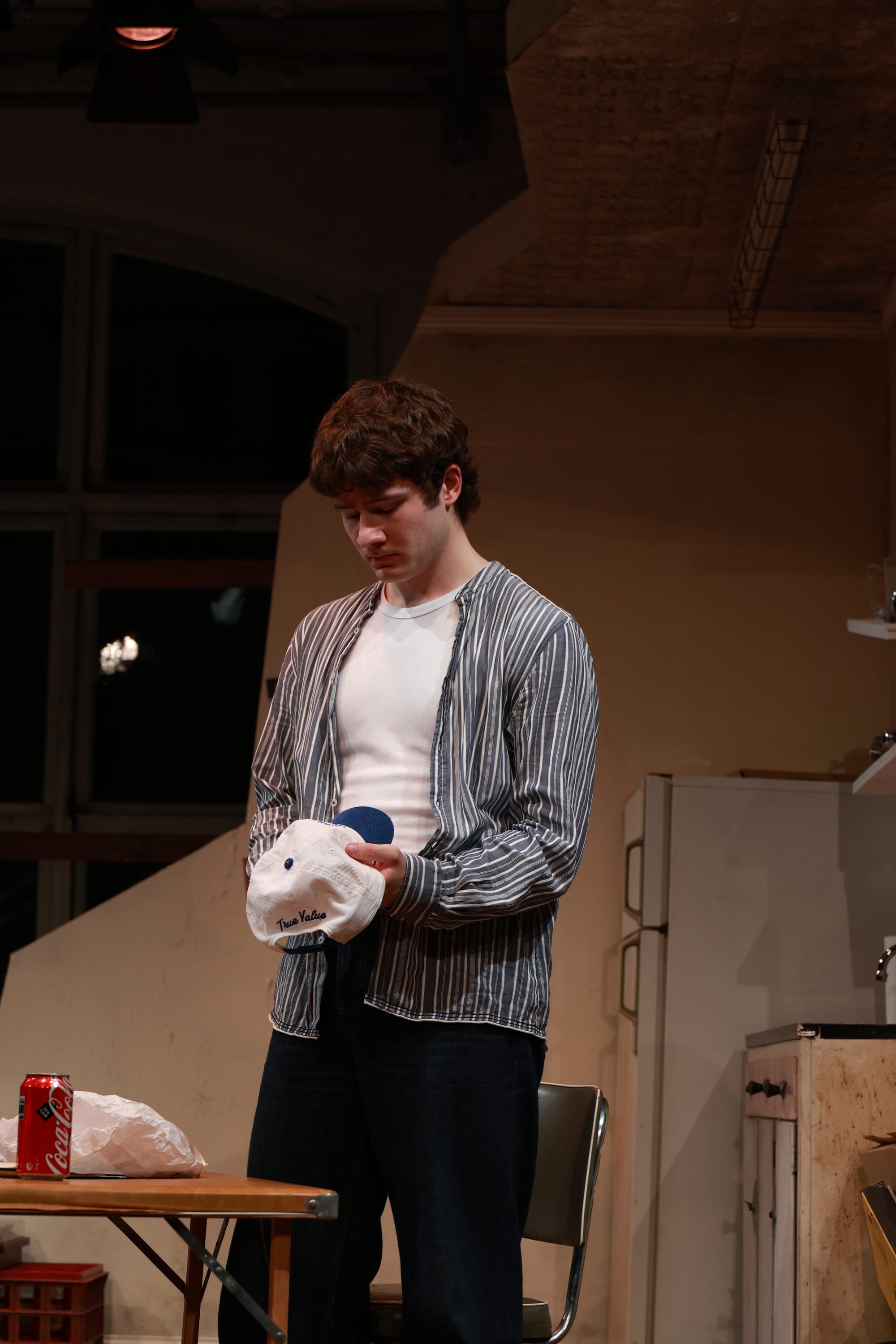
It is tempting, amid all this splendid foolishness, to overlook the nastier habits these young men are acquiring. Dennis has an elaborate system for dealing with women. When his girlfriend becomes angry, he becomes angrier, until she retreats. He explains this with the satisfaction of a man imparting a useful household tip. His treatment of Warren follows much the same principle: insult, intimidate, occasionally deliver a punch in the guts. Yet Dennis is rather less formidable than his performance of authority would suggest. The death of a friend sends him into a frenzy of anxiety and self-advertisement, as he imagines the great crowds that would attend his own funeral. For a moment, all that noise begins to sound rather lonely.
Warren is easier to love, which may be why we're slower to recognise what he's capable of. His father is violent; his sister was murdered by a much older boyfriend. He accepts Dennis's treatment with the bewildered loyalty of a dog that keeps returning to an unkind owner. Then Jessica hits a nerve, and the amiable, ungainly boy we've been cheering on becomes someone else. His anger has none of Dennis's noisy theatricality. It is cold, seething, and directed at a woman who, until moments earlier, had every reason to believe herself safe with him.
When Warren's father finally tracks him down by telephone, Herring seems to shrink inside his own body before sinking into a chair. The boy who can terrify Jessica is still terrified of the man waiting at home. And home, we discover, is where he intends to return. There is a meek capitulation in the decision, something horribly circular, though Lonergan is too fascinated by his characters to reduce them to a cautionary tale.
There are many ways of learning to be a man, and these two appear to have had particularly unfortunate tutors. Dennis, who appears to have drunk rather deeply from the Reaganite Kool-Aid, complains that his mother has reduced him to “emasculated mincemeat”. He has made something of a hobby of ensuring nobody else gets the upper hand. Warren's education has been less theoretical. Between his father's fists and the man who murdered his sister, he's had rather more instruction than any boy ought to need.
One might have hoped, in the thirty years since Lonergan wrote This Is Our Youth, that we'd become rather better at teaching boys how to live alongside women. Apparently the syllabus remains under review. There is a temptation, when confronted with young men behaving badly, to begin immediately with the corrections. A little less of this, please. None of that. Quite right, too, as far as it goes. But Hook's production suggests the limits of a conversation conducted entirely in reprimands. Lonergan gives us nearly three hours in which to discover what these boys love, what frightens them, whose voices they've mistaken for their own. We begin with Dennis's magnificent conceit and Warren's hopeless social graces, and find ourselves somewhere rather less comfortable, among the fears and humiliations that have helped to make them who they are and who they seem to be becoming. It's possible to condemn their behaviour without knowing very much about them. Indeed, it's considerably quicker. Lonergan takes the longer route, following their boasts and evasions, their small acts of tenderness, their ridiculous attempts to impress one another, until we begin to recognise – beneath the problems awaiting correction – people whose problems have a history. It is an extravagant amount of attention to pay to two young men who have made such a mess of things. Perhaps that's precisely the point.
Lunatix Theatre’s This Is Our Youth plays at fortyfivedownstairs until 15 November 2026.
Disclosure: A complimentary ticket to This Is Our Youth was provided to Melbourne Stage Review for the purpose of review. We retain full editorial independence.