Manifesto of Silences: When silence moves
Irene Holub’s Manifesto of Silences is an exhilarating reimagining of opera, where signing bodies, shifting images and vibrations beneath the seats create a work of extraordinary beauty, anguish and tenderness.
Before anything happens onstage, something stirs beneath my feet. A low vibration travels through the seating bank, gathering strength, then subsiding. Later, the sensations become lighter, quicker, almost effervescent, like tiny bubbles rising through water. I can hear the music, but I find myself listening with my legs.
This is an opera. Just not one that begins with an audible voice.
Created and directed by Deaf artist Irene Holub, Manifesto of Silences brings Auslan poetry, Visual Vernacular, dance, sound and projection into an extraordinarily rich theatrical conversation. Presented at Arts House as part of Melbourne Fringe, it traces histories of Deaf language and its suppression while proposing something altogether more expansive: an opera in which the signing body takes centre stage.
* * *
Two figures approach one another across a translucent screen. They are mirror images of the same person, moving from opposite directions until their bodies begin to overlap. They meet, separate, meet again, never quite resolving into one. Behind them, another projection surface creates a strange sense of depth, as though the figures might pass through one another and disappear.
Then Walter Kadiki appears.
His hands move rapidly, then hesitate. His face tightens; his body seems to draw inward before opening again. Small sounds escape him, scarcely more than breath. There is delicacy here, but also fear, frustration, a mounting urgency. His signing seems to gather force until the whole body is caught up in it.
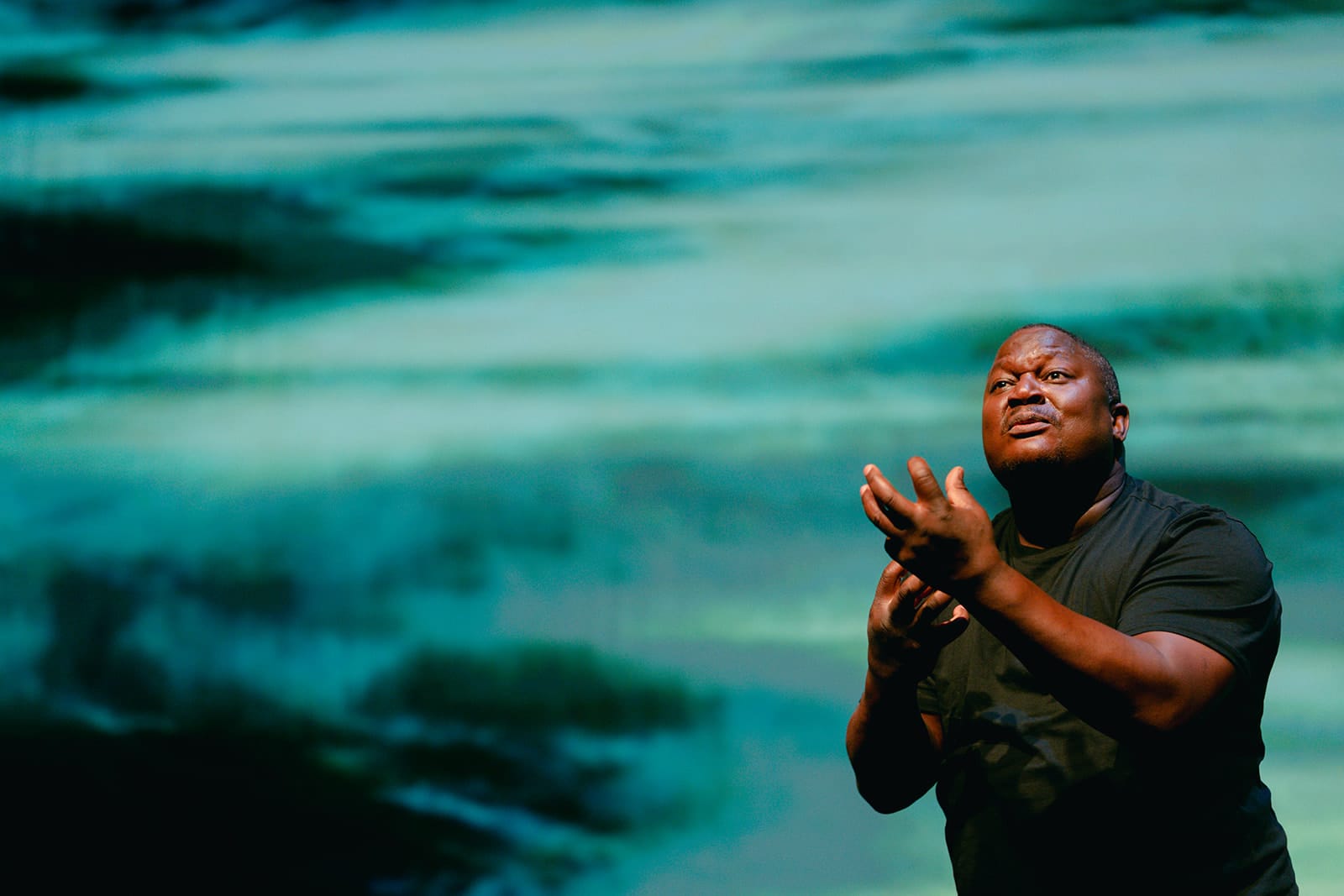
I don't understand Auslan. I know that Kadiki is communicating something specific, something I cannot fully access. Yet I am absorbed by the shifts in his movement, the way an expression flickers across his face or a gesture changes its weight. The performance seems intensely legible as feeling, even as its linguistic meanings remain beyond me.
There is something operatic about its scale. Not the sound, particularly, but the physical extravagance of expression: the face, hands, shoulders and torso all working together, each movement shaped with an exactness that makes its emotional force seem enormous. Kadiki's performance has the sweep of an aria, its moments of restraint as affecting as its more expansive passages.
The work moves between historical episodes and more elusive, associative sequences. Three figures in period dress advance slowly before a projected celestial diagram. The image changes to a globe.
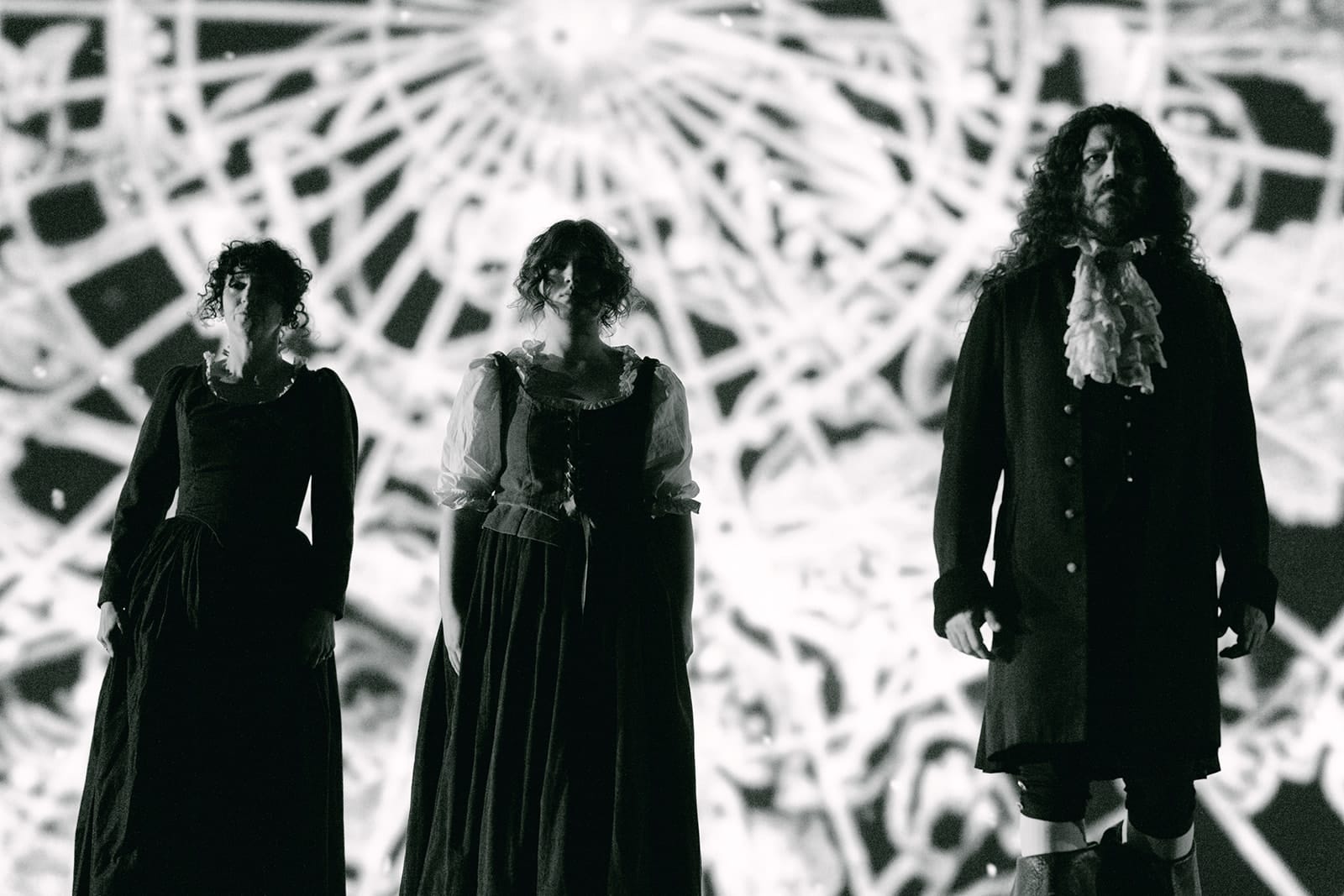
They turn around one another, forming and reforming a small circle, their gestures delicate and measured. A French phrase appears on the screen, offering a glimpse of the scene's historical setting: eighteenth-century France, where Abbé Charles-Michel de l'Épée helped establish a tradition of Deaf education using sign language.
At times I watch the signing as I might watch dance, following the direction of a hand or the changing distance between bodies. I know there is more happening, but this knowledge doesn't diminish the experience. It makes me look harder.
A projected word becomes a clue. An archival photograph illuminates an earlier gesture. Meanings arrive late, sometimes several scenes after the moment to which they seem to belong. Others remain uncertain. There is pleasure in this continual adjustment, in watching a work that allows my understanding to be partial and still offers so much to see.
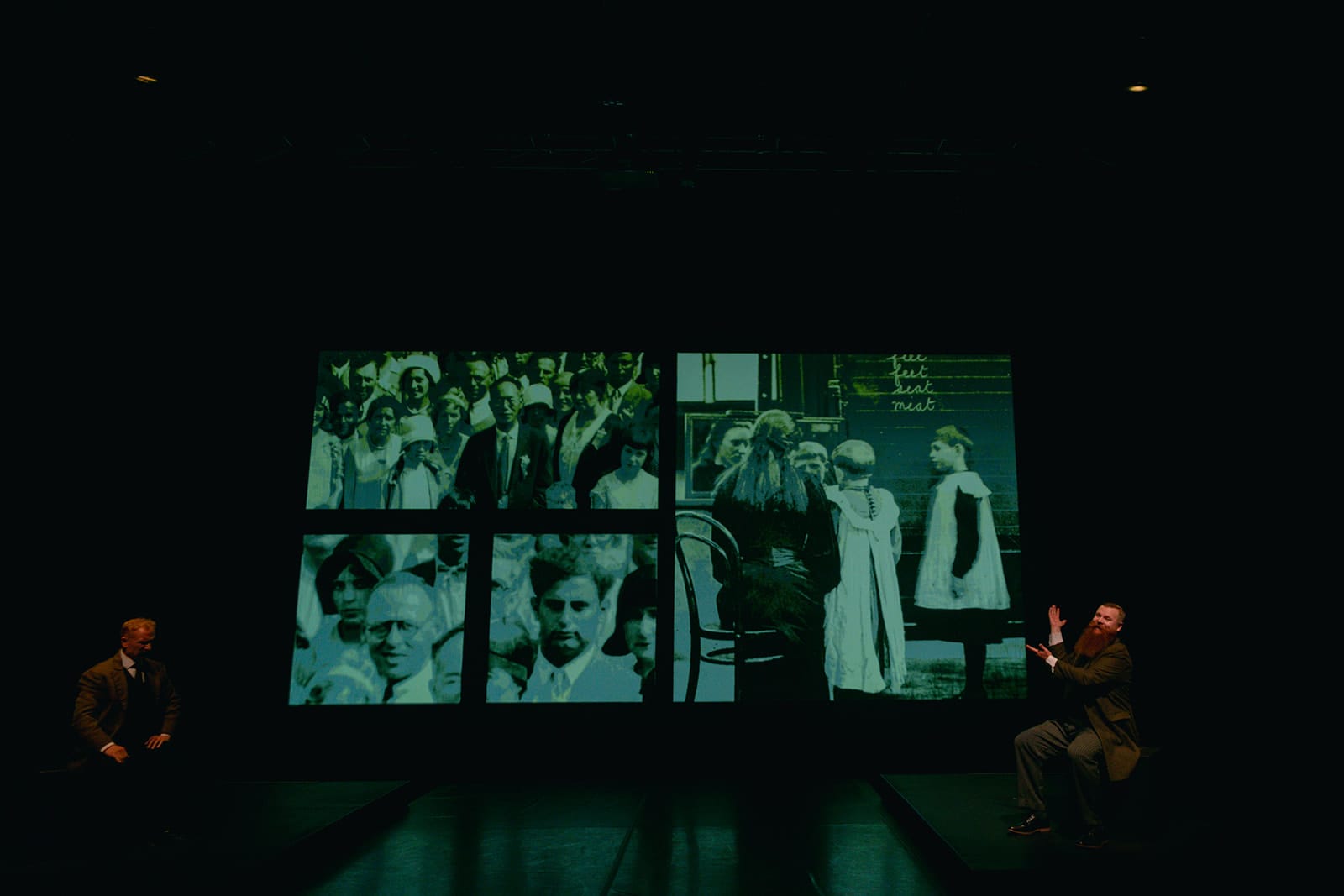
The historical imagery grows more troubling. Children appear in photographs, learning to form sounds through methods that now seem both ingenious and cruel: feeling vibrations in another person's throat, holding mirrors before their mouths, watching the shapes made by lips. Images of the telephone follow. Then the 1880 Milan Conference, whose endorsement of oralist education helped legitimise the suppression of signed languages.
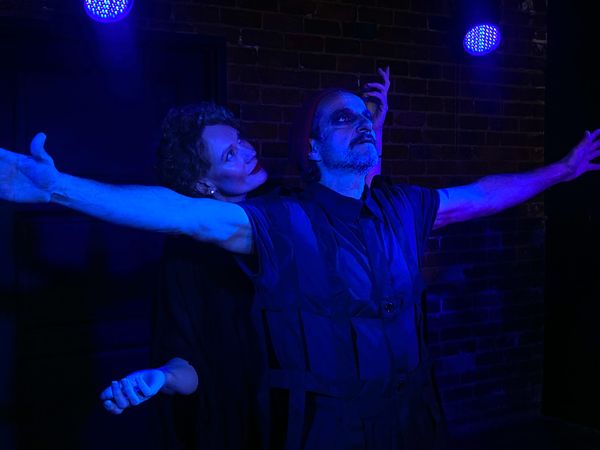
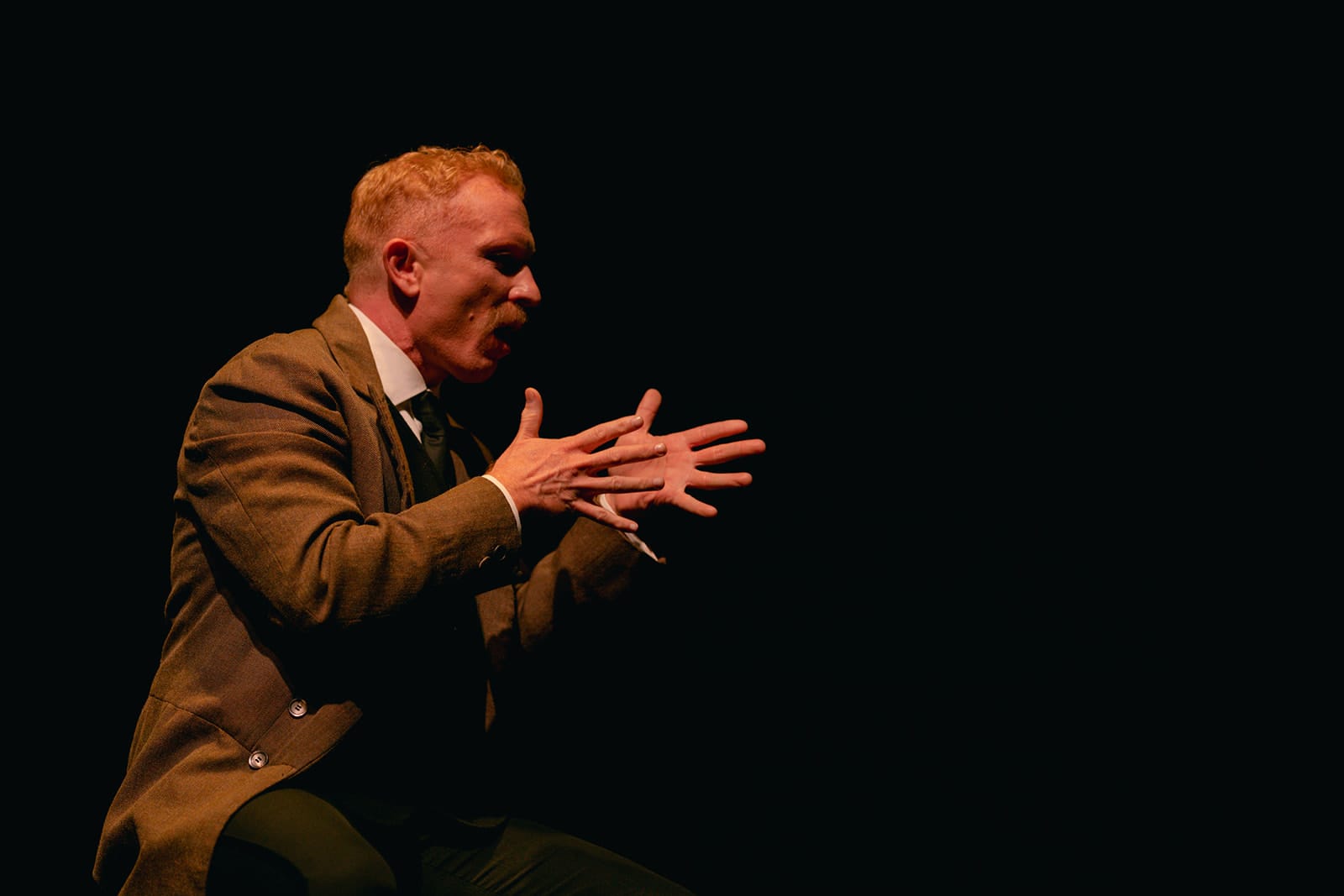
Two men argue. One is sharp and emphatic, his gestures insistent, his body almost rigid with conviction. The other has a more open, expansive manner, seeming to appeal to those around him. Their signing differs not only in tempo but in the way each occupies the stage. One presses his argument forward; the other seems to gather people towards him. The precise exchange escapes me, but the conflict is unmistakable.
Rhian Hinkley's projections move between documentary evidence and something more elusive. An ocean returns again and again, sometimes recognisable, sometimes obscured by layers of mist-like distortion. Archival portraits loom behind the performers; bodies multiply and dissolve across the screens. The images have their own rhythm, occasionally clarifying the action, elsewhere drawing it into uncertainty.
Sharyn Brand's sound design works just as restlessly. Deep tones press through the seats. Chords arrive with spaces between them, each separated from the next by a moment of quiet. At other times the sound becomes dense and slightly distorted, almost too much for the ear to contain. The vibrations shift in texture and intensity. I begin to wonder which parts of the score can be felt as distinctly as they can be heard, and how differently the work might unfold for someone whose experience of sound is primarily tactile.
Then Anna Seymour sits down on a chair.
A red light flashes across her body, abruptly illuminating and releasing her. Behind her, a woman's face appears in projected footage. She is demonstrating the formation of sounds, her mouth opening and closing in careful, repetitive movements. The image enlarges. It repeats. The mouth grows bigger, blurrier, until it begins to dominate the space.
Seymour moves.
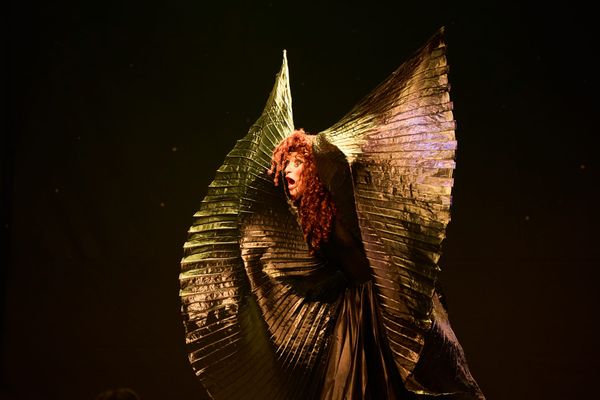
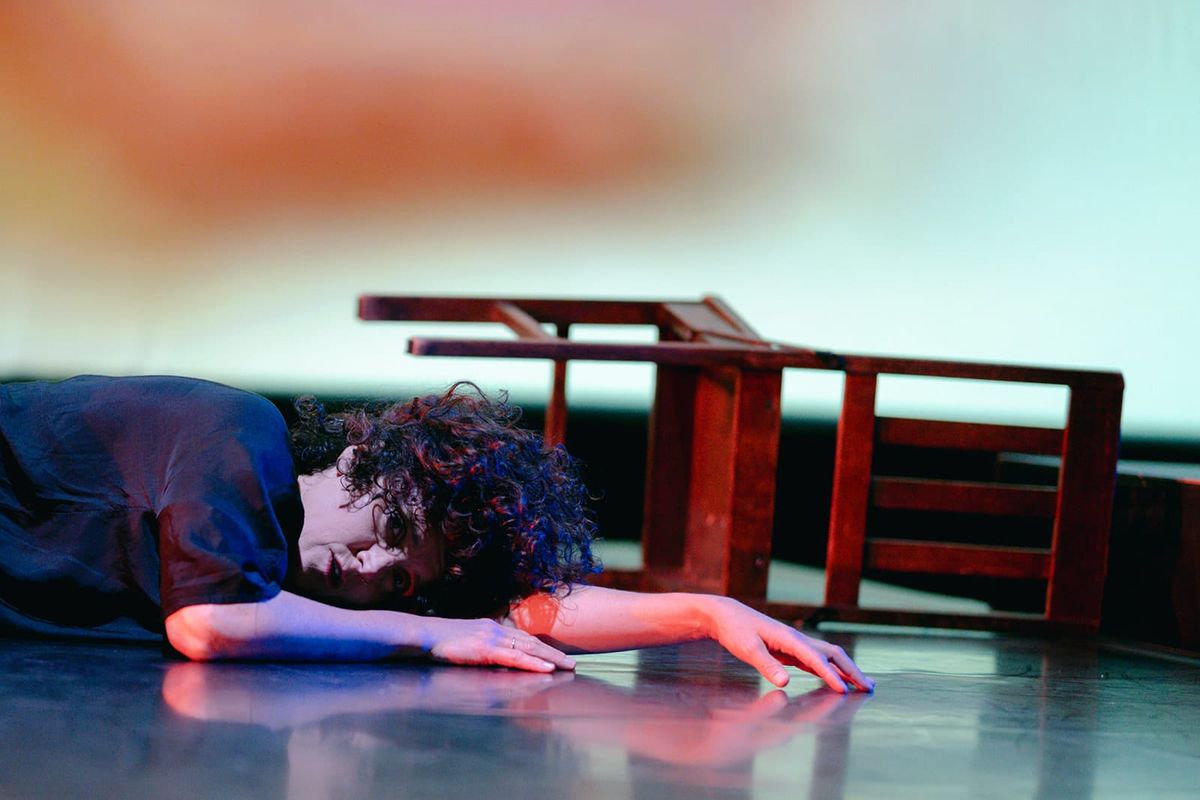
Her arms sweep outward with startling force. Her fingers spread, rigid and extended, as though dragging across an invisible surface. Her hands fly to her head. She folds, rises, turns. Then she lifts the chair and spins with it, circling again and again before setting it down. Her body drops to the floor, rolls, struggles upwards, falls once more.
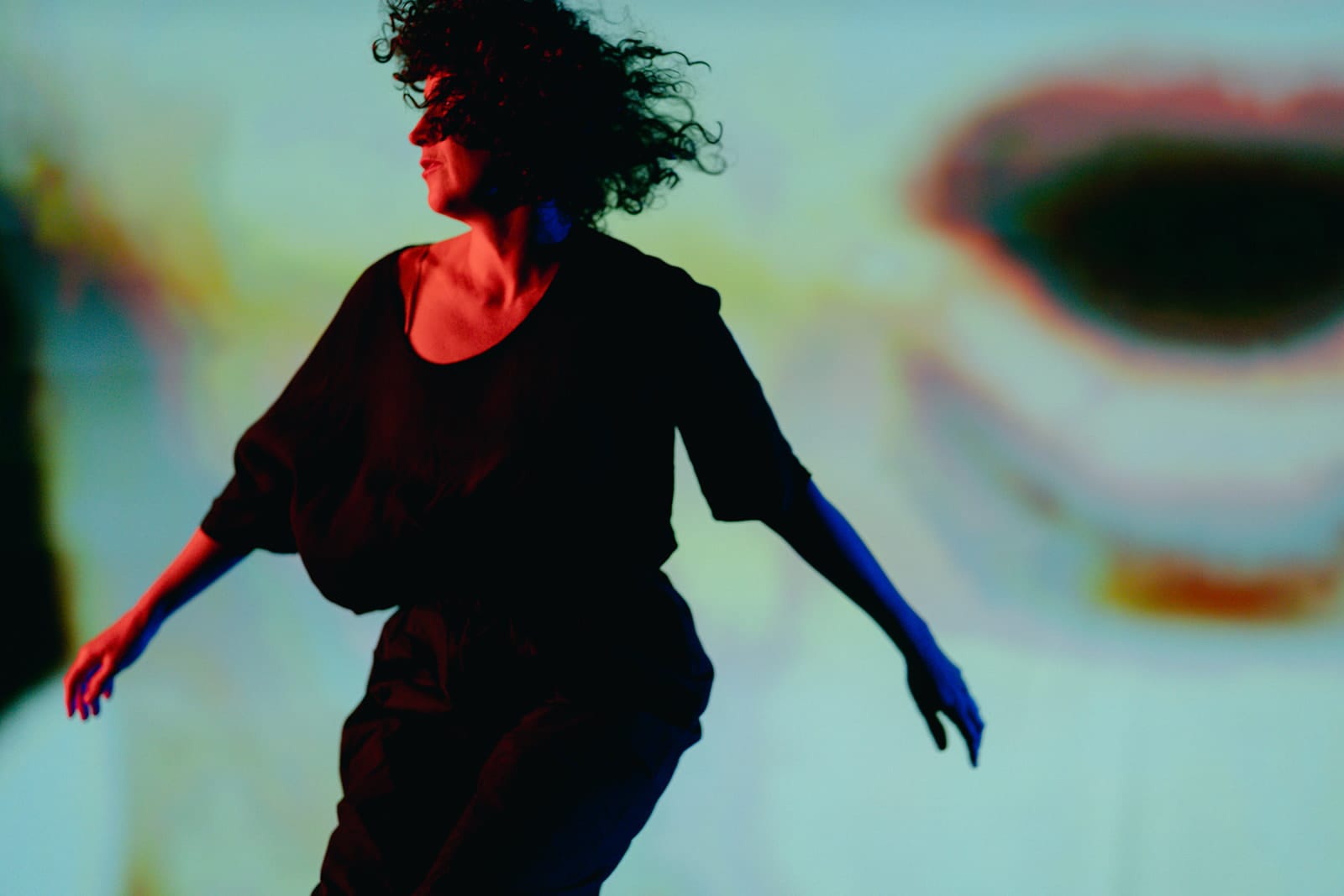
Behind her, the mouth continues its patient demonstration.
The contrast is almost unbearable. On the screen, the careful repetition of a prescribed action; below it, a body that seems unable, or unwilling, to contain what is happening to it. Seymour's movements are furious, but not indiscriminate. Each sudden change of direction, each contraction and release, has a terrible clarity. At last she lies on the floor, breathing.
Walter Kadiki enters.
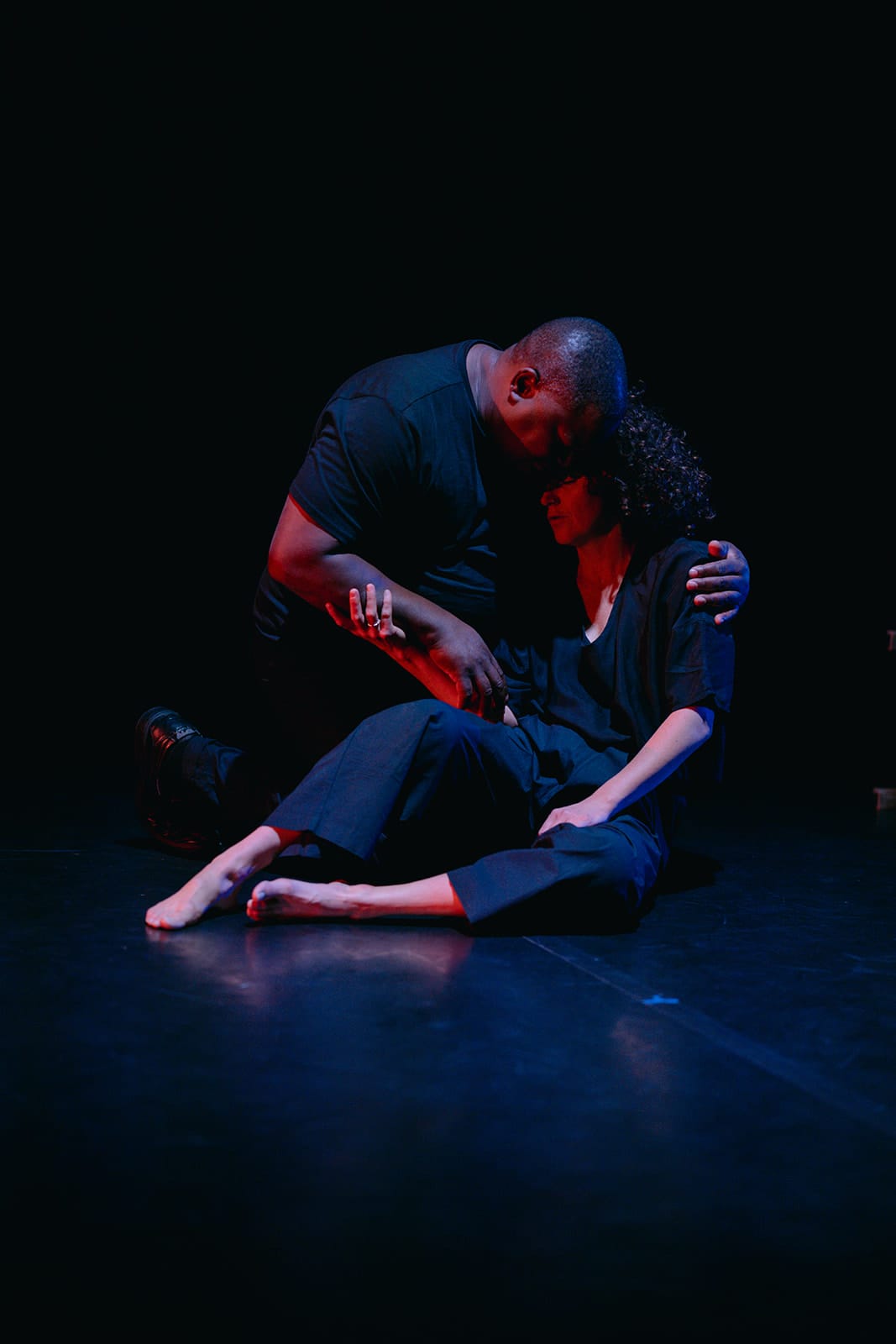
He kneels beside her, gathers her gently into his arms and helps her rise. A small sound escapes him. It is perhaps the purest sound of compassion I have ever witnessed. The movement is unhurried, almost ordinary, and after the violence of the preceding dance, extraordinarily tender. For a moment, the space seems to soften around them.
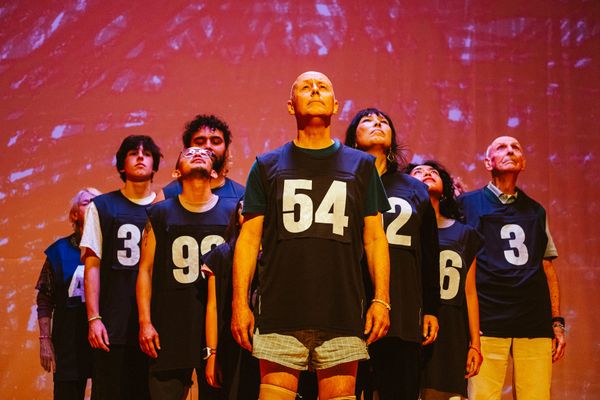
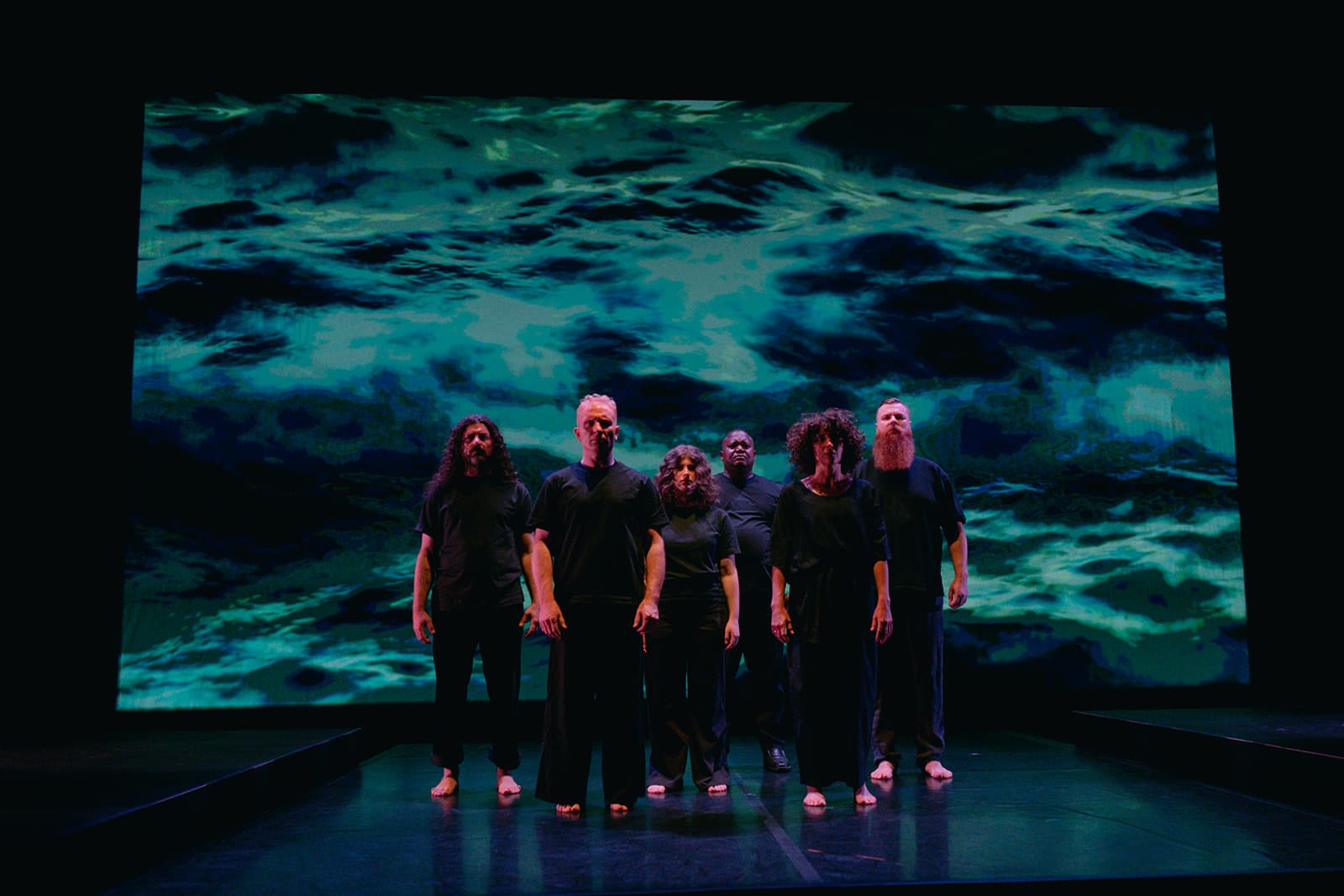
Bronwyn Pringle's lighting becomes especially eloquent in the final ensemble sequence. Six performers stand in silhouette against the returning ocean. One steps forward, then another, their bodies emerging into pale blue and pink. They turn towards us. Their faces register pain; their mouths open in silent screams. Darkness falls, and the figures retreat into shadow.
The sequence begins again, but something has changed. Heads tilt sharply towards shoulders. Shoulders contract. Fingers touch foreheads. The gestures are quick, almost percussive, and increasingly shared. Six bodies moving together, their timing so precise that the smallest deviation seems momentous.
They carry one another, hold one another, return to the line. The light warms towards orange, then cools again. The music seems to shift beneath them, no longer pressing so insistently against the movement but travelling with it. Something has opened. The performers have not escaped the history that preceded them, but their bodies now seem to occupy the stage differently, with a collective assurance.
On the screen, eight figures appear in a grid. Their hands move through repeated sequences, covering and then crossing their faces, stacking one hand over another. The grid expands until dozens of small squares fill the projection. The same gestures recur across different bodies, at once individual and shared.
Then the many become one.
A woman looks out from the screen. She is no longer signing. She blinks, quietly, almost imperceptibly.
The ocean returns. Beneath a wash of pink light, the six performers sit with their backs to us. A curtain moves slowly across the stage, concealing them. There is no final declaration, no image that gathers everything into a single, reassuring meaning. The performers simply remain there, together, as the curtain closes.
* * *
Manifesto of Silences is exhilarating, deeply moving and formally adventurous. Its visual and physical language is so richly developed that even when the meaning of a signed passage is unavailable to me, the experience remains absorbing. This is not because Auslan can be reduced to gesture or emotion. It cannot. Rather, Holub and her collaborators have created a work in which language, movement, image, light and sensation operate alongside one another, sometimes converging, sometimes pulling apart.
I leave with questions, and with the distinct feeling that I have witnessed something extraordinary. There are things I would like to understand better, passages I would gladly encounter again.
What stays with me is a body falling, another bending to lift it, and the faint sound that passes between them.
Manifesto of Silences was performed at Arts House as part of Melbourne Fringe Festival 2026, from 6 to 11 October.
Disclosure: A complimentary ticket to Manifesto of Silences was provided to Melbourne Stage Review for the purpose of review. Melbourne Stage Review retains full editorial independence.